My cat won't eat: how long is it dangerous and what to do today
If your cat won't eat and a whole day has gone by without touching anything, call the vet today and book an appointment. If, besides not eating, your cat looks yellowish, is very weak, drooling, vomiting or lying in a corner without reacting, don't even book: go now. In cats, going without food turns into liver disease within a few days, and waiting for the appetite to come back on its own is the bet that goes wrong most often.
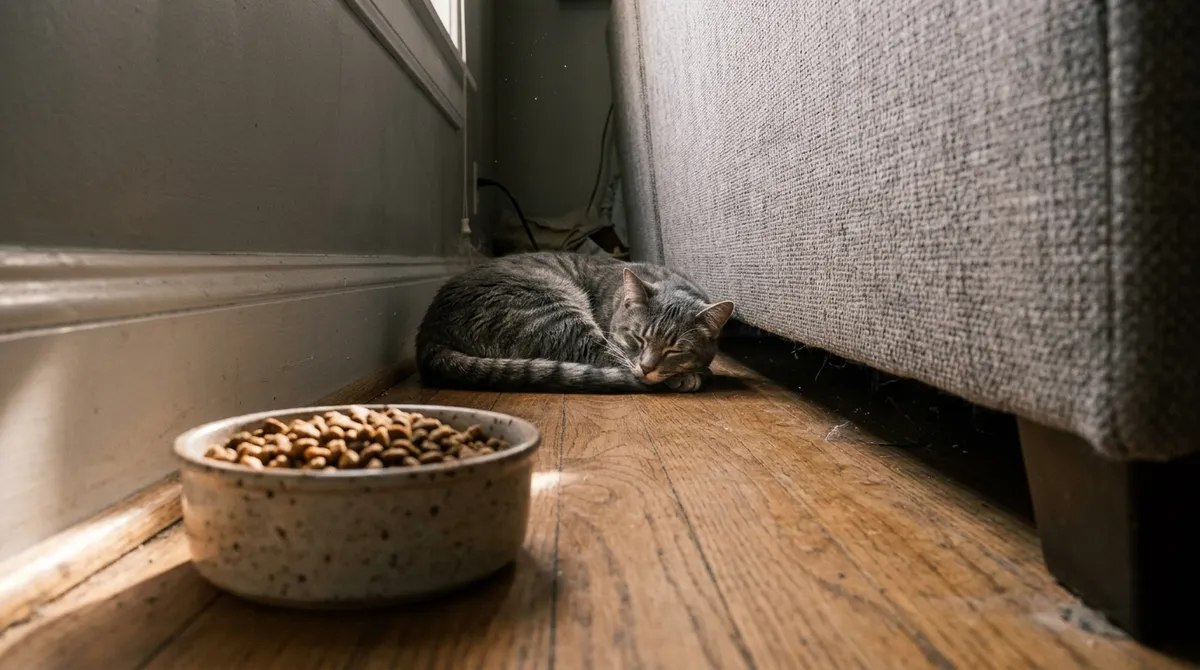
It's the second morning the food sits untouched. Your cat, who usually meows in the kitchen at six on the dot, is curled up behind the sofa and barely lifts his head when you call. You shake the bowl, open a pouch. Nothing. And the double fear sets in: overreacting, and waiting too long. With cats, the second fear is the one that's right. We'll go step by step, and every step ends in what to do.
My cat won't eat: how long is it dangerous?
The rule is short: a whole day without eating anything is already a reason to call the vet the same day. Kittens, senior cats and cats already being treated for an illness need to be seen even sooner: don't wait even that day.
Sounds like too much of a rush? The reason is the liver. When a cat stops eating, the body sends stored fat to the liver, and a cat's liver can't handle large amounts of it. According to VCA, a network of veterinary hospitals in the United States, cats that go up to 48 hours without eating can already develop fatty liver, and after three days the body enters a dangerous period, with a risk of serious and possibly irreversible damage. Do the math: day one is the day to call, day two is already the start of the risk, and whoever waits for day three is too late.
Eating too little counts too
Many people relax because the cat “nibbled” something. The disease usually shows up after three or four days in a row of eating little or nothing. If the bowl he used to empty in one day now lasts three, that is a loss of appetite, even if he has never gone down to zero.
That's how a lot of stories end badly. It isn't rare for an owner to arrive at the clinic after about two weeks of this, with a cat that has lost a quarter of its weight. In a four-kilo cat, that is a whole kilo disappearing under the fur.

Emergency signs: take your cat in today
Some signs change the conversation from “call and book” to “leave the house now.” Take your cat in today, without waiting for any deadline, if he isn't eating and also:
- has skin, gums or the inside of the ears that look yellowish, or very pale gums;
- drools excessively;
- vomits or has diarrhea;
- just lies there, hiding, not reacting when you call;
- can't hold his head up;
- breathes with difficulty or effort;
- has lost so much weight that the spine and hips can be felt under the skin.
A cat that won't eat and just lies “sad” under the bed is worrying. The sadness owners describe is almost always apathy, and apathy together with not eating is an emergency. The same goes for anyone who writes in a panic that their kitten hasn't eaten anything for two days and is drooling a lot: two days of fasting is already past the deadline, and drooling is an emergency sign by itself.
How to transport a very weak cat
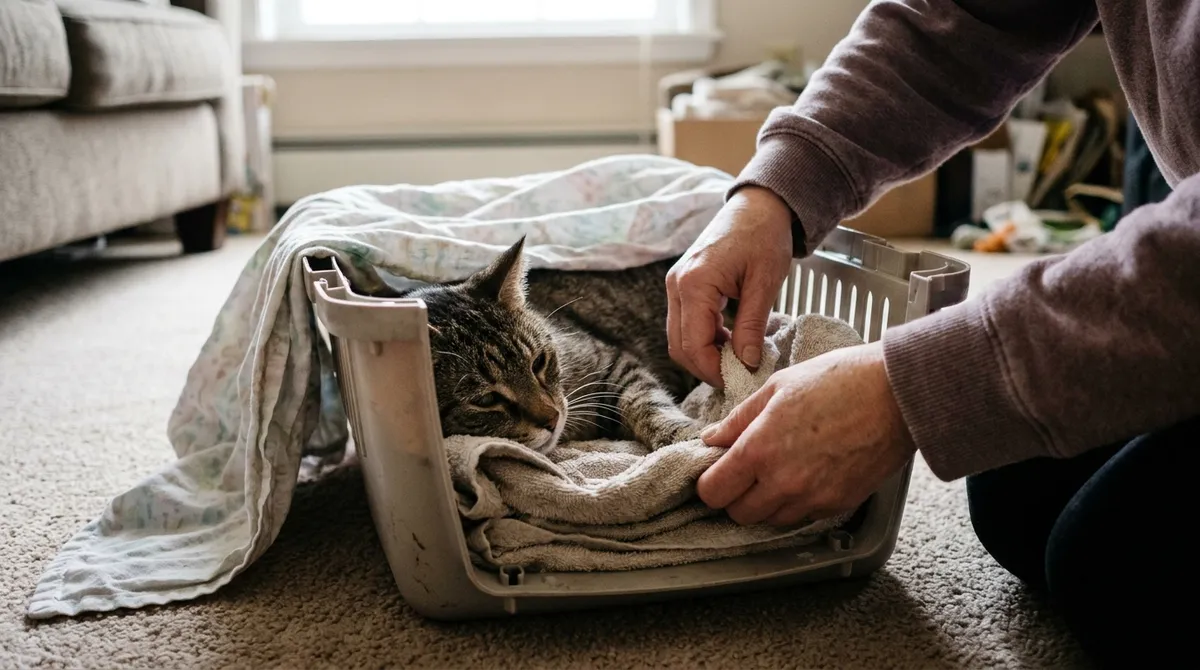
If he is so weak that his head and neck droop, hold back the rush. Cats in this state tolerate very little stress and can have trouble breathing, or even faint, when held tightly. Lay him in the carrier on a towel, without pushing (if the carrier only opens at the front, wrap the cat in the towel and put the bundle in), cover it with a light cloth so it's dark inside, and call before you leave, letting them know he is very weak.
What to say on the phone
Have at hand how long he hasn't eaten, what else is going on (vomiting, drooling, apathy), his age, any illnesses and what changed at home. A direct sentence helps: “Eight-year-old cat, hasn't eaten anything since yesterday morning, hiding, vomited once. Do I need to bring him in today?”
“I don't have the money for the vet right now”
It happens to many people. Calling and describing the situation already tells you whether you need to go now. Film your cat and bring your notes: they shorten the appointment.
What you must not do is medicate on your own to save money. The wrong medicine delays the diagnosis, and the bill for an advanced fatty liver ends up much higher than today's appointment.
Why going without food is so risky for a cat
Think of his liver as a kitchen that copes with the normal flow of orders. When the cat stops eating, the body ships stored fat there all at once to be turned into energy. The kitchen can't process that much, and the fat piles up inside the organ until it stops working properly. That is fatty liver, which vets call hepatic lipidosis.
It isn't rare. It is the most common liver disease in cats, and it can kill. A yellow tint in the skin and gums is one of the signs that the liver has already been affected.
“He's just being picky”
This is the myth that delays the appointment the most. VCA estimates that in more than 90% of cats with fatty liver, there was another illness behind it that took away the appetite first: bowel problems, another liver disease, pancreatitis, diabetes, respiratory disease, cancer, anxiety. The cat didn't stop eating for no reason. Something made him stop, and then the fasting created a second problem on top of the first.
That's why, when an owner asks “could it be leukemia, FIV, kidneys?”, the honest answer is that nobody can tell from the outside or through a phone screen. That is exactly what blood tests and imaging look for. Your job isn't to guess the disease. It's to get there early.
My cat won't eat but seems fine and active: can I wait?
No. He can be playing and purring on your lap and still leave the bowl full. Cats hide feeling unwell like no one else, and the liver doesn't look at his mood: it looks at how much food went in. The whole-day rule applies just the same to a lively cat.
In the meantime, swap “I think” for measurements:
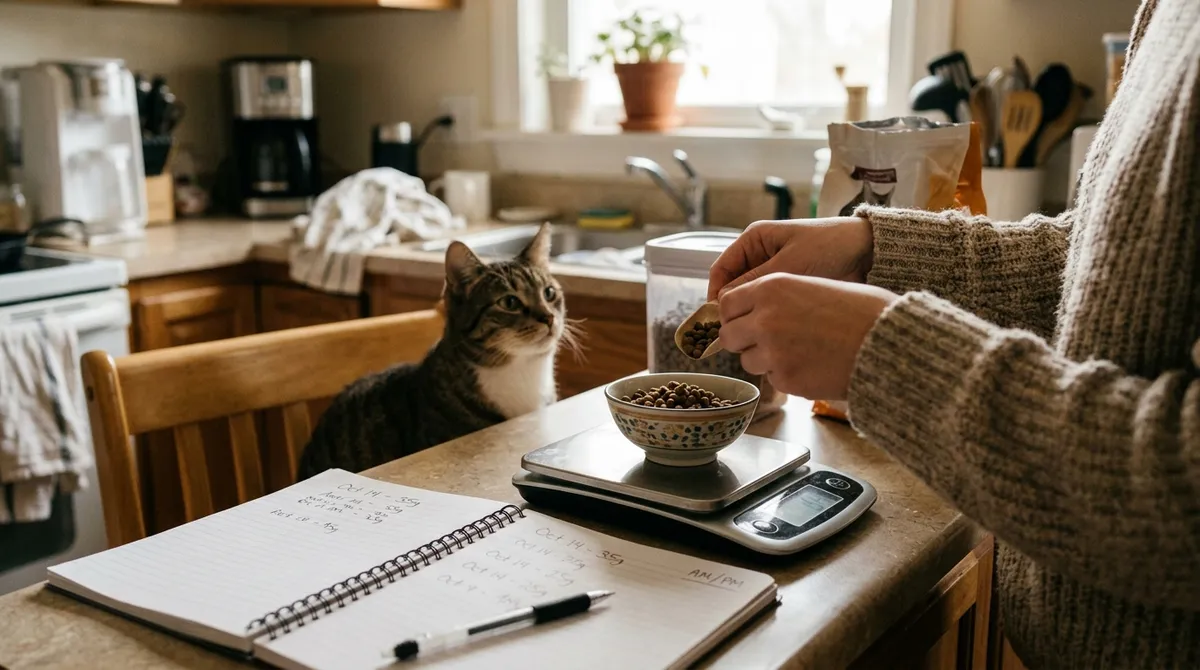
- Measure before serving. The same spoon or kitchen scale, every time. Write down the time and the amount.
- Measure what's left.
- Separate the cats at mealtime, if you have more than one. Otherwise you never know who ate.
- Write down the rest of the day. Water, pee, poop, vomit, hiding: two lines on your phone are enough.
- Weigh your cat, if you can. Step on the scale holding him, then alone, and subtract.
In two days, “I think he's eating less” becomes “he ate a third of the normal amount.”
He wants to eat but can't: when the problem is the mouth
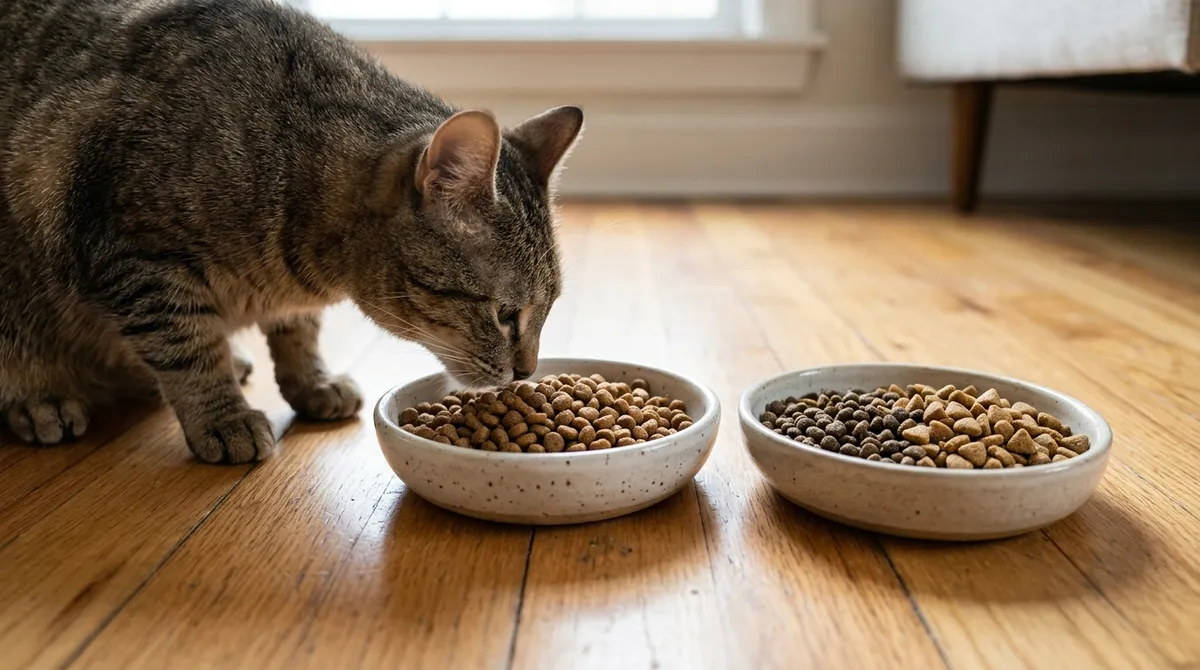
There is a scene that fools a lot of people. The cat comes running at the sound of the bowl, sniffs, picks up a piece of kibble... and gives up. Sometimes he drops the food, chews on one side only or shakes his head. This cat is hungry. What he can't do is eat, and the vet calls this false anorexia.
Almost always the cause is pain: inflamed gums, a loose tooth, a sore in the mouth or throat, pain when opening the mouth, a jaw problem or pain somewhere else in the body. None of this gets better by switching food or waiting. Don't force his mouth open to look. Film your cat trying to eat and tell the vet that he goes to the bowl and gives up: it is one of the most useful pieces of information in the appointment.
My cat won't eat dry food, only pouches or treats: pickiness or illness?
It can be preference, it can be pain, and the danger lies in deciding it's pickiness too soon. Dry food requires chewing, pouch food hardly does. A cat with a sore mouth swaps crunchy for soft, and the owner reads that as a whim.
Start with the simple things: smell the bag and check the expiration date. Old or spoiled food puts a cat off.
Then, the deciding criterion is the total amount. If he eats pouches in the usual volume, there is time to talk calmly about his diet. If he eats two little treats and nothing else, he is eating too little, and the liver deadline applies just the same.
“Leave only the dry food, hunger will beat stubbornness”
With cats, this advice comes at a high price. Taking away the pouch and leaving only dry food until he gives in is betting that hunger arrives before the liver disease, and the cat often loses that bet. He doesn't give in: he gets sick. In a cat that is eating poorly, quantity matters more than the perfect menu. If he accepts pouches, offer pouches, just don't let that become a reason to put off the appointment.
I changed his food and he won't eat the new one
Cats are conservative about food, and a sudden switch is one of the known triggers for them to stop eating, even when the new food is a weight-loss one. If he has dug in, go back to the old one today, if he ate well with it. Once he is eating normally again, start the switch over slowly, across 7 to 10 days, mixing a little more of the new food into the old each day.
What you must not do is keep pushing the new food while he goes without eating, hoping hunger will solve it. And stay alert: if he keeps refusing even with the old food back, the problem probably never was the food, and the one-day rule still stands.
My cat stopped eating after a move, a trip or a new cat: is it just stress?
Four hours in the car with the cat yowling in the carrier, a house that smells of paint and cardboard. He steps out of the carrier, disappears into the closet and doesn't show up even for dinner. Twenty-four hours later, he's still there, hiding and not eating.
Stress takes away a cat's appetite, that's real. Moving house, a trip, a boarding stay, the arrival of another animal, the loss of a housemate or of someone in the family: all of this can make him stop eating. The word “just” is what's wrong. The liver doesn't know why the cat is fasting, and fasting from stress leads to the same fatty liver as fasting from illness. The deadline is the same: one day without eating anything, call.
While he settles in, help the house feel less scary:
- Set up a quiet room just for him, with a hiding place, a piece of your clothing, water, food and a litter box, with the food away from the box.
- A new pet stays separate for a few days, each with its own bowl, and is introduced slowly.
- Let him come out of hiding in his own time, without pulling him.
If the move also threw off his bathroom habits, we have a guide on the cat that won't use the litter box.
My cat is fat: wouldn't a few days without eating be fine?
This myth is dangerous because it sounds logical. The opposite happens: an overweight or obese cat has a higher risk of fatty liver when food is missing. The most common cases are exactly middle-aged, chubby cats that lost at least a quarter of their weight.
Cutting the food suddenly, or switching to a diet food overnight, is among the triggers of the disease. A fat cat does need to lose weight, yes, but slowly, with a plan from the vet, and never through hunger. And the thin cat isn't safe either: the risk is higher in the fat cat, not exclusive to him.
Can I force-feed with a syringe?
On your own, no. Videos are going around teaching people to hold the cat by the scruff and push pâté with a syringe into the corner of the mouth. The intention is good, but a cat should never be forced to eat or swallow. A sick, resisting cat goes through a stress it can't handle, and mealtime becomes a fight. And the syringe doesn't find out why he stopped eating: it only gives a feeling of control while the cause is still there.
If the vet decides that assisted feeding at home is the way to go, they will teach you how to do it, with which food and in what amount, after examining your cat. And one rule always applies: at mealtime, the cat stands or sits, never lies down.
Is there a medicine to boost a cat's appetite?
There is, by prescription only, and on its own it tends to disappoint. According to the Merck Veterinary Manual, appetite stimulants sometimes help when started early, but most of the time they don't work and the cat needs a feeding tube. They work better for a cat that is already recovering than for a sick cat that eats nothing. Whether it's worth it, and which one, is the vet's call.
What about home remedies?
Activated charcoal, yam, soup, coconut water, the recipe that went viral in a video: none of this is a treatment for loss of appetite. It doesn't find the cause and it uses up days the liver doesn't have. Three days testing recipes are three days of the deadline already gone.
What to do at home while you book the appointment
Nothing here replaces the vet. It's meant to help your cat eat whatever he can until then, without pressure:
- Offer a little, several times. A sick cat feels full quickly.
- Pick the food he likes most and warm it slightly. Warm, never hot, it gives off more smell, and cats eat through the nose. Test it on your wrist.
- Use a shallow, wide bowl. Many cats hate touching their whiskers to the rim.
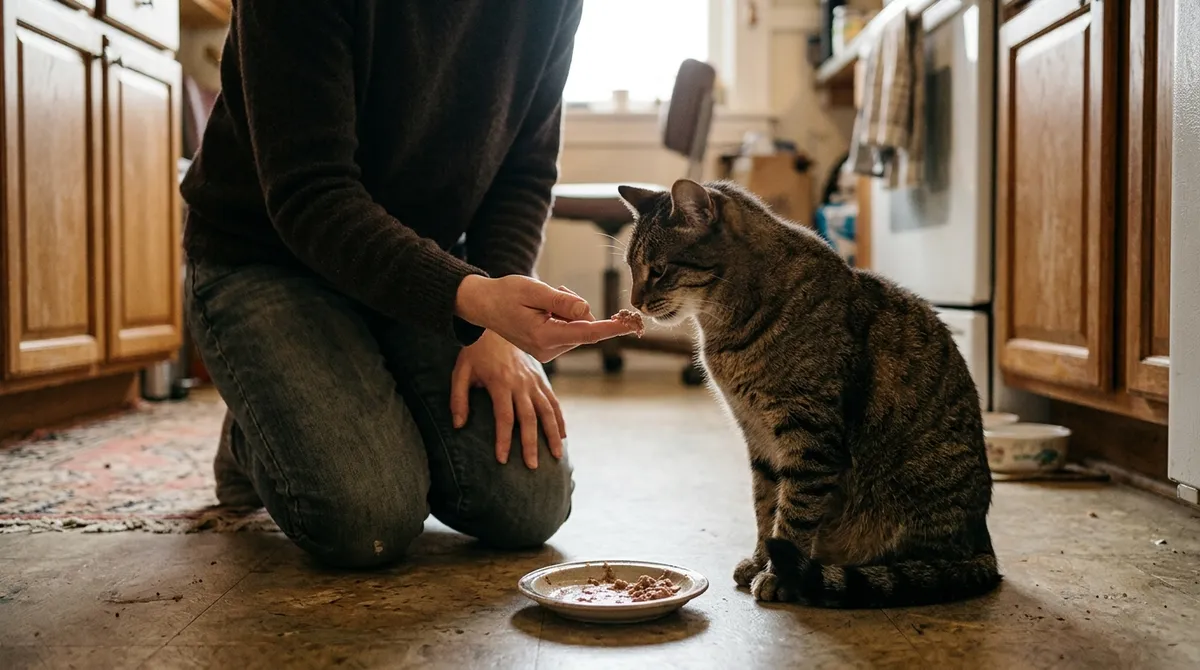
- Offer it by hand. A little pâté on the tip of your finger, with affection and a low voice, sometimes convinces a cat that refused the bowl. Praise him when he accepts.
- Choose a calm spot, away from the litter box, other animals and the door that opens and closes.
- Leave fresh water always within reach.
- Remove leftover food after a while. A pouch left out goes sour, and the bad smell puts the cat off the next try.
- Don't force it. He refused? Try again later and write it down.
If even with all this he doesn't eat, you already have your answer: the appointment can't wait. And if the dog at home is also refusing the bowl, we have a guide on the dog that won't eat.
What the vet will do and how long the treatment lasts
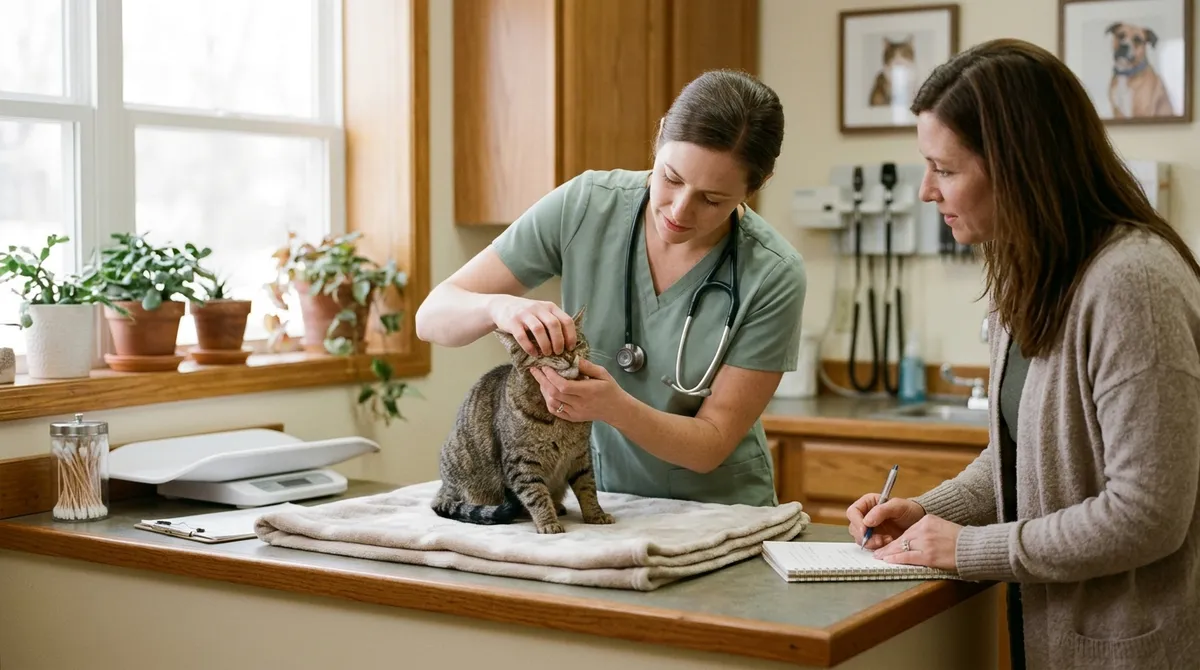
The appointment starts with a conversation and an exam. That's where your notes are worth gold. The vet looks at the mouth, feels the belly, checks the color of the gums and weighs your cat. Then, almost always, come blood tests and imaging, such as X-rays and ultrasound, and in some cases more detailed tests. The goal is twofold: find the illness that took away the appetite and see whether the liver has already been affected.
If it is fatty liver, the treatment is supportive: fluids for dehydration, replacement of vitamins, minerals and salts and, above all, food.
The tube is scary, but it's the part that helps
Many people panic when they hear about a feeding tube. There's no need. It delivers food straight to the stomach, without forcing anything through the mouth, and it is usually well tolerated. Putting off the tube while waiting for the appetite to return doesn't help, because each day without food is one more day of fasting for the liver.
As for time, be prepared: many cats with fatty liver stay in the hospital for a week to ten days. After that comes recovery at home, and the illness that started it all also needs treatment. The earlier he arrives, the shorter that road tends to be.
Summary to keep
- A whole day without eating anything: call the vet today. Kitten, senior or sick cat: before that.
- Eating far less than normal for days counts as fasting for the liver.
- Yellowish, pale, drooling, vomiting, with diarrhea, apathetic or breathing badly: take him in today.
- He seems fine but isn't eating: the deadline applies just the same. Measure and write it down.
- He goes to the bowl and gives up: it may be pain in the mouth.
- Stress takes away appetite, and the deadline is the same.
- A fat cat doesn't handle fasting better. He handles it worse.
- No syringe on your own, no medicine without a prescription, no home recipes.
A cat doesn't complain about hunger. He just stops asking. When the bowl is still full in the morning, you're the one who has to speak for him, and the sooner the better.
Sources
This article was written from the sources we consulted in October 2026:
- Anorexia in Cats — VCA Animal Hospitals
- Hepatic Lipidosis in Cats (Fatty Liver Syndrome in Cats) — VCA Animal Hospitals
- Tube Feeding in Cats — VCA Animal Hospitals
- Critical Care Nutrition for Cats — VCA Animal Hospitals
- Feline Hepatic Lipidosis — Merck Veterinary Manual
- Disorders of the Liver and Gallbladder in Cats — Merck Veterinary Manual
- 2022 ISFM Consensus Guidelines on Management of the Inappetent Hospitalised Cat — Journal of Feline Medicine and Surgery (ISFM and AAFP)
- Finicky Felines: Managing Anorexia in Cats — VetFolio
- Not Eating Means Big Problems — CatWatch Newsletter
- Mi gato no quiere comer: causas frecuentes y cuándo acudir al veterinario — Veterinaria Oyanguren
- O gato parou de comer? Veterinário explica a anorexia felina — União Química
- ¿Por qué mi gato no come? Causas, síntomas y tratamientos — MiVet