How to Potty Train a Puppy: Pee Pads or Going Outside, Step by Step
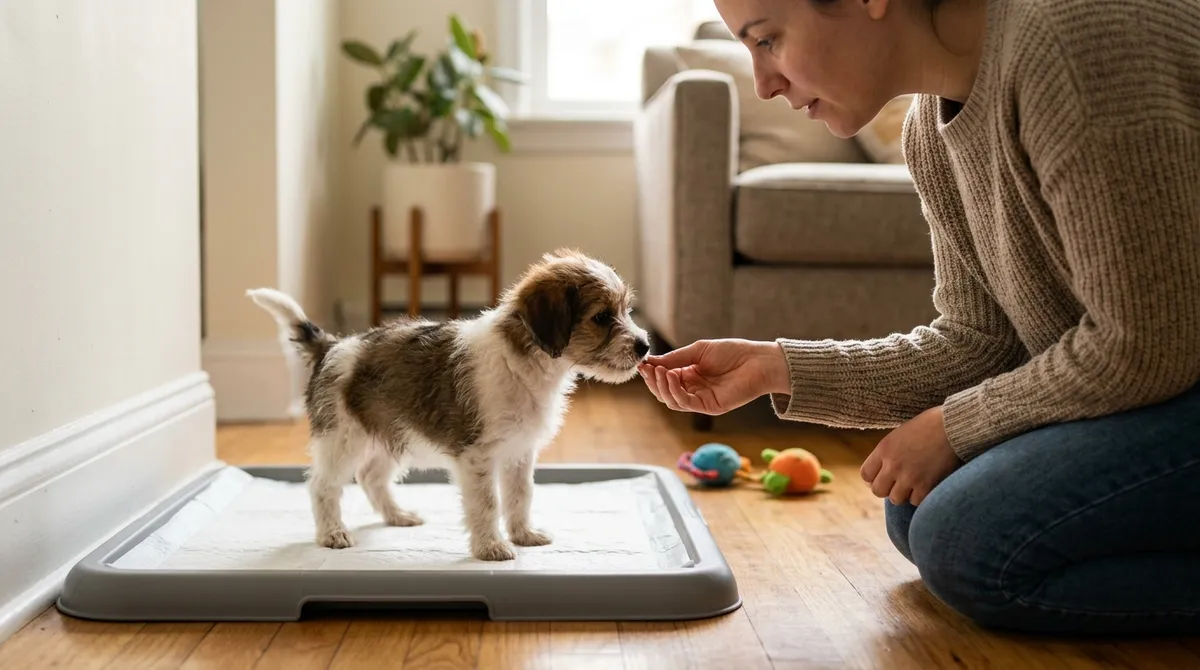
To potty train a puppy (or stop a dog peeing in the house), teach him to go on a pee pad or outside: pick one fixed spot, take him there when the urge shows up (after waking up, after eating, after playing) and give him a treat right away, while he is still on the pad or on the sidewalk. A routine, close supervision and a reward at the right moment teach puppies and adult dogs alike.
Seven in the morning. You cross the living room in your socks, still half asleep, and feel that cold, wet squish under your foot. The puppy comes over to say good morning, tail wagging, as if nothing happened. Or you get home from work and the first thing you notice is the smell, and then the poop behind the couch, for the third time this week. Your neighbor swears the answer is to rub his nose in it. Forget the neighbor. This is fixable, and we will take it one step at a time.
Why your dog pees and poops in the wrong place
Get the idea of revenge out of your head. Dogs have accidents because they have not yet understood where the right spot is, because they cannot hold it, or because something has changed. The most common reasons:
- Age. Puppies have small bladders and little control.
- No routine. Without set times, he goes when he has to, and he has to wherever he happens to be.
- A spot that keeps changing. A pad that is in the laundry room one day and in the bathroom the next is confusing.
- Lingering smell. Where he went once, his nose finds the spot again, even after a soapy rag.
- Marking. Small amounts of pee on furniture legs, doors and baseboards, more common in unneutered males.
- Excitement or submissive peeing. It leaks out when you get home or when a guest bends down to pet him.
- Fear and anxiety. Fear of noises, fear of the street, distress at being left alone.
- Illness. Bladder or kidney problems, diabetes, diarrhea, worms, joint pain and, in senior dogs, loss of control or confusion. The signs are in their own section, further down.
One detail that helps tell causes apart: poop in the house is almost never marking. When poop is the problem, think of training that has not sunk in yet, fear or health.
What you need at home before you start
- One chosen, fixed spot. A corner of the house for the pee pad, or a spot outside (always leaving through the same door). Decide today and do not change it.
- Small, tasty treats, about the size of a bean, always within reach.
- An enzymatic cleaner, the kind sold at pet stores that breaks down the odor instead of just perfuming it.
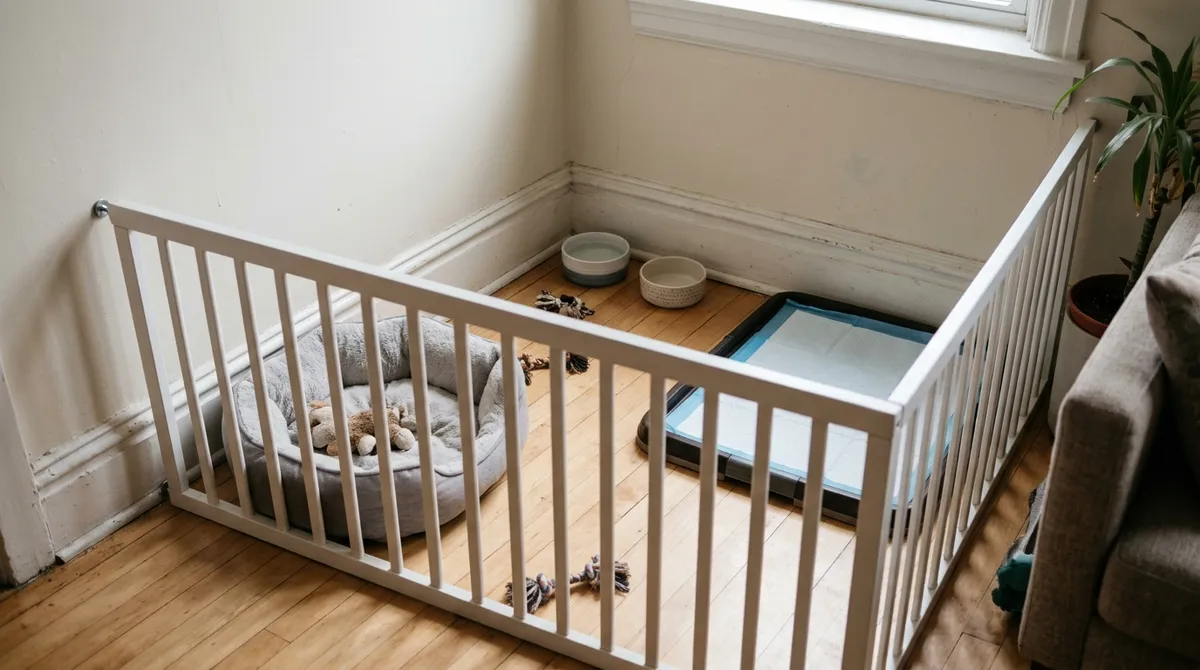
- A small confined space for when nobody can watch him: a playpen, a small room or a crate, with the bed on one side and the pad on the other.
- Patience for a few weeks, with the same rule every day.
Two homemade tricks: a plastic holder with a rim keeps the pad in place (without a holder, tape down the corners). And when you change the pad, leave a small piece of the used one on top of the new one: the smell tells him this is the bathroom.
Step by step: how to stop my puppy peeing in the house with a pee pad or outside
The method is the same for the pad and for outside; only where you take him changes. And it starts the day he arrives: the routine is what helps him settle in.
1. Set up a schedule
The secret is to get there before the urge does. Take the puppy to the right spot:
- right after waking up, in the morning and after every nap;
- after eating or drinking a lot of water;
- every half hour during energetic play;
- every hour or two while he is awake;
- every four hours, even when he is resting;
- during the night too, until he is about five months old.
It sounds like a lot, and it is, but the trips to the pad or outside get farther apart as he gets it right. And the "age in months plus one" rule converted into hours? Forget it. Write down for two or three days when he goes: if he pees every hour and a half, his schedule is every hour and a half.
2. Take him to the spot and wait quietly
At the right time, go with him to the pad. If the spot is outside or in the yard, go along, on a leash. Alone out there, he will chase a fly, come back in and go in the living room.
Stand there, still, without playing. When he starts to get into position, calmly say the same short word every time, such as "pee" or "potty". Over time it becomes a cue for what he came there to do, and that is a lifesaver on rainy days.
If nothing comes out in five minutes, take him back inside, keep him close and try again about fifteen minutes later.
3. Reward right away, while still at the spot
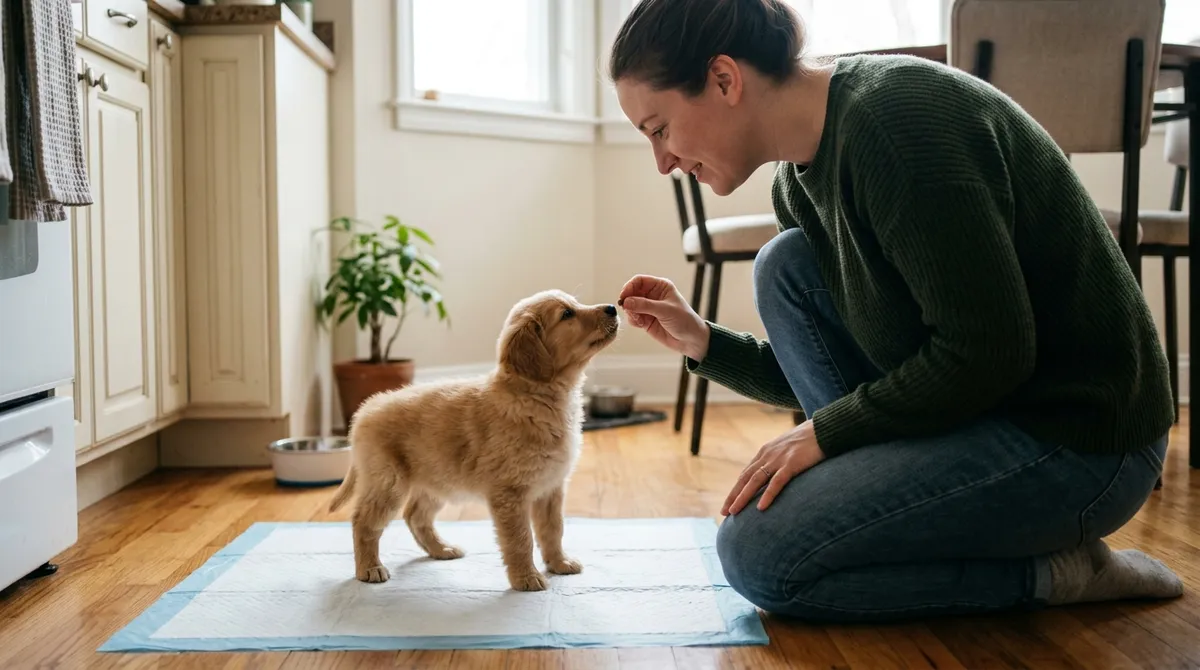
Done peeing? Throw a party right there: a happy voice and a treat in the first few seconds, still on the pad or on the sidewalk. A treat given in the living room rewards the living room. Outside, free play on the walk comes after the pee, and he learns that the sooner he goes, the sooner the fun part starts.
4. Watch him closely for the first few weeks
At this stage, the puppy lives in one of two situations: with someone watching closely (within 10 feet, or 3 meters, or on a leash tied to your waist) or in the confined space. Loose with nobody watching is where the puddle behind the couch is born.
The signs he is about to go:
- sniffing the floor intently;
- circling or walking with stiff back legs;
- suddenly stopping what he was doing and starting to squat;
- getting restless, heading toward the door or trying to get away from you.
Saw one of these? Pick him up and take him to the spot right away.
5. Use the confined space when you cannot watch
Shower, meeting, trip to the store: it is playpen or crate time. In a closed crate, a puppy can stay about three hours at most. Beyond that, he needs a break or a bigger space with a pad.
Get him used to it gradually, with treats and a toy inside. And open up the house slowly: one or two rooms where he can be seen, then one more, as the successes add up. Too much freedom too soon is the top cause of "he was doing so well".
6. Caught in the act? A short sound and off to the right spot
The puppy started to squat on the living room rug right in front of you. Clap once, just once, or give a short whistle. The idea is to interrupt without scaring: a scare teaches him that peeing near you is dangerous. Pick him up, take him to the pad or outside and, if he finishes there, party time.
7. Clean properly and change the job of his favorite corner
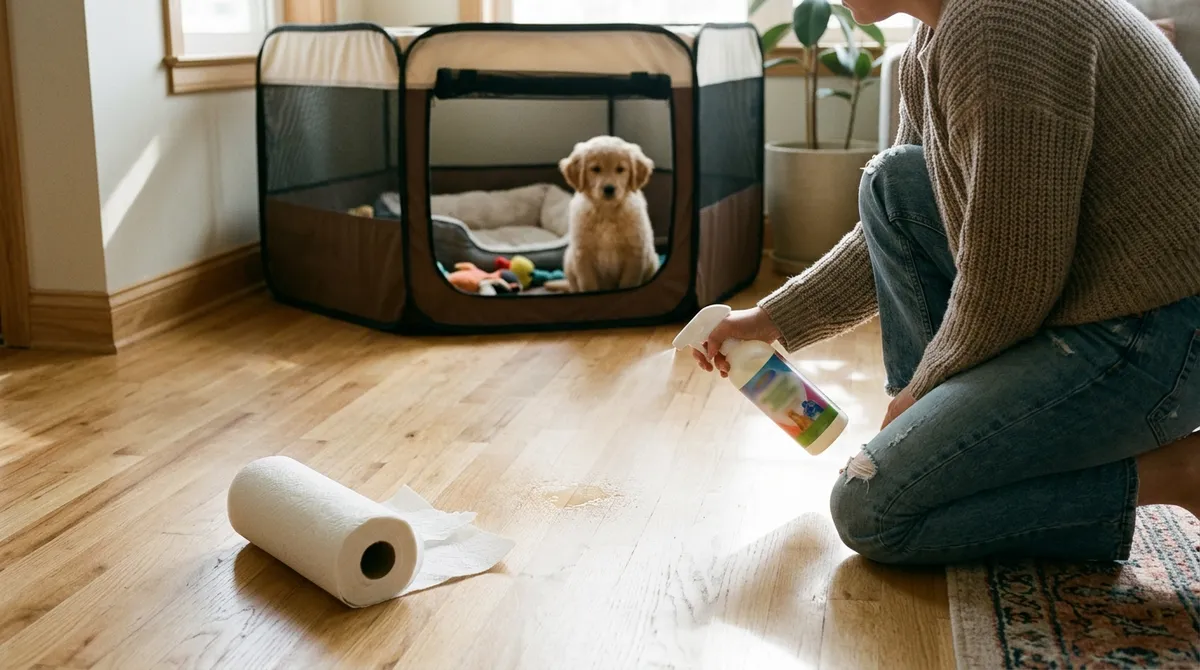
Clean quietly, without an audience, with the enzymatic cleaner. If any smell is left, his nose leads him back to the same corner.
If he has already picked a favorite spot, block access for a while. When that is not possible, change the corner's job: put his bed or his food and water bowls there. Dogs avoid peeing where they eat and sleep.
"My puppy is two months old and has accidents all the time. Is that normal?"
Yes. A puppy of 30 to 60 days has a tiny bladder and no idea where the bathroom is in the new house. What changes the picture is the routine from step 1, and the sign that you are on the right track is seeing the successes beat the accidents week after week.
I live in a small apartment with no yard
It works, and watching him is even easier. Pick a fixed corner, away from food and bed: laundry room, bathroom corner, screened balcony. Set up the playpen around it for the first few weeks and open up the apartment room by room.
How to stop your dog peeing on the living room rug
When the habit already exists, the path is the same step by step, done more strictly, with a few adjustments.
He goes in the house right after coming back from outside
Two minutes after the walk, he is squatting in the living room. It is almost always one of these:
- There was too much to sniff outside and he forgot to go.
- The treat did not come right away, so he did not understand what you wanted.
- Supervision ended at the door. Did not go outside? Once inside, he stays near you or in the playpen, and you try again in fifteen minutes.
- He never had to hold it. A dog that lived in a pet store cage or loose in a yard takes longer.
- He is afraid of the street. He holds everything in outside and lets go where he feels safe, which is your living room.
That last one also explains the puppy who refuses to go outside and lies down on the sidewalk. Start with short outings on quiet streets, always to the same spot, and widen his world little by little.
One pee pad or several around the house?
One spot only, fixed. That is how a dog learns "the bathroom is there"; pads scattered around teach him that any cloth on the floor will do. Big house? Shrink his space instead of multiplying pads. And roll up and put away, for now, the living room rug, which looks a lot like the pee pad to him.
The product that really removes the smell
Enzymatic cleaner, in every corner where he has already had an accident. Scented disinfectant and bleach take the smell out of your nose, but not his. To break the cycle, the product has to really eliminate the odor.
He tears up, eats or lies on the pee pad
Use the holder with a grid or rim, which leaves the pad with no corner to pull. Caught pulling? Swap it for a chew toy and praise him. If he lies on the pad, put a soft bed on the other side of the playpen. If he swallowed a piece and seems listless, vomited or stopped eating, call the vet.
Peeing when you arrive or when guests arrive
You open the door, he flops belly up and a little pee escapes. That is excitement or submission, his way of saying "I come in peace", and not a training failure. Scolding makes it worse, because it makes the dog more nervous at the next greeting. Come in without a fuss, wait a minute or two and greet him crouching sideways, in a calm voice. Ask the same of guests. There is medication for hard cases, but the vet is the one to assess that.
What about belly bands for male dogs?
They protect the couch while you train, but they treat nothing. Check at least twice a day, because the damp, trapped skin can get infected.
Adult dogs: what they never learned and the ones who only go outside
A family adopts a four-year-old mixed-breed rescue, sweet as can be, and on the first night he pees by the table leg. Relax: adult dogs learn, and they hold it longer than puppies. Treat every newcomer as untrained, even if the previous home swears he was perfect.
A healthy adult can hold his pee about three to four hours at rest, and most poop one to three times a day, often within an hour after eating. His routine:
- 10 to 20 minutes after every meal;
- after drinking a lot of water;
- right at the start of playtime;
- and, in general, every few hours.
If he spent years going around the house, count on a few months.
"My adult dog only goes outside. How do I teach him to use the pad?"
The way is to take the pad to where he already knows how to go, and then bring it inside.
- Take a pee pad on the walk and let him pee on it, in his usual spot. Treat right away.
- Save a piece of that used pad and put it on the pad indoors, first near the door; then, little by little, move it to the final corner.
- At the times he would go outside (after waking up, after eating), take him to the pad on a leash and wait the five minutes. Did he go? The best treat in the house.
- If nothing comes out, go on the normal walk and try again at the next time.
How to teach your dog to ask to go out
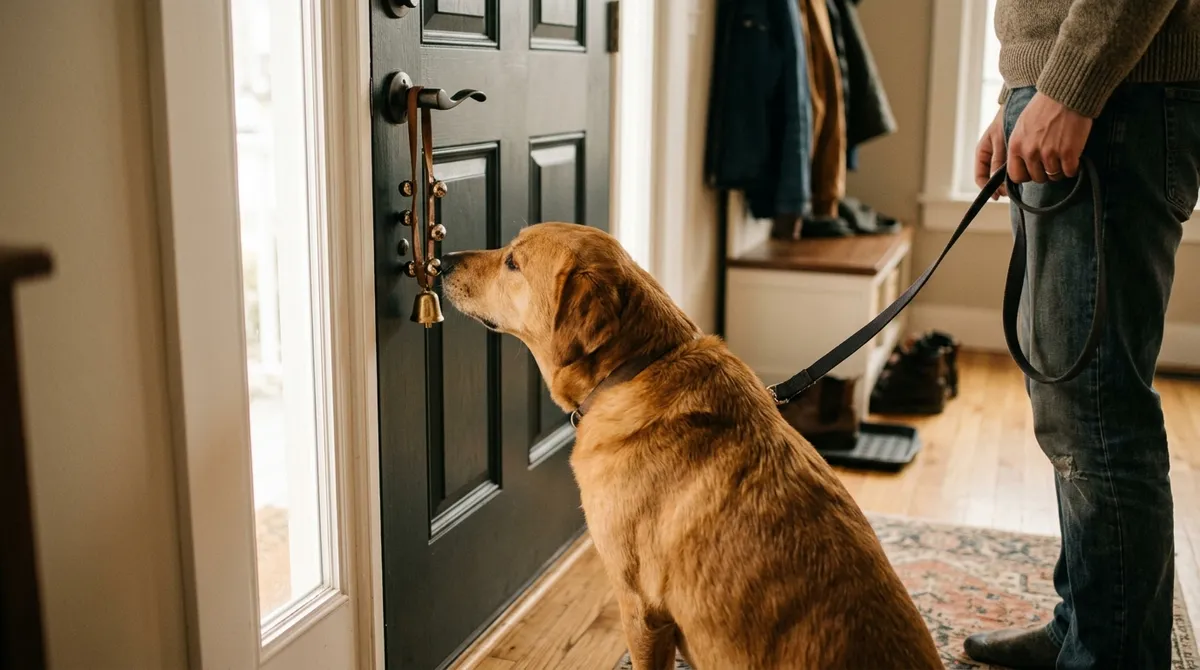
Hang a small bell on the doorknob, at nose height. Every time you take the dog out to pee, let him touch his nose to the bell and go out right away. Just one rule: a rung bell means a trip to pee, not a long walk, otherwise he rings it all day to go for walks.
The adult male who marks the whole house
Refrigerator, couch leg, baseboard. Clean each spot with an enzymatic cleaner, block his favorites and interrupt with the short sound when he lifts his leg. Neutering reduces marking in 50% to 80% of males, at any age, but it does not teach him where the bathroom is: the training goes on. Talk to your vet about your case.
Does he know he did wrong? Myths and mistakes that slow training down
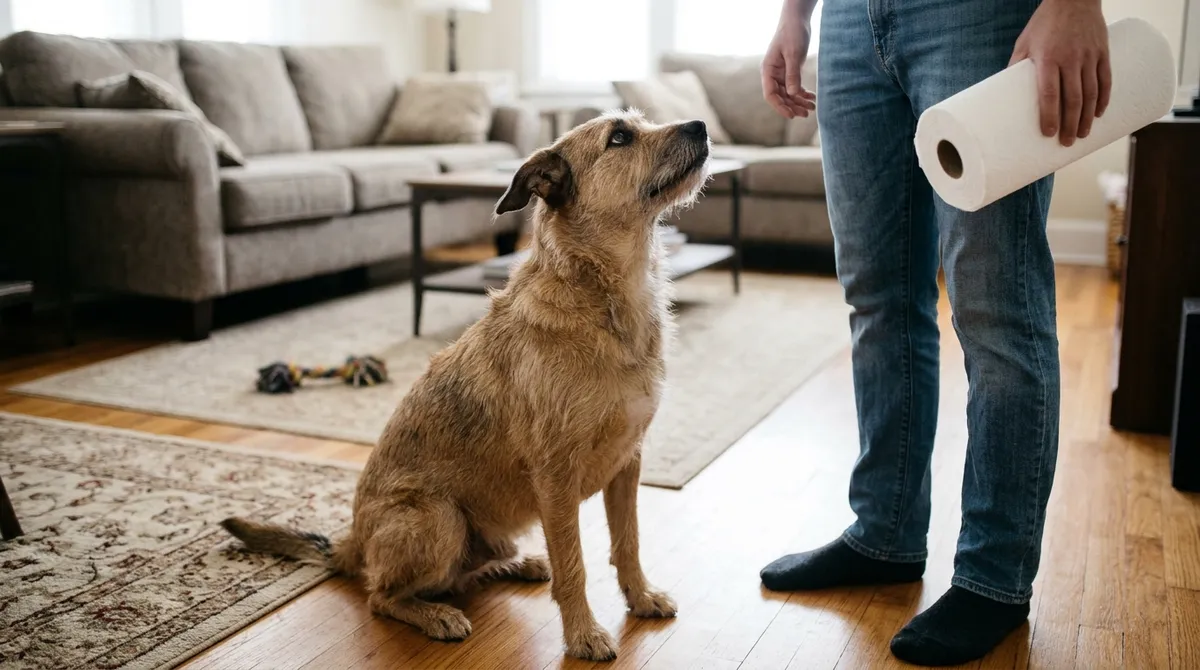
He only goes in the living room when you are out and, when you get back, he is hiding under the table. It looks like proof that he knows he did wrong. But the lowered gaze and ears pinned back are worry about your mood; he does not remember the pee from two hours ago. And hiding usually comes from an earlier scolding, the same lesson as the puppy who only goes when nobody is looking.
If the peeing happens only when he is alone, even with a walk beforehand, it may be anxiety or fear, especially if it comes with crying or scratching at the door. Leave your phone recording when you go out and show the video to the vet.
The mistakes that hold training back the most:
- Rubbing his nose in the pee, hitting him, swatting him with a slipper. He does not understand "wrong place". He understands that peeing near you is dangerous and starts to hide to go. Then you can never catch him in the act to teach him.
- Scolding over pee found later. He links the scolding to you arriving, not to what he did. Just clean it up.
- Clapping loudly to scare him. A short sound to interrupt, yes. A scare turns into fear.
- Moving the pad, rewarding late, sending him to the yard alone. Each one undoes a piece of the step by step.
- Switching food or treats in the middle of training. A sudden change can loosen the bowels and cause accidents that are nobody's fault.
Puppy peeing in the house at night: how many trips
Until about five months old, count on at least one trip during the night, because the bladder still cannot last all night. What helps:
- take him to the spot right before bed;
- let the puppy sleep near you, in the playpen with a bed and pad or in a crate next to your bed, so you hear when he wakes up restless;
- on the night trip, dim light and no playing. Take him, he goes, quiet praise and back to bed.
When he starts waking up with a dry pad, begin stretching the interval.
How long it takes to learn
Within a few weeks, most dogs get the hang of it. To lock in the habit, count on one to two months of routine. And only consider the dog truly trained after about eight weeks in a row with no accidents; three days without a puddle is still a start.
Slipped up? Go back a step: more supervision, a smaller space, treats again for every success. And you are not alone: about 20% of dogs pee or poop in the wrong place, and it is one of the most common reasons dogs are given up.
When to see the vet
Training fixes training problems; illness, no. Take him to the vet if:
- he strains to pee, or goes to the pad many times and produces little. According to VCA animal hospitals, this may point to inflammation or a blockage in the urinary tract, so call right away;
- he struggles or has difficulty getting into position;
- he is drinking water and peeing much more than normal;
- he has diarrhea that does not go away (a change of food or treats can also cause it);
- a dog who always got it right suddenly started having accidents;
- he is a senior and has started losing control or seems confused. A dog's memory starts to decline between ages 6 and 8, according to the Merck Veterinary Manual, so "it's just age" is not enough;
- he stopped eating or seems listless. See also what to do when your dog won't eat.
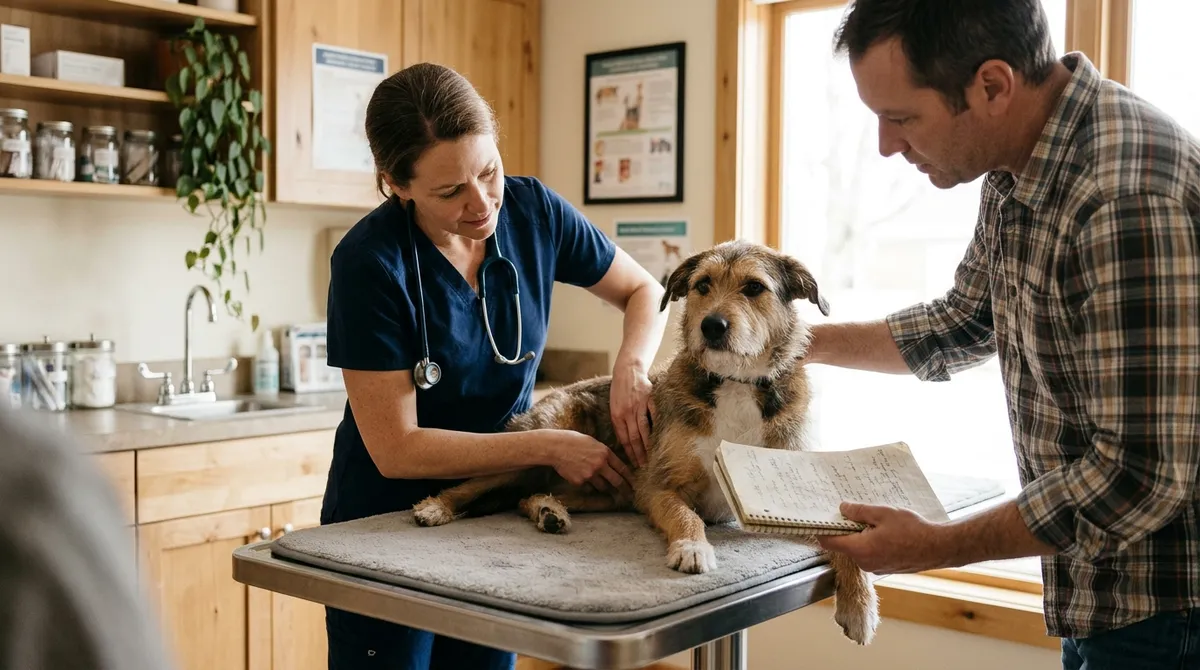
At the visit, the vet usually examines the dog and asks for a urine test and an imaging exam of the bladder. From age 5, blood tests are added. If the problem is poop, a stool test for worms and a rectal exam.
After the illness is treated, the dog may keep going in the living room, because relief there has become a habit: restart the training from zero. And if his health is fine and training is not moving after a few weeks of a consistent routine, look for a behavior professional who uses positive reinforcement.
"I don't have money for the vet right now"
The minimum is to call the clinic and describe what you see; the conversation alone tells you whether it can wait. Write down how many times a day he pees, whether he strains, the color, whether he drinks more water, and record video. What you cannot do is give medication on your own: it can hide the problem and delay treatment.
Fridge summary
- One fixed spot, pad or outside, always the same.
- Times: after waking up, after eating, drinking and playing, and every hour or two for a puppy.
- Go along, on a leash, and wait five minutes.
- Treat right away, still at the spot.
- Nobody watching? Confined space.
- Caught in the act: a short sound and off to the right spot.
- Clean with an enzymatic cleaner.
- Never rub his nose in it, scold or swat with a slipper.
- Suddenly having accidents or straining? Vet.
Every puddle in the living room has a reason, and almost every reason has a fix. With routine and patience, the morning goes back to starting with a good-morning wag, and not with a wet sock.
Sources
This article was written from the sources we consulted in October 2026:
- House Training for Puppies and Dogs — VCA Animal Hospitals
- Dog Behavior Problems: House Soiling — VCA Animal Hospitals
- Testing for Inappropriate Urination (Urinating in the House) — VCA Animal Hospitals
- Behavior Problems of Dogs — Merck Veterinary Manual
- Canine House Soiling: Back to Basics — Today's Veterinary Practice
- House Training Your Dog or Puppy — ASPCA
- Housetraining for Adult Dogs — Wisconsin Humane Society
- House Soiling Causes and Solutions in Dogs — Veterinary Partner (VIN)