Cat Pooping Outside the Litter Box: What the Dirty Rug Is Telling You
When your cat is pooping outside the litter box, it's telling you something is bothering it: pain when pooping, a box it doesn't like, or a home that has changed. If you're wondering how to get your cat to use the litter box again, the order that works is vet first, box second. And one warning before anything else: if your cat goes into the box, strains and nothing comes out, call the vet today. Not tomorrow.
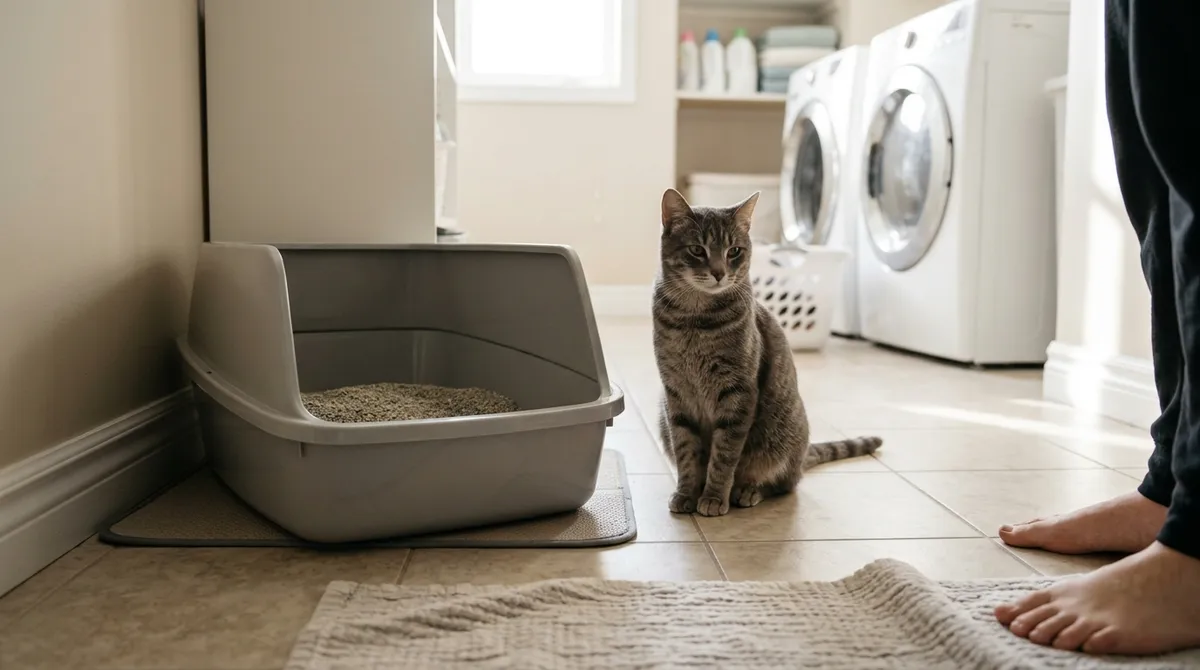
Seven in the morning. You walk barefoot down the hallway and step on the rug. For the third time this week. You've already changed the litter, and the cat is still on the windowsill, looking as calm as can be. It's just solving a problem of its own the only way it has found.
And you're not alone: at least 10% of cats develop some problem going to the bathroom in the right place, according to the ASPCA, the largest animal welfare organization in the United States. It can almost always be fixed, and we'll go step by step.
Why my cat won't use the litter box to poop
To a cat, the litter box is a bathroom that has to be clean, roomy and in a spot where nobody can surprise it. When one of those pieces fails, or when its body hurts, it looks for somewhere else. The causes fall into three groups.
Health. Constipation, colitis (inflammation of the large intestine) and anal gland problems make pooping painful. Joint pain, common in older cats, turns the edge of the box into an obstacle and makes squatting hard.
The box. Dirty, too few boxes, too small, hard to reach, a lid or liner the cat dislikes, litter that's too deep.
The environment. Moving house, a baby, a new pet, another cat lying in wait in the hallway, a routine turned upside down. And a preference for another surface: the fluffy rug, the soil in a plant pot, the bedding on the floor.
The groups overlap, and from the outside nobody can tell which one weighs most in your case. That's why the order doesn't change: the vet rules out disease, then you work on the box and the home. Fixing the box for a cat in pain is just wasting litter.
Pees in the box, but always poops outside it
“I've changed the box, the spot, the litter, and the poop is still next to it.” It's one of the most common reports, with three likely explanations. First: many cats prefer separate spots for peeing and pooping, and for this cat a single box is half a bathroom; a second box in another part of the house often solves it. Second is pain: with constipation or inflamed anal glands, the box becomes the place of pain only at poop time, and then the vet comes before any change of litter. Third is fur: in a long-haired cat, stuck poop and mats around the rear hurt, and trimming the fur in that area often ends the problem.
Poops next to the box, not in it
Poop an inch from the edge looks like a provocation, but almost always the cat wanted to use the box and something drove it out. A cat that got scared in the box tends to go in and out very fast, sometimes before finishing, and ends up going beside it. Think of the washing machine that started its spin cycle, the other cat that jumped on top, the door that slammed. Remove the source of the scare or put a box in a calmer corner.
How to read the clues your cat leaves
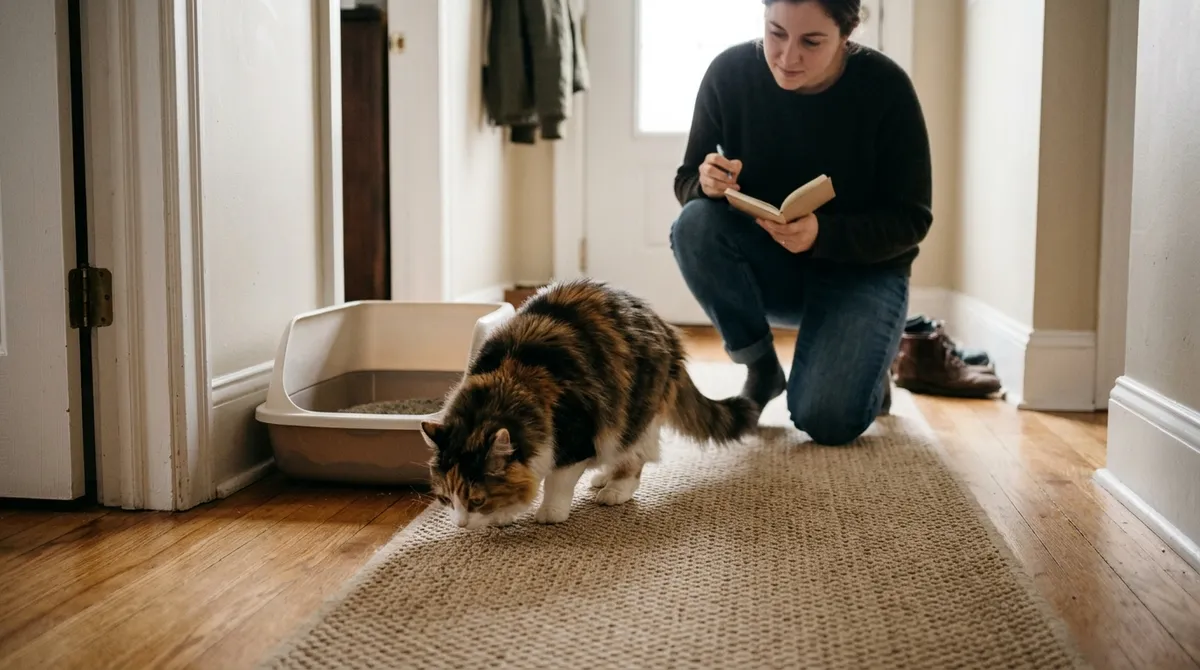
Where the poop shows up tells you a lot. Take notes for a week:
- In several places and on several surfaces (rug, floor, bed, bathtub): your cat doesn't like the box.
- Always in the same corner: your cat likes that spot, often the calmest one in the house.
- Always on the same surface, like a rug or a towel: a texture preference. A finer, softer litter often helps.
And marking territory with poop is extremely rare: cats that mark use urine, which is the subject of our guide on the cat that pees outside the litter box.
Is my cat doing it on purpose, out of spite?
No. You went away, it pooped on the bed, and it feels like a personal message. But cats don't soil the house out of spite: they go outside the box because a physical, social or medical need isn't being met. Feline medicine specialists take this so seriously that they changed the technical name of the problem to one that doesn't blame the cat. Whoever understands the message will look for what's missing.
My cat hasn't pooped in 2 or 3 days: is it serious?
If you're already counting the days without poop, call the vet today. There's no safe formula for “how many days is OK,” because what matters is the whole picture: whether it's eating, whether it's active, whether it strains, whether it seems to be in pain. And cats hide discomfort very well.
Goes into the box, strains and nothing comes out
This is the most important point in the article. You see your cat straining, leaving and coming back minutes later, and you think constipation. But from the outside nobody can tell straining to poop from straining to pee. The cat may have a blocked urethra, unable to pee at all, while the owner waits for the bowel to work. Mistaking one for the other kills.
The first signs of this urethral obstruction are exactly the ones we associate with constipation: meowing more, going to the box many times, licking the rear and straining with no result.
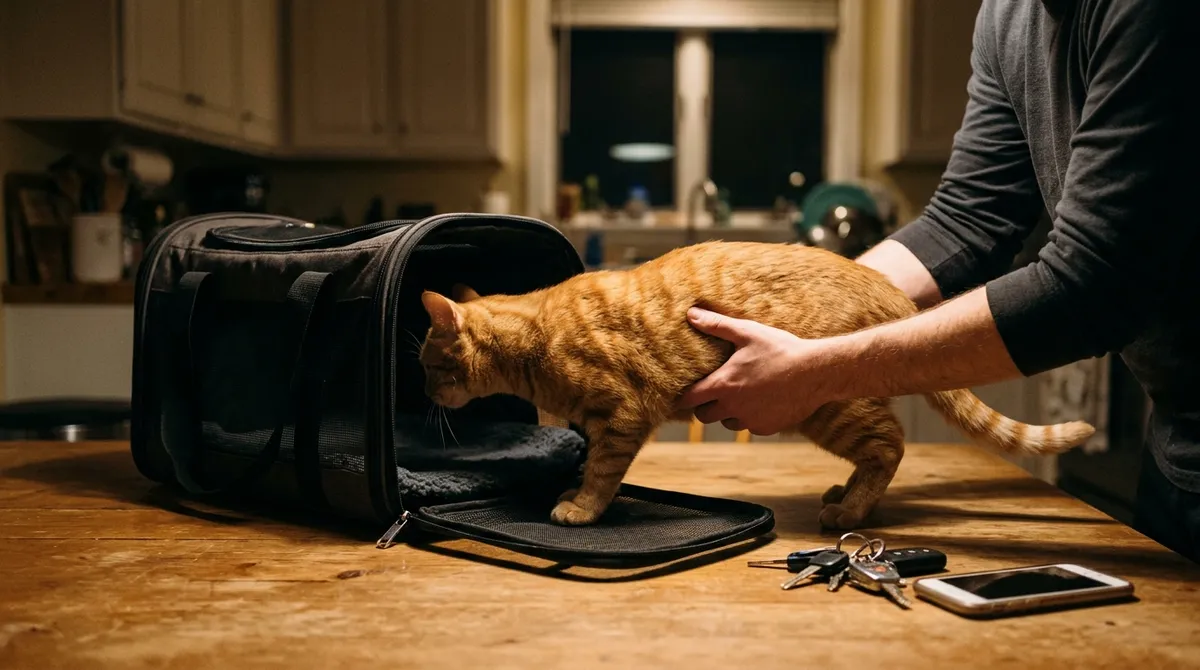
The Cornell Feline Health Center calls obstruction an absolute emergency: from complete blockage to death can take less than 24 to 48 hours. Males are at higher risk, because their urethra is longer and narrower, especially young and middle-aged males; overweight cats and cats that eat only dry food also call for attention. Vomiting, lethargy or a cat that can't stand are signs of an advanced case. Grab the carrier and go now.
And what about a cat that lies or sits still inside the box?
A cat that stays in the box for a long time, lying down or sitting still, may be straining or in pain. Watch whether anything comes out when it gets up. If nothing comes out, or if the scene repeats, treat it like straining with no result: vet the same day.
First step: the vet
With no sign of an emergency, book the appointment anyway, before buying the fifth brand of litter. The exam, sometimes with blood work or an X-ray, shows whether there's a disease or pain behind it. A lot of “stubborn cats” are cats in pain.
One detail catches many people by surprise: a cat that felt pain in the box may keep avoiding the box even after it's healed, because it kept the association, and a cat that has gone outside for weeks gets used to the wrong spot. Treating the disease is often half the job; the other half is making the box a good place again.
“I don't have the money for the vet right now”
It happens. Call the clinic and describe what you see: the conversation alone helps figure out whether it can wait. Write down since when, how many times your cat goes to the box, what the poop looks like and whether it's eating as usual. Film your cat in the box, from a distance. What you can't do is try to fix the bowel at home with a laxative, oil or an internet recipe: it can make things worse and, in a cat with an obstruction, waste exactly the hours it doesn't have.
How to get your cat to use the litter box for poop again
With health ruled out or under treatment, look at the box the way a cat would.
How many boxes to have
One box per cat, plus one. One cat, two boxes; three cats, at least four. In a home with more than one floor, one on each floor. And spread them out: boxes lined up in the same corner count, to the cat, almost as one.
Size: bigger than you think
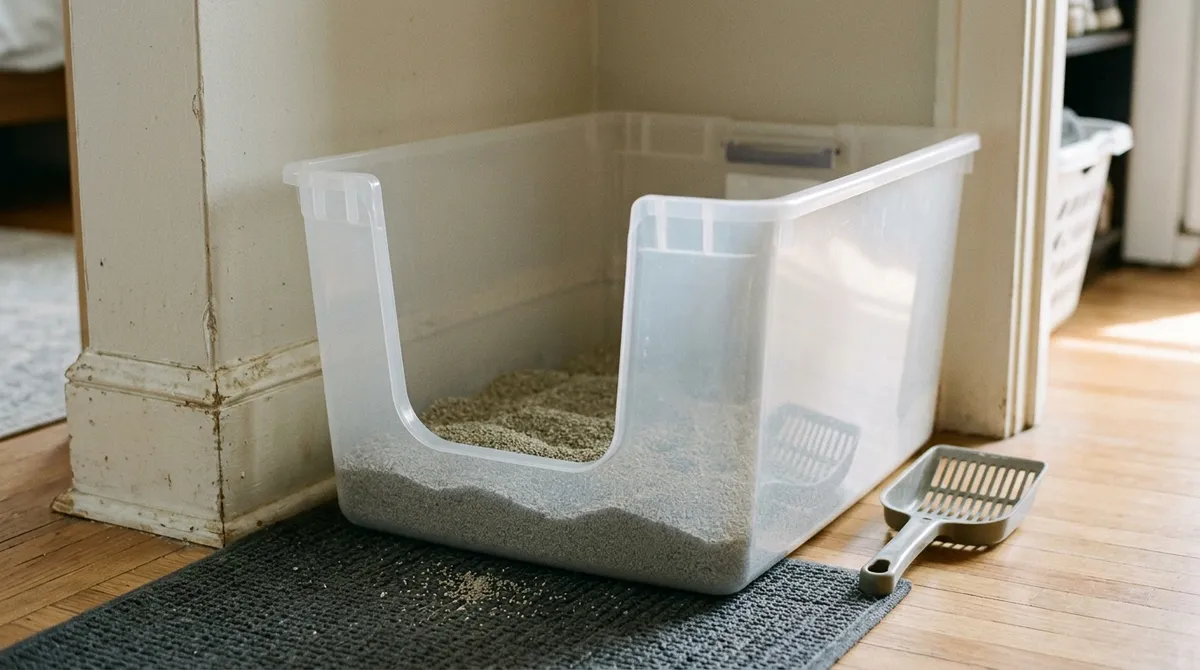
The right size is your cat's: about one and a half times its length, from nose to base of tail. Do the math with a tape measure, no need to argue over which measurement in inches is the official one. The cheap solution: a large plastic storage bin, without the lid. If it ends up too tall, cut a low entrance in one side and sand the edge. For senior cats or those with joint pain, the life stage care guidelines recommend a low-sided box.
Which litter cats prefer
Most cats prefer clumping, unscented litter with a fine to medium grain. That strong “country meadow” scent pleases the human nose and drives the cat's nose away. And many keep a preference for the litter they used as kittens.
Did anything change when the problem started: brand, type, location? Go back to what it was before. Want to test a new litter? Put it in a box next to the old one and let your cat vote with its paws.
Litter depth
Most cats prefer a layer of 1 to 2 inches (2.5 to 5 cm), much shallower than many people use. When in doubt, test a shallow box and a deeper one side by side.
Covered or uncovered box?
The lid holds in the smell when cleaning runs late (great for your nose, terrible for the cat's) and, with more than one cat, it becomes a trap: the other cat lies in wait at the exit. Most cats prefer an open box, but some feel safer in a closed one. The safest route: take the lid off or put an open box beside it and watch which one your cat uses. Plastic liners also bother many cats.
Cleaning: the item that matters most
Scoop the clumps at least once a day. Wash the whole box with warm water and unscented mild soap, replacing all the litter, once a week; with clumping litter and clumps scooped daily, a full change can stretch to every 2 to 4 weeks. If your cat is avoiding the box, stick with weekly. And a box used for years holds smell even when washed: replace it with a new one.
Where to put the box
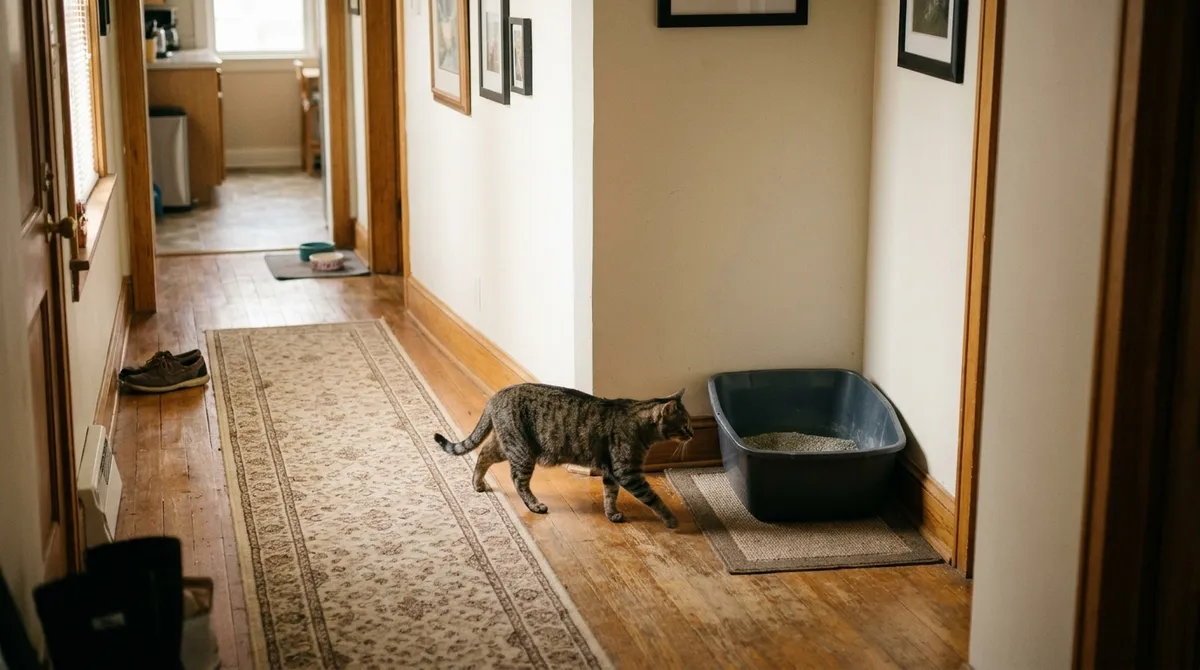
Cats want privacy, but they don't want to feel cornered. The right spot is quiet, lets the cat see who approaches and has more than one way out, away from the washing machine and the door that slams. Food and water stay away from the box. A quick test: sit on the floor next to the box, at the cat's level. Can you see who's coming? Can you escape in two directions? If not, move it.
How to get rid of the smell where it went
As long as the rug smells like a bathroom, the cat's nose will keep calling it back. Use an enzymatic cleaner made for pet messes. Ammonia-based products are out, because their smell draws the cat back to the same spot.
Then change the meaning of that corner: aluminum foil, double-sided tape or a light left on, or put food, a bed or toys there. Just know this can push the cat to another inappropriate corner. It works together with a box the cat wants to use, never alone.
I have several cats: who's pooping outside the box?
A simple camera, or an old phone pointed at the spot, is often the best solution. Another way is to mix a little non-toxic crayon into one cat's food: its poop comes out colored. Separating the cats for a while also works, with a catch: if the cause is fighting, separating them can make the problem disappear on its own, and you're left not knowing who it was. If it went away when you separated them, the clue is conflict, which is sometimes just one cat sitting in the hallway to the box, staring. That's where more boxes come in, spread out.
The cases owners describe most
Cat adopted from the street, used to dirt
Offer a large, shallow box with fine, soft litter, the closest thing to loose soil. An old tip from owners: for the first few days, sprinkle a little clean soil over the litter and gradually reduce it. And cover the soil in plant pots while it learns.
Cat afraid of the box
“As soon as I put it in, it runs away.” Stop putting it in. Placing it by force in a box it associates with something bad only deepens the fear. Do the opposite: a new box, of a different model, open, in a different place from the old one, and let it discover the box on its own, in its own time.
Throws the poop out and plays, or only uses the box at night
A cat that digs until the poop flies out is usually in a box that's too small or with litter it doesn't like. Test a bigger box and another litter, and remove the poop right away so it doesn't become a toy. A cat that only uses the box at night is showing you when it's quiet: during the day people walk by, the doorbell rings, the vacuum runs nearby. Try a second box in a quieter corner and see whether the pattern changes.
“I've tried every litter and it still happens”
Then the problem is probably in another item. Go over it: has it seen the vet? Is there one box per cat plus one, in different places? Is the box one and a half times its length? Is the spot quiet, with an exit? Is another pet guarding the way? Did anything change in the house? If everything checks out and nothing improved, see the timeline in “How long until you see results.”
My cat eats litter: is it harmful?
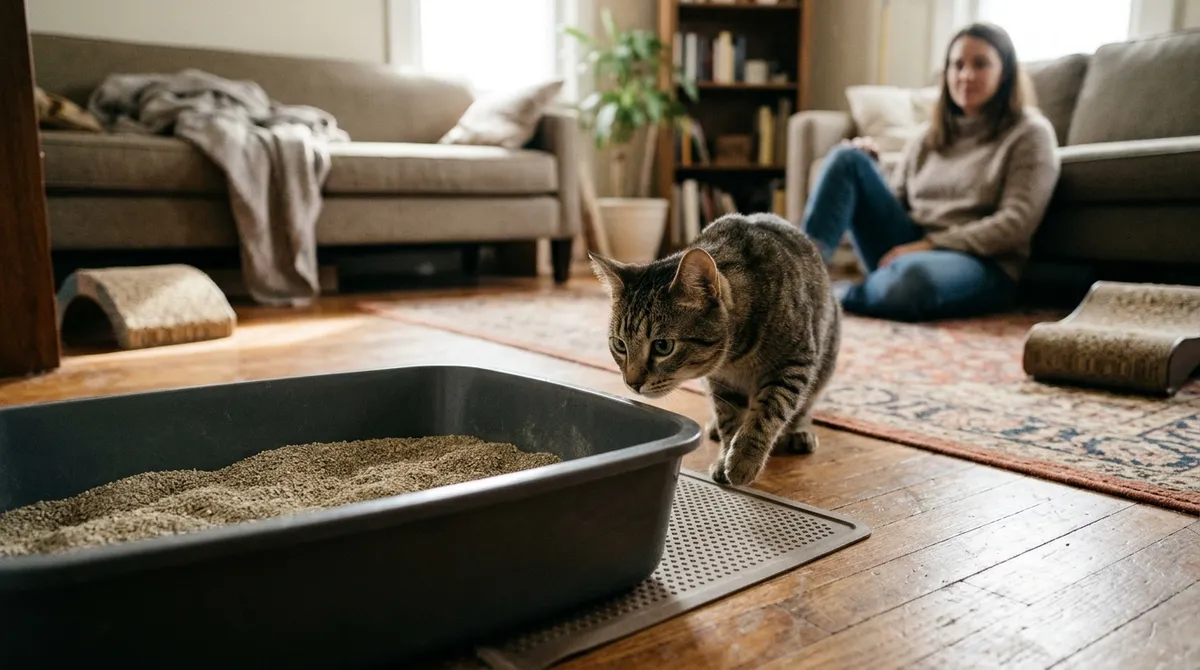
It can be. Repeatedly eating things that aren't food has a name, pica, and may be linked to anemia, parasites or hyperthyroidism. In addition, swallowing litter can cause obstruction and poisoning. With pale gums and lethargy together, call the vet right away; in other cases, book an appointment.
My cat doesn't bury its poop: is that a problem?
Not always. Nobody really knows why cats cover their poop, and not covering it has no specific medical cause. But if your cat always buried it and suddenly stopped, look at the rest: pain tied to the box makes a cat want to run from there, and a new cat or a change of routine also affects this habit. If it comes with straining in the box or poop outside it, tell the vet.
Do automatic litter boxes work?
For many cats, yes; others are afraid of the noise. If the poop outside began after it arrived, go back to a regular box.
What about medication?
It helps when the cause is stress or anxiety, always prescribed by the vet. It doesn't fix a bad box and comes in as a last resort, alongside changes at home.
What not to do
You'll be tempted, but don't:
- rub its nose in the poop: it learns to fear you and to go in secret, behind the sofa;
- scold it or drag it to the box: the box becomes a place of scolding;
- lock the cat in a room for days without treating the cause;
- clean with an ammonia-based product.
Treats when it uses the box usually don't help either: many cats don't like attention while they're going.
And the kitten that hasn't learned yet?
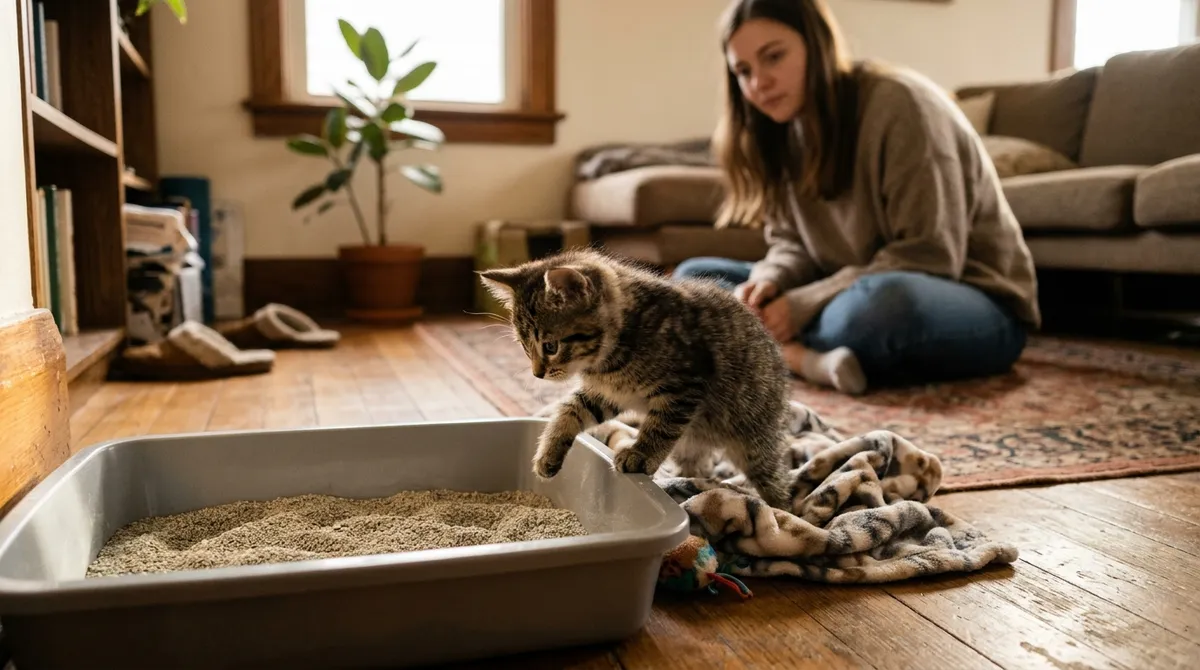
Kittens are another story: they have no aversion to the box, they just haven't formed the habit yet. A low box, near where the kitten spends its time, fine unscented litter and daily cleaning. After it eats or wakes up, place the kitten near the box and wait for it to show interest. Force and scolding stay out.
How long until you see results
Count in weeks. Cats change habits slowly, and an accident along the way doesn't mean it failed. If the simple measures don't work within a few weeks, the case calls for a deeper evaluation with the vet, who can refer you to someone who specializes in feline behavior.
When to see the vet
Go today, without waiting:
- strains in the box and nothing comes out, or very little, especially if it's a male;
- goes to the box many times, meows more than normal or licks its rear a lot;
- is vomiting, lethargic or unable to stand.
Call today and book an appointment:
- you're already counting days without poop;
- your cat stays a long time lying down or sitting still in the box;
- the poop outside started suddenly, or your cat is a senior that has started avoiding the box;
- there's blood in the poop or it seems to feel pain when squatting;
- it eats litter, especially with pale gums;
- a few weeks of adjustments and nothing changed.
Bring your notes and, if you can, a video.
Fridge cheat sheet
- Straining in the box and nothing comes out: vet today.
- Poop outside: vet first, box second. No homemade laxatives.
- Boxes: one per cat plus one, spread out, one per floor.
- Size: one and a half times the cat; low sides for seniors.
- Litter: clumping, fine, unscented, 1 to 2 inches (2.5 to 5 cm). Test side by side.
- Cleaning: scoop clumps daily; regular full wash.
- Smell: enzymatic cleaner, never ammonia.
- Never: scolding, nose in the poop, cat put in by force.
The cat that poops on the rug is either asking for a better bathroom or warning you that something hurts. When you find out which of the two, the hallway goes back to being just a hallway.
Sources
This article was written from the sources we consulted in October 2026:
- Litter Box Problems — ASPCA
- Cat Behavior Problems – House Soiling — VCA Animal Hospitals
- Inappropriate Elimination Disorders in Cats — VCA Animal Hospitals
- Feline Lower Urinary Tract Disease — Cornell Feline Health Center
- Feline Behavior Problems: House Soiling — Cornell Feline Health Center
- Urethral Obstruction in Cats — MSPCA-Angell
- Guidelines address house soiling in cats — AVMA/JAVMA News
- AAFP and ISFM Guidelines for Diagnosing and Solving House-Soiling Behavior in Cats — Journal of Feline Medicine and Surgery (via ResearchGate)
- General Litter Box Considerations (2021 AAHA/AAFP Feline Life Stage Guidelines) — AAHA
- Feline House Soiling — Clinician's Brief
- Why Is My Cat Eating Litter? — PetMD
- Why is My Cat Eating Litter? — Pewaukee Veterinary Service
- Why Does My Cat… Not Cover Her Poop? — Vetstreet
- Why Cats Don't Cover Their Poop — Purina