How to Stop My New Puppy Crying at Night: A Plan So You Can Sleep Tonight
To stop your puppy crying at night, first work out why he is crying (pain, needing to pee, hunger, fear or asking for attention), fix the real need, and from then on give attention only when he is quiet. Scolding has no place in the plan, ever.
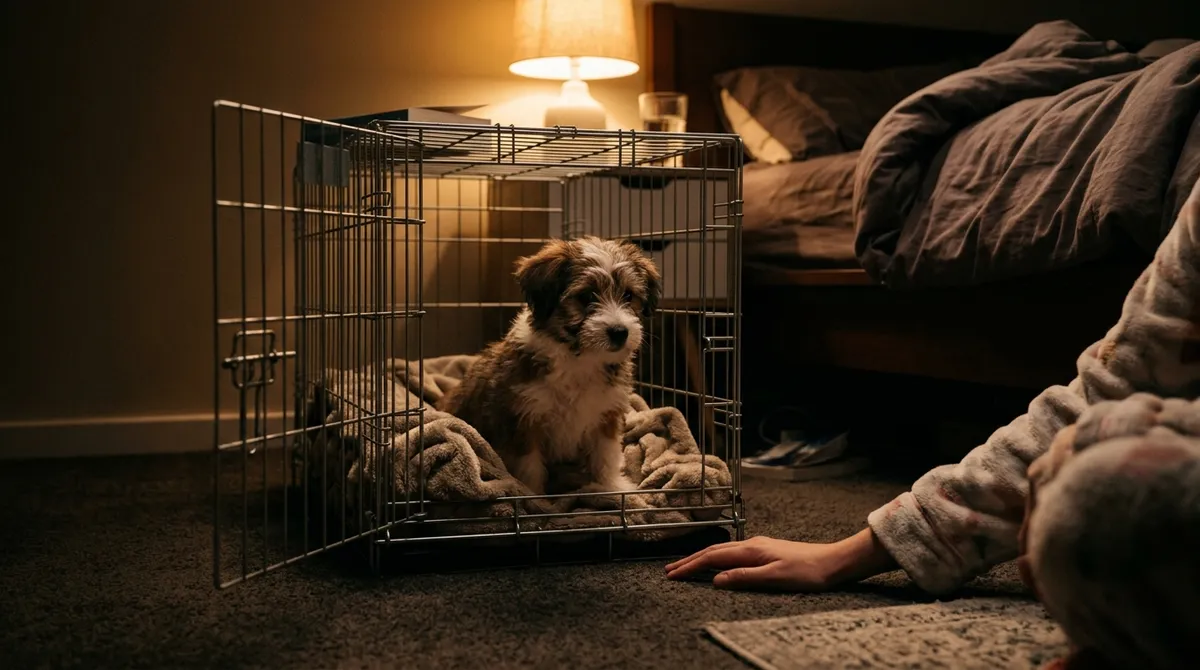
On a calm afternoon it looks easy. At three in the morning, it doesn't. The puppy came home yesterday, he is in the crate beside your bed, and that thin crying starts and seems to have no end. You get up and he stops; you lie down and he starts again. Breathe: puppy crying has a cause, almost every cause has a fix, and we'll take it one step at a time.
How to stop your puppy crying: the step-by-step
Puppy crying at night: the first nights
The puppy who comes home has lost his mother, his littermates and the warm pile he slept in, all at once. Now the light goes out, everyone disappears behind a door, and he is alone in a place he doesn't know yet. Crying is the only way he has to call someone.
Set up the night like this:
- Burn off energy early. A calm play session early in the evening, without getting the puppy wound up right before lights out.
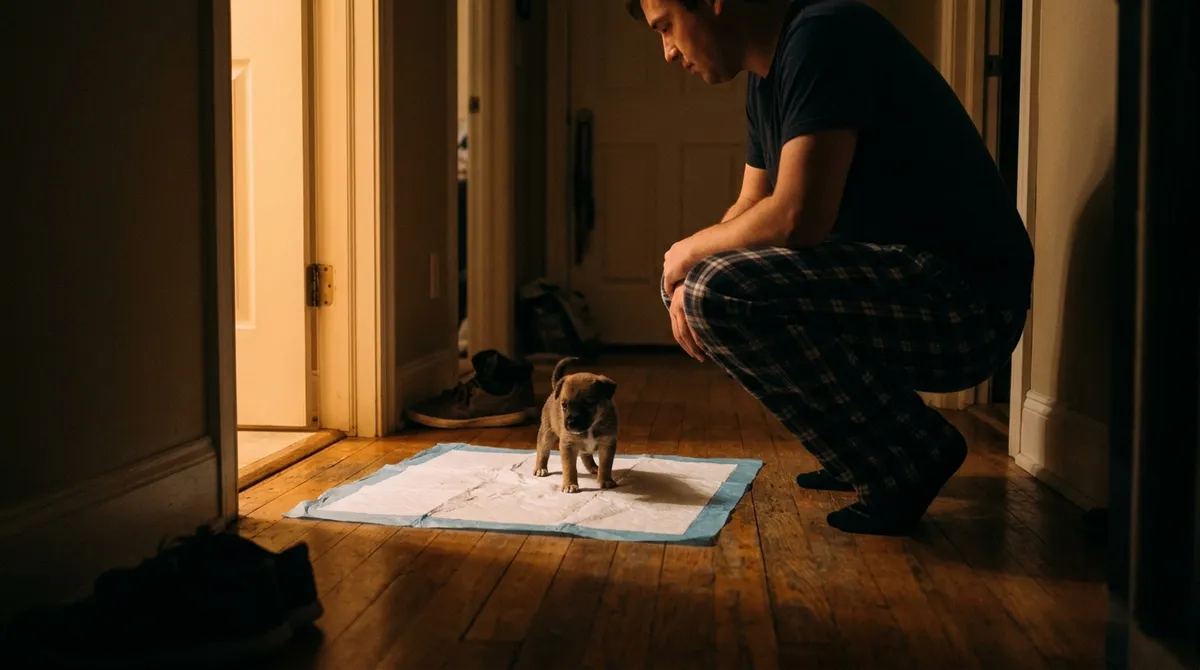
- Empty the bladder. Take him out to pee and poop right before bed. It is the most obvious step and the one everybody skips.
- Build a safe den. A soft bed, a blanket and a toy, in a spot he already knows from the daytime: the crate with the door open, or a playpen. Many people keep this spot near the bed for the first nights, so they can hear if he needs to go out.
- Turn off the light and stay calm. No excited chatter and no half-hour cuddle.
An old trick that often helps: a stuffed toy or a blanket that smells like his mother and littermates. If you can, ask the breeder or shelter for one, or rub a towel on the litter before you bring the puppy home. Once he has settled into the house, a T-shirt you've worn does the same job in his bed. Just keep an eye on him: if he starts chewing and tearing it, take it away.
And when the crying comes in the middle of the night? Listen for a few moments, because the crying of a puppy who is just getting settled is usually short. If it doesn't stop, think about the bladder first: take him to his potty spot with the lights low, praise him quietly and put him back to bed with no fuss. If he has already gone, is comfortable and keeps crying, wait for a pause of silence, even a few seconds long. In that lull you step in, put your hand on his bed, speak softly and stop there. He learns that what brings you is calm, not a scene.
“My puppy is one month old and cries a lot. Is that normal? For how many days?”
This is the question that comes up most. A puppy of 30 to 60 days crying a lot in the first days in a new home is to be expected. How many nights it will last, nobody can promise, because it depends on the puppy, the home and what happens each time he cries. What you control is the direction. If every night you do something different (one day you ignore him, the next you take him into your bed, the next you scold him), he doesn't understand the rule and the crying drags on.
The sign that you're on the right track: shorter cries and slightly longer pauses of silence each night. If the crying gets worse, or comes with a puppy who is lethargic, won't eat or complains when you touch some part of his body, the answer is no longer patience.
Step by step, for any time of day
Crying at two in the afternoon follows the same logic as crying at two in the morning. Work through the list from top to bottom:
- Pain first. Does he complain when you touch somewhere? Does he shift position without finding a way to lie down? This comes before any training.
- Basic needs. Pee, poop, hunger, thirst, cold, heat.
- Watch the body, not just the sound. Crying along with pacing, circling or licking himself is usually anxiety. Crying while looking at you, with a relaxed body, is usually a request.
- For a request, silence comes before the reward. Petting, treats and play only after a few seconds of quiet.
- Catch him being quiet. Walked past the puppy and he's calm? Give him a pet.
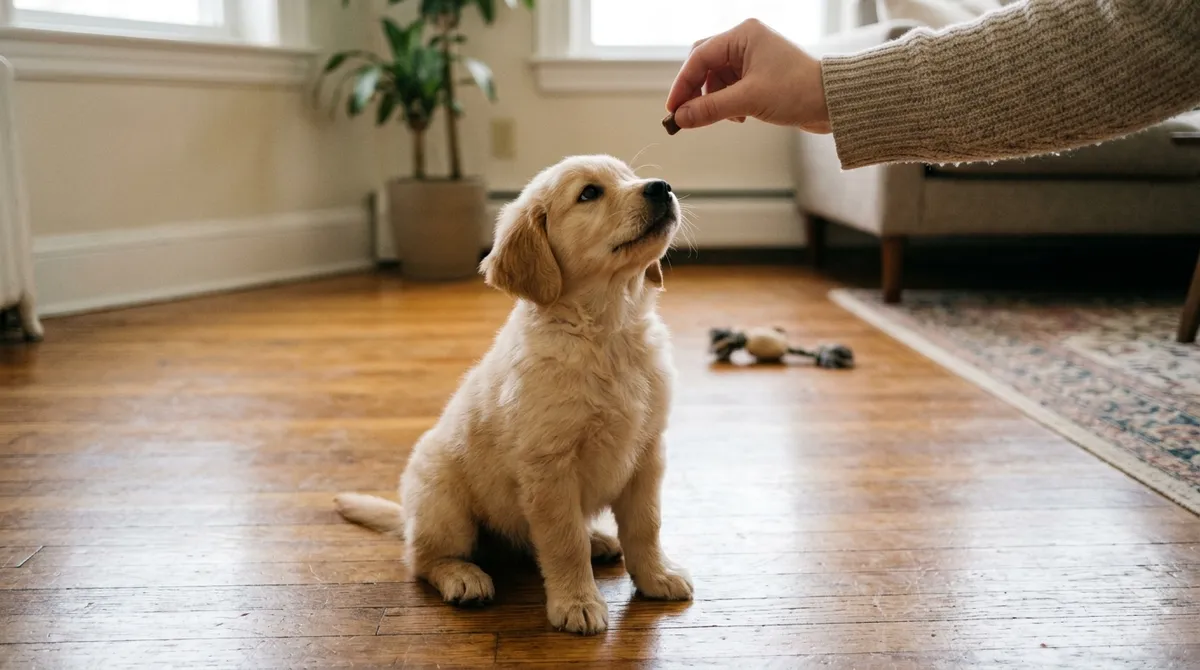
- Teach another way to ask. Sitting, or touching his nose to your hand. A dog who knows that sitting gets him things doesn't need to cry.
- Train alone time in small doses, every day. A puppy who spends a few calm periods alone in his den every day is less likely to develop a fear of being left. Five minutes while you're in the kitchen; then ten. It is the daytime training that pays off in the best nights.
Why dogs cry or whine
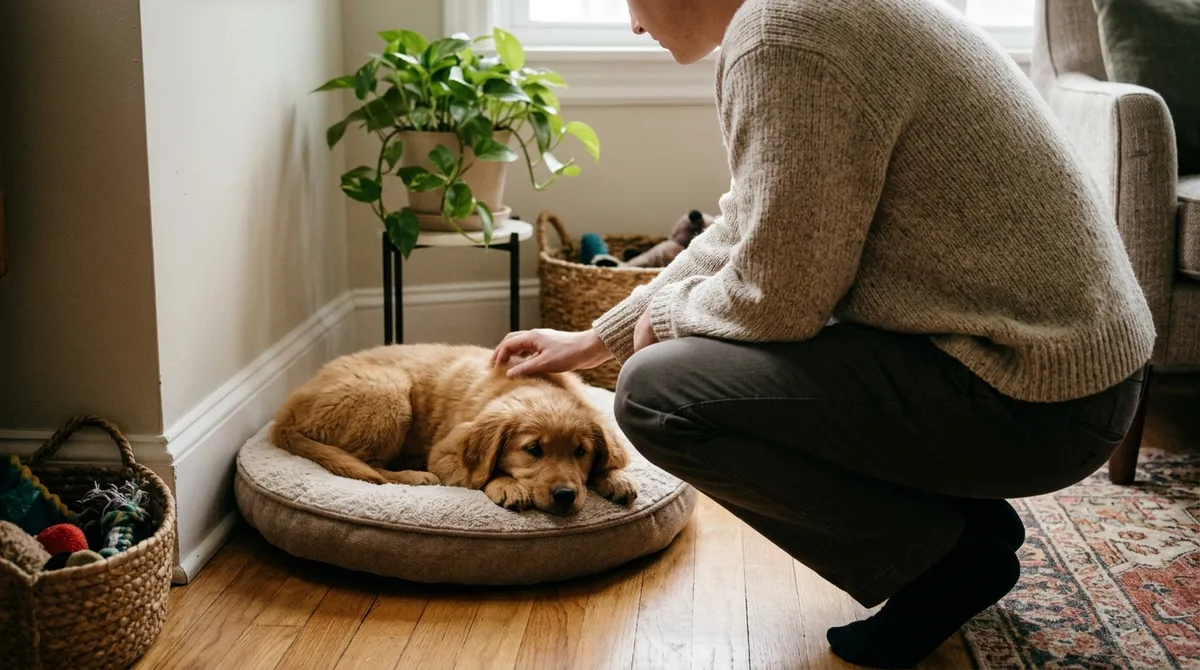
Whining is one of the ways a dog talks, and the same sound can mean very different things. The five most common reasons are these.
Asking for attention. He wants you, a treat, the ball that rolled under the couch. Here is the trap: looking at, touching or talking to the dog, even to scold him, already counts as attention, as explained by the ASPCA, the largest animal welfare organization in the United States. Anyone who has said “stop that!” in the middle of the night knows: ten minutes later he is crying again.
Excitement. The high-pitched whine when a visitor arrives or the walk leash comes out of the drawer. Too worked up, the dog can't hold the sound in.
Appeasement. Some dogs whine when interacting with people or other dogs, with tail tucked, body low and eyes averted. It is their way of saying “I come in peace,” and it is normal. Punishment only makes this whine increase.
Anxiety. Under stress, the whine comes out almost involuntarily, along with pacing, circling and licking. It doesn't go away while the cause of the fear is still there.
Pain. Dogs whine a lot from pain or from illness that hurts. That is why it comes first in the step-by-step.
Knowing which of the five is happening is half the job.
Pain or attention-seeking: how to tell
Attention-seeking has an audience. The dog who cries for attention cries while looking at you, stops when he gets what he wants and starts again when you turn your back. He eats well, plays well, runs well.
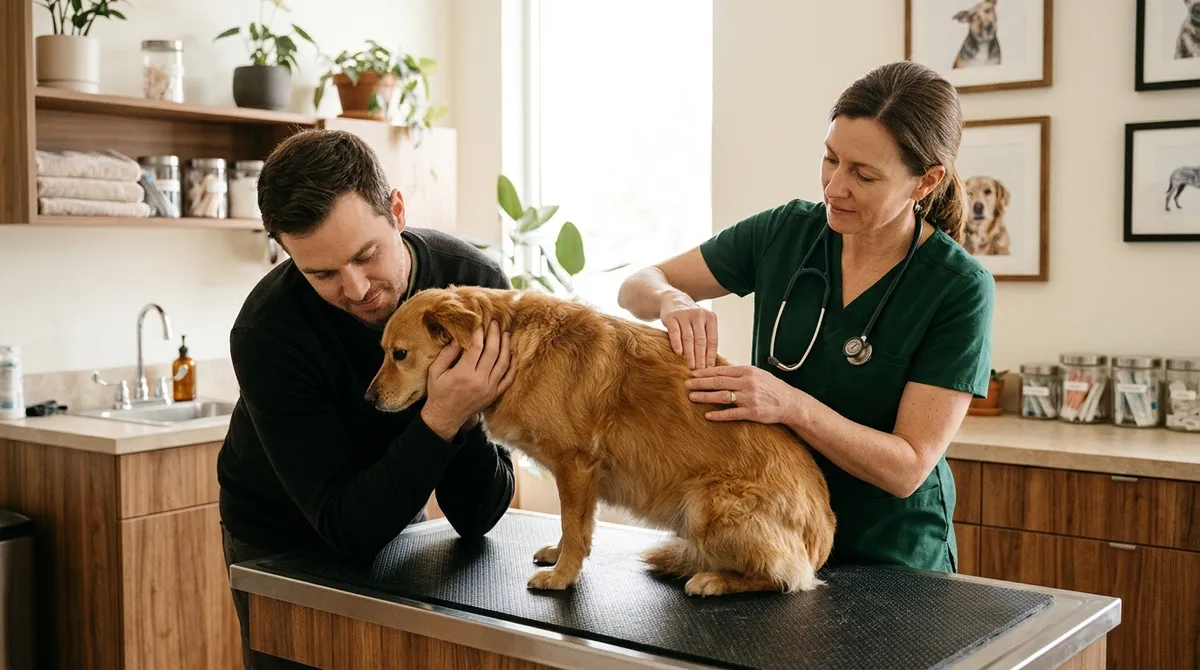
Pain looks different. According to the AAHA, the American Animal Hospital Association, a change in behavior is the main sign that something hurts, and at any sign of pain the advice is to call the veterinarian. Watch out if he:
- whimpers or whines when you touch a part of his body;
- limps, walks hunched, or has trouble getting up or lying down;
- keeps changing position without finding comfort;
- sleeps differently, greets you less, plays less or eats less;
- becomes skittish or even aggressive when touched.
The strongest clue is novelty: crying that started suddenly, in a dog who didn't cry before, deserves a vet visit before any training. And pain weighs more than it seems. In cases seen by veterinary behaviorists, 28% to 82% of patients had signs of pain, according to the Merck Veterinary Manual. A lot of “annoying dogs” are sore dogs trying to warn you. When in doubt, treat it as pain: erring on that side costs a vet visit; erring on the other costs a pet suffering in silence while you “don't give in.”
“I don't have the money for the vet right now”
It happens to a lot of people. If there are signs of pain, the minimum is to call the clinic and describe what you see; the conversation alone helps you know whether it can wait or whether you should go now. Write down when the crying started, at what times it appears, whether it gets worse when touched, whether he eats and pees and poops normally, and take a video. What you must not do is medicate on your own to save money.
Why he cries only at night
During the day the house has noise, people passing, play. At night everything stops, and for a puppy who doesn't yet know that everyone comes back in the morning, it is the longest stretch of loneliness of the day. Add a small bladder that can't hold through the whole night in the first weeks, and learning: if on the first night the crying brought someone running with a cuddle, by the second he already knows what to do.
That is why the night plan starts in the daytime, with short alone-time training, and continues before you go to bed, with good tiredness and a pee done. For the senior dog who has started crying in the middle of the night, the story is different, and it has its own section further down.
Do I go to him or ignore him?
It is the fight in every home with a new puppy. One side says “don't give in, or he'll learn”; the other can't stand hearing the crying. What decides is the kind of crying.
- Asking, with the puppy comfortable: wait for the silence. No looking, no talking, no “shhh” through the crack of the door. This is not disappearing for hours, it is not rewarding the crying in the middle of it. When the lull of calm comes, you show up, give a quick pet and leave.
- Needing to pee: go, take him to the right spot, go back to bed. You're not giving in, you're taking care of him.
- Panic (throws himself at the bars, drools, pants, tries to escape): go and calm him. Leaving a terrified puppy alone teaches nothing, it only prolongs the fright.
- Looks like pain: go, examine him gently and talk to the veterinarian.
Does comforting the puppy teach him to cry?
It depends on the moment. What teaches crying is the crying paying off: he cries, you show up excited in the middle of the fuss, he gets a cuddle and conversation. Repeat it a few times and he has learned. Petting given when he has already calmed down teaches the opposite.
With a frightened puppy, the math changes. Calming an animal who is afraid doesn't reward the fear: staying nearby, speaking softly and offering a safe place helps the fright pass and raises a puppy who trusts you.
I live in an apartment and the neighbor complains
Talk to the neighbors before the next complaint: telling them the puppy just arrived and that you are training him buys more patience than any gadget. Put the den in your bedroom, away from the wall shared with the neighbor. And act early: if the crying has started and won't stop, check pee and comfort right away, in silence.
Cries when you leave the house: is it separation anxiety?
You leave at seven. Late in the afternoon, the neighbor tells you, polite but tired: the dog cried all morning. It could be separation anxiety, and it might not be.
When it shows up
The crying comes shortly before you leave or while you're away, and almost always comes with another sign: pacing, panting, heavy drooling, destroying things (mainly near doors and windows, or objects that smell like you), peeing or pooping indoors, looking down. The signs usually appear in the first 15 to 30 minutes after you leave, with the crying strongest right at the start. Many dogs already get distressed when they hear the keys or see you put on your shoes.
How to be sure
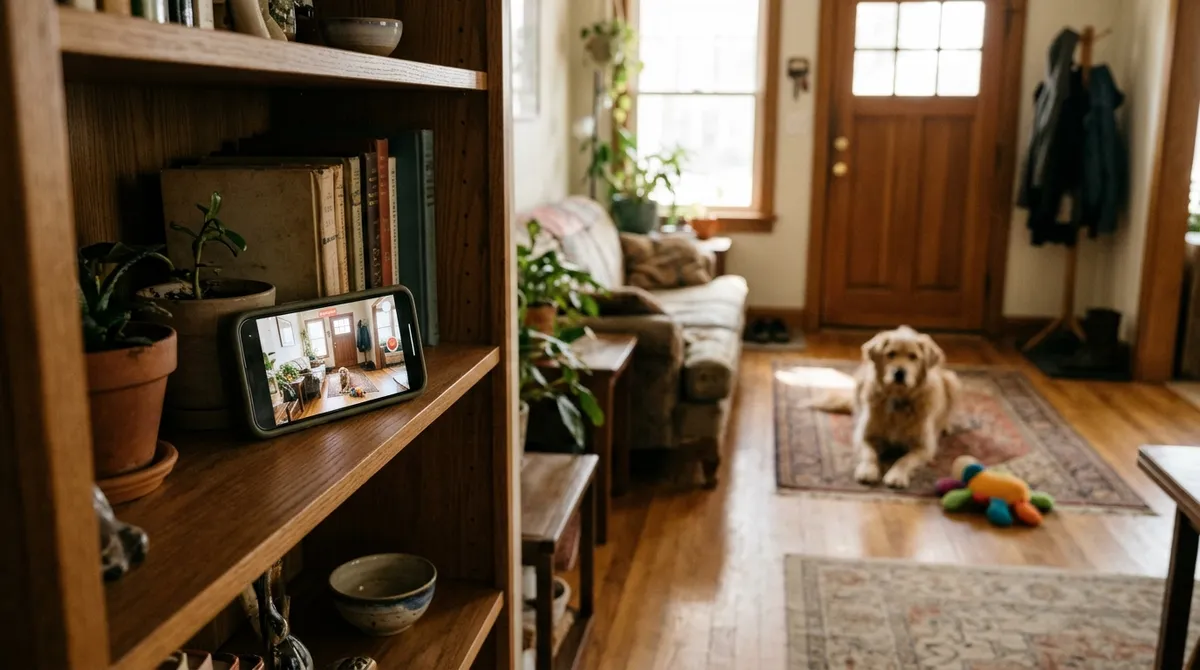
Film him. Leave your phone recording, leave as usual and watch it later. You'll see whether he cries for five minutes and sleeps or spends the morning scratching at the door. Before making up your mind, rule out look-alikes with another cause: a puppy who hasn't yet learned where to go potty, boredom, street noise, fear of thunder or fireworks, distress from being shut in a tight space. Fear of noise and separation anxiety often go together, and sometimes it all starts after a scare while the dog was alone, like a thunderstorm.
The myth of the clingy dog
Does your dog follow you to the bathroom? You can take that weight off your shoulders: a clingy dog is no more at risk of separation anxiety than others. He just likes you.
What really helps
- Less time alone while you treat it. Doggy daycare, a sitter, a relative who drops by at lunchtime. For people who spend the day away, this support changes everything.
- Exercise and reward-based training in the routine. A tired dog with a busy mind copes better.
- Make leaving a good thing. In mild cases, a food-stuffed toy that only appears when you leave.
- Fake departures for the serious cases. You leave for a very short time and come back before he panics, building up little by little. It takes months, and the classic mistake is rushing: going too fast leaves the dog even more sensitive. Got worse? Go back to the time he was fine with. When the case is moderate or severe, the safest path is to build this plan with the veterinarian.
- Crate, only if he likes it. For a puppy, the den is great. But a dog with separation anxiety can get more distressed in a small space and even hurt himself trying to escape. If he panics when shut in, leave the crate open or use a safe room.
He whines when I get home: is that normal?
It is, and it is the cutest cry on the list: pure excitement. If the commotion bothers you, turn down the temperature of your arrival. Say a calm “hi,” wait for him to settle, ask for a “sit” and then give real petting. In a few weeks he understands that sitting gets you to him faster than shouting.
If the arrival whine comes with a low body, tucked tail and averted eyes, he is appeasing. Scolding at that moment is the worst thing you can do.
Senior dog crying in the middle of the night: old age, pain or dementia?
The thirteen-year-old dog who has slept at the foot of your bed his whole life starts waking at three in the morning with a mournful howl. During the day, he sleeps more than he used to.
Many things can be behind this: hearing loss, nervous system disease, needing to pee, hunger, joint pain. So the first step, especially if the crying came with restlessness or a greater need to go potty, is a full exam at the vet to look for a medical cause before treating it as behavior.
The signs of cognitive dysfunction
There is also cognitive dysfunction, which many people call canine dementia. Pay attention if your dog:
- seems lost in places he knows or stares at the wall;
- has changed how he interacts with the family, becoming clingier or more distant;
- has swapped day for night;
- has gone back to peeing or pooping indoors;
- has become more anxious, including when separated from the family;
- has changed his activity level and vocalizes more.
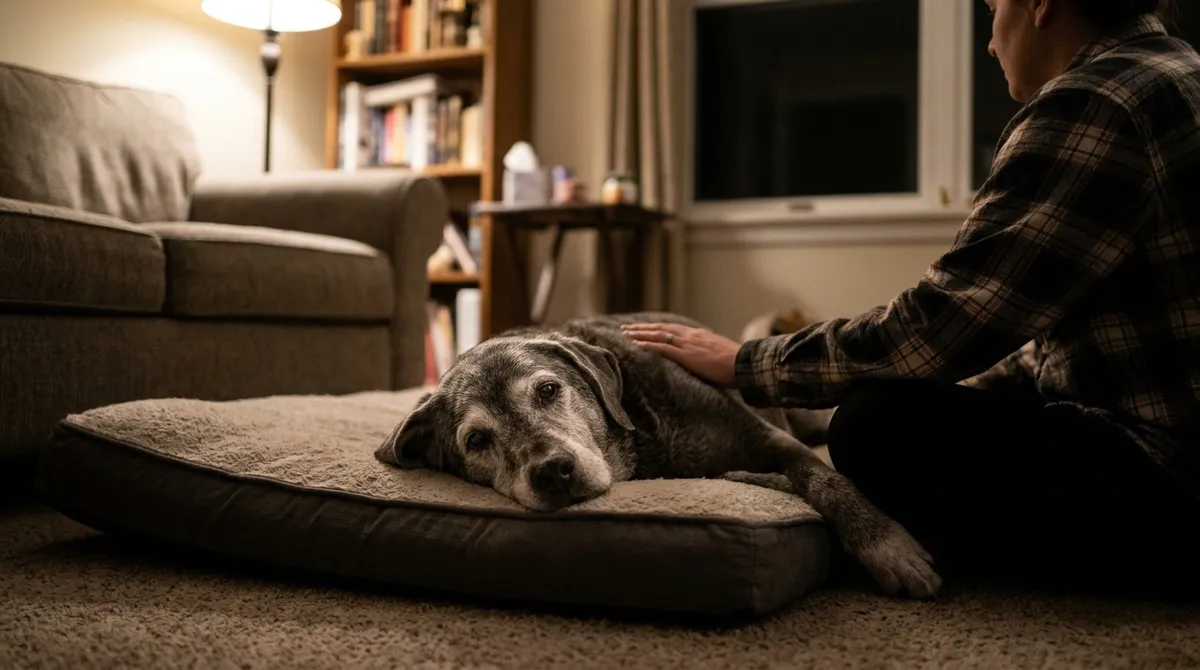
It is more common than it seems. A study cited by Merck found compatible signs in 28% of dogs aged 11 to 12 and in 68% of those aged 15 to 16, and a good share of cases goes undiagnosed because the family thinks it is “just old age.” Bring notes on what changed: sleep, pee, appetite, the way he walks. At home, patience: frustration and punishment increase his anxiety and make the night worse for everyone.
What about supplements?
You will find products promising to end the senior dog's night barking. The evidence is thin: a 2022 study tested one of these supplements on only 3 dogs, and some of the authors worked for the manufacturer. Before spending, rule out pain and illness with the vet.
Do anti-bark collars or scolding work?
No. Scolding is attention: if he cries to call you and you show up yelling, mission accomplished. And with the anxious dog, the one who whines to appease and the confused senior, it increases the fear, which is the cause of the crying, and can even make the dog afraid of you.
Shock collars, spray collars, citronella and everything that works by startling count the same way. What causes pain or fear can leave a lasting fear and even aggression, and it silences the sound without touching the cause: if the crying was from pain, you have switched off the only warning he had. Hit your limit? It happens. That is the time to ask the veterinarian for a plan.
Medication or a calming aid: is there one?
There is medication for some behavior problems, and whether your dog needs it is for the veterinarian to decide, after an exam. A calming pill recommended in the neighborhood group, a leftover tablet in the drawer, tea, a home remedy: none of that. Medicating on your own can hide a pain that needed to be seen, and on its own it teaches nothing. When prescribed, it goes together with training, never in place of it. For the puppy in his first nights, the calming aid that works is routine.
When to see the veterinarian
Call or go in when:
- the crying started suddenly or he vocalizes all the time for no apparent reason;
- he whines when touched, limps, walks hunched or can't find a position to lie down;
- the puppy won't eat, is lethargic or the crying only gets worse over the days;
- the senior has started whining in the middle of the night, especially with restlessness;
- there are strong signs of separation anxiety, such as destruction, injuries or heavy drooling.
Bring your notes and, if you can, a video.
Cheat sheet for the fridge
- Cause first: pain, pee, hunger, cold or fear.
- Before bed: calm play, pee done, comfortable den.
- Woke up crying: pee with no fuss and back to bed.
- Crying to ask: wait for the pause of silence before showing up.
- Catch him being quiet and teach “sit” as a way to ask.
- Every day, a few minutes alone in his own corner.
- Panic is not ignored.
- Cries when you leave: film before concluding.
- Senior crying in the middle of the night: full exam.
- Never scolding, scary collars or medicating on your own.
A dog who cries is trying to tell you something. When you find out what, the night goes back to being for sleeping.
Sources
This article was written from the sources we consulted in October 2026:
- Whining — ASPCA
- Behavior Problems in Older Dogs — ASPCA
- Behavior Problems of Dogs — Merck Veterinary Manual
- Signs of Pain in Dogs and Cats — AAHA
- 9 Things You Need To Know About AAHA's Pain Management Guidelines — AAHA
- Separation Anxiety: The Fear of Being Alone — Veterinary Partner (VIN)
- Equine placental extract supplement as a night barking remedy in dogs with cognitive dysfunction syndrome — PubMed Central