Why Is My Dog Throwing Up? What to Do Now and When to Rush to the Vet
If your dog is throwing up and won't stop, take the food away now, leave just a little water within reach, and look at your dog, not just the puddle. If they are listless, in pain, throwing up blood, retching with nothing coming out, or can't even keep water down, go to the vet right away. If they threw up once or twice and still seem alert and wagging their tail, you can watch them at home for a few hours, with good judgment.
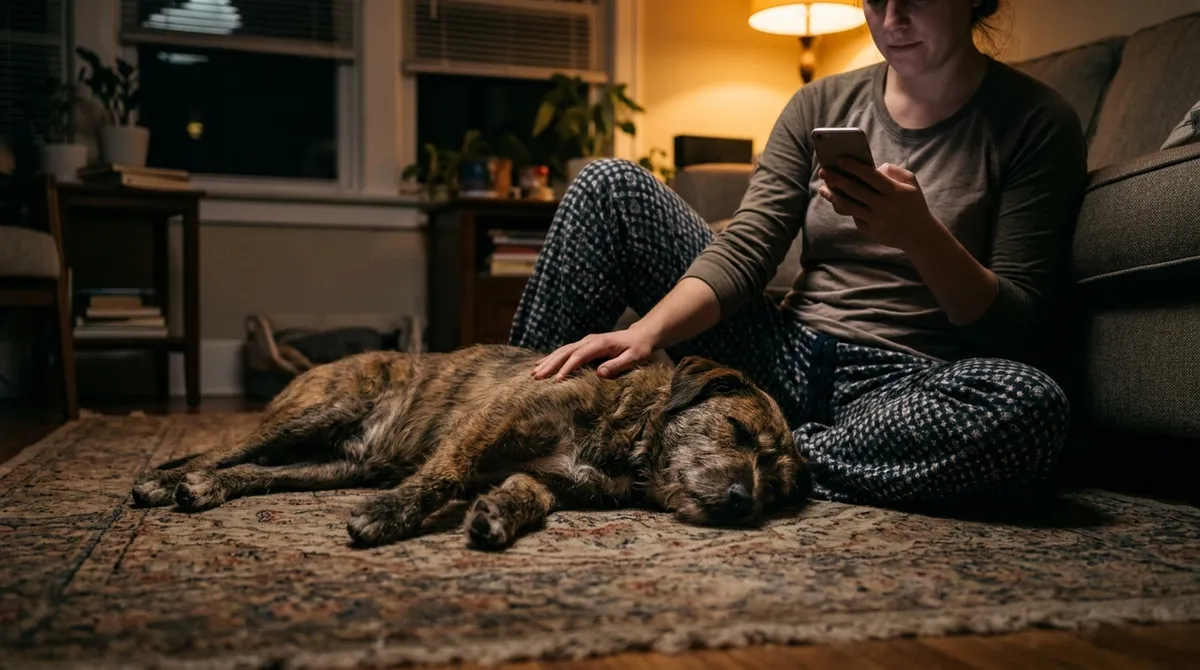
It's Sunday night. From the other side of the house comes that retching sound every dog owner recognizes in the dark, and you already know there's a rug to wash. By the third puddle, phone in hand, your dog is lying quietly in a corner, and one question keeps pounding: do I rush out now, or can this wait until morning? Breathe. Most of the time you can decide with clear criteria, and we'll take it step by step.
What to do if my dog is throwing up right now
The vomit tells only half the story; the other half is in how your dog is acting. In the first few minutes:
- Pick up the food. The food bowl, treats, the cat's dish your dog likes to raid.
- Leave water, but only a little. Just a splash in the bowl, not a full one. A nauseous dog that drinks a lot at once usually brings it all back up.
- Look at the whole dog. Do they get up when you call and wag their tail, or are they slumped over, unable to lift their head? That matters more than the number of puddles.
- Check the belly and mouth. Swollen or hard belly, heavy drooling, pale gums? Stop reading here and go to an animal hospital.
- Do a walk-through of the house. Trash knocked over, a toy with a piece missing, dropped medication, an open cleaning product, a chewed plant.
- Photograph the vomit before you clean it. The photo says what you won't be able to describe at three in the morning.
- Start a note on your phone. Time of each vomiting episode, what it looked like, whether there was loose stool, whether your dog drank water or peed. That note is how you decide whether to watch, call, or run.
My dog threw up once and seems fine: do I need the vet?
Not always. Many sudden bouts of vomiting clear up on their own within 24 hours, with no treatment and without anyone ever finding the cause.
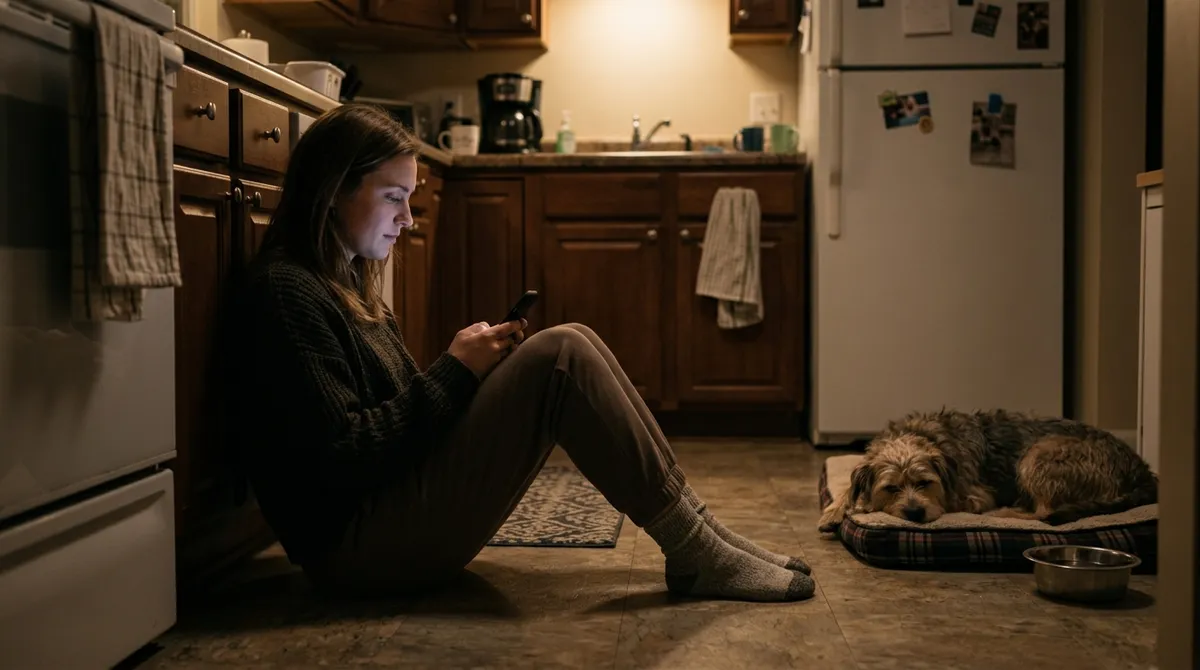
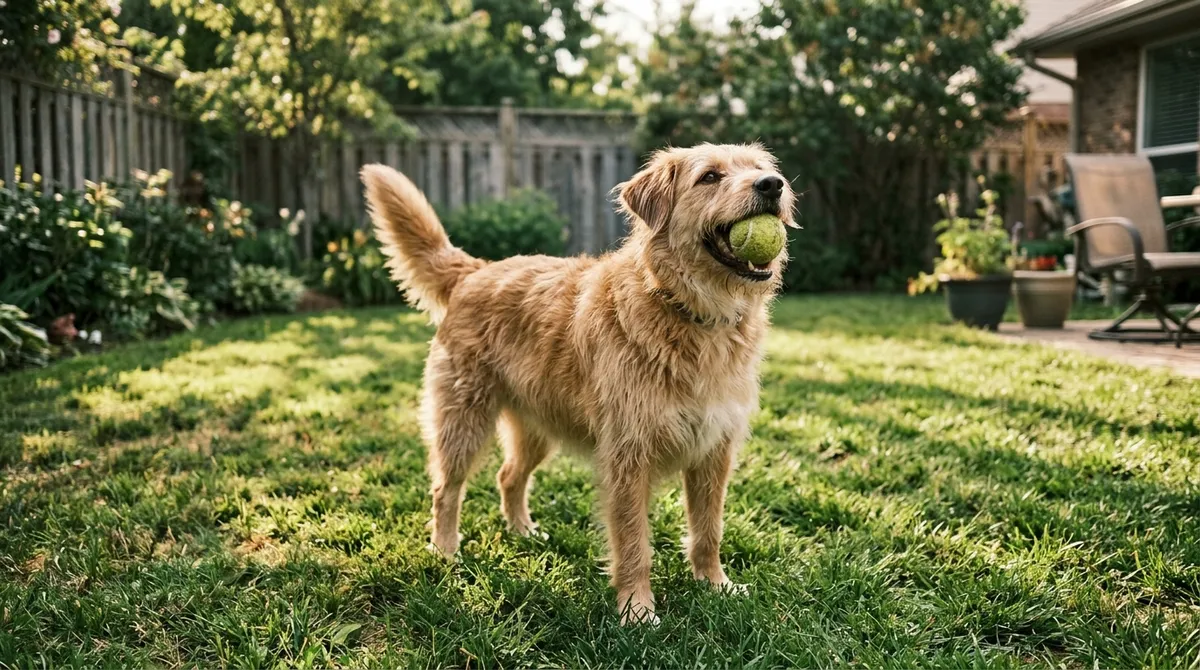
The test that settles most doubts is a single question: does your dog look sick? A dog that threw up once and came running back with the ball in their mouth can be watched safely. One that threw up and went to lie down in a corner, not even reacting to the rustle of the treat bag, probably has something wrong.
The causes of mild vomiting are old acquaintances of anyone who owns a dog:
- Eating something they shouldn't. Trash, barbecue leftovers, a bone found on a walk. The dog that eats grass and throws up right after belongs here: an occasional episode, with the dog otherwise fine, usually passes.
- Eating too fast. The one that empties the bowl in ten seconds and brings it all back in twenty.
- A sudden food change. New brand overnight and the vomiting started? That adds up. Go back to the old food and switch by mixing in the new one gradually over several days.
- Worms and other parasites, and also viral or bacterial gastroenteritis.
- Motion sickness and anxiety: car rides, moving house, fireworks.
Some dogs, though, don't get a “let's wait and see” even for the first vomit. Puppies under 16 weeks and senior dogs are more fragile, and even mild dehydration can knock them down. The same goes for a dog with a known illness that starts vomiting. For these dogs, call the vet right away.
When to see the vet: the signs that can't wait
This is the list to save on your phone. The first tier has no waiting period at all.
Go to an animal hospital now, at any hour, if your dog:
- tries to vomit and nothing comes out, or only a bit of foam, even without a swollen belly;
- has a swollen or hard belly, is restless, pacing, panting or drooling heavily;
- has pale gums, trouble breathing or has collapsed;
- throws up blood, bright red or looking like coffee grounds;
- throws up and is listless, in pain, feverish, has diarrhea or shows signs of dehydration;
- may have eaten something toxic or an object that got stuck;
- can't keep even water down;
- is a puppy or unvaccinated dog with vomiting and diarrhea.
Call the vet today if your dog:
- has thrown up more than 1 to 2 times in 24 hours, or is still vomiting after about 4 to 6 hours;
- throws up and refuses food;
- is a puppy under 16 weeks, a senior or has a known illness, even if they threw up only once;
- started vomiting again when you reintroduced food;
- regurgitates often.
Book an appointment if your dog:
- seems completely fine but keeps vomiting for more than 1 to 2 days;
- often throws up yellow in the morning, even with food split into more meals.
And that common message, “threw up, is quiet, shaking, won't drink water and seems to have a fever”? It sits squarely in the first tier. You don't need a thermometer, and don't wait for morning.
Belly pain isn't always obvious
Dogs rarely whimper from belly pain. Sometimes they signal it like this: chest and front legs lowered to the floor, rear end up in the air, like a stretch. That's the so-called prayer position. A stretch after a nap is normal. Repeating that pose over and over in the middle of a vomiting spell is pain.
My dog is trying to throw up and nothing comes out: is it dangerous?
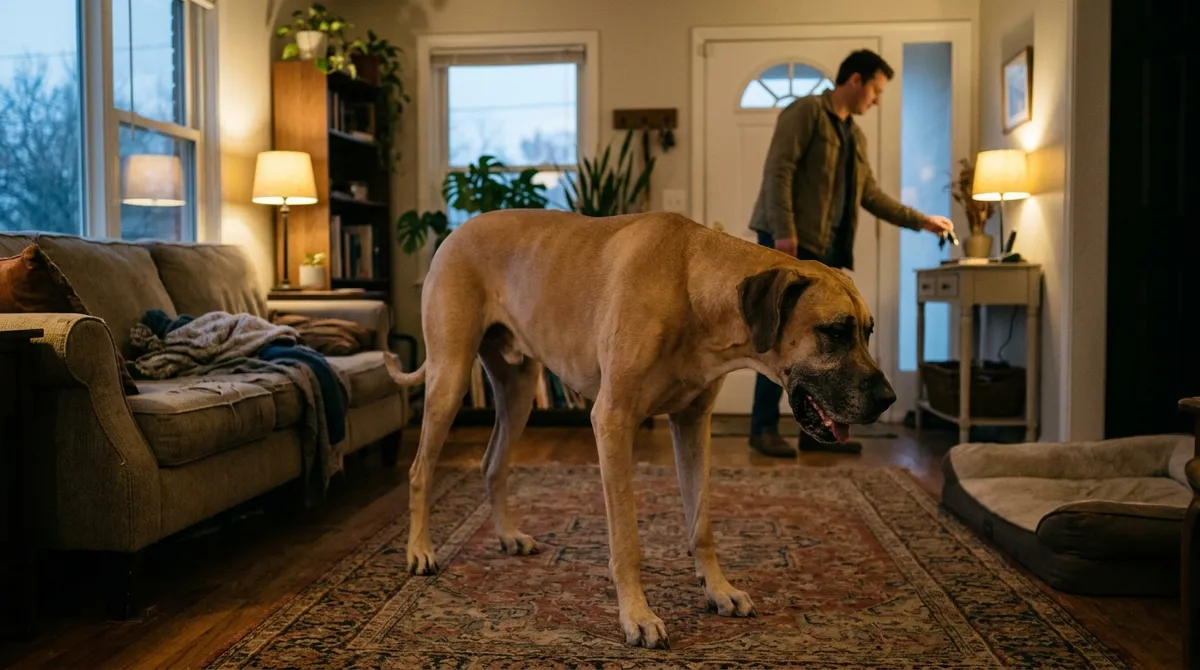
Yes, very. The most treacherous myth on this subject is “they strained and nothing came out, so it isn't serious.” Retching that produces nothing is the classic sign of gastric torsion (GDV, or bloat).
In torsion, the stomach fills with gas and twists on itself, which can cut off the blood supply to the stomach and spleen. The dog gets up, walks, lies down, drools, pants, strains and nothing comes out. The condition is more common in deep-chested dogs, and in some breeds the risk is frightening: according to BluePearl, a network of veterinary hospitals in the United States, about half of Great Danes and about 1 in 5 Irish Wolfhounds will have gastric torsion at some point in their lives.
And depending on the dog's build, the swollen belly may not even show, so don't wait for it. Searched for “my dog can't throw up”? Grab your car keys and go to an animal hospital now, calling on the way.
What to do if my dog is throwing up and won't eat: is it serious?
“I woke up, there was yellow slime on the floor and my dog is very sad, wouldn't eat.” The answer is firm: vomiting together with refusing food is not something to wait out.
A dog that threw up from eating something silly is usually eyeing the bowl half an hour later, looking like they did nothing. When they turn their nose up even at a favorite treat and keep vomiting, the chance of something more serious goes up. During the fast, watch for interest: a dog who doesn't even get up when the food bag rustles has no appetite.
The rule is this: threw up and doesn't want to eat, call the vet today, not tomorrow. If on top of that your dog is listless, in pain or has loose stool, the call becomes a visit.
How long can you wait at home if your dog is throwing up? And how many times can a dog throw up?
It depends on how your dog is doing.
- With any sign from the first tier of the list: the wait time is zero. Not even an hour.
- Alert, but the vomiting repeats: if your dog has thrown up more than 1 to 2 times in 24 hours, or is still vomiting after about 4 to 6 hours, call the vet.
- Completely fine, eating and playing, but vomiting now and then: the limit is 1 to 2 days. Past that, book a visit.
The limit exists because repeated, prolonged vomiting takes its toll: weakness, lethargy, weight loss, dehydration and an imbalance of the body's salts. When in doubt between two time frames, go with the shorter one and call.
“I can't afford to take my dog to the vet right now”
It happens, and no one should be ashamed of it. The minimum that makes a difference:
- Call a clinic with your note in hand and describe the picture: how many times, at what times, the color, whether your dog drinks water, whether they peed. That conversation often already tells you whether it can wait until morning.
- Write it down and film it, and do what is safe: food withheld for a few hours, water in sips.
- Don't medicate on your own to save money. That's where a simple case gets complicated, and the wrong medicine often costs more than the visit.
If any sign of an emergency shows up, lack of money doesn't change the severity. Seek care and discuss payment there.

Should I withhold food? And water? For how long?
The safest path: take the food away for 6 to 8 hours and never cut off water completely.
- Water in sips. A little, several times, in small amounts. A splash in the bowl every so often, instead of a full bowl.
- Don't force it. No syringing water into the mouth and no pushing food. If your dog doesn't want it, you write it down and watch.
- Kept the water down? Good sign. After the fasting hours, move on to light food, in the next section.
- Can't keep even water down? Vet. Don't keep trying at home.
Forget the “whole day without water to settle the stomach”: a vomiting dog is already losing fluid.
Small puppies and senior dogs shouldn't be fasted on the owner's own decision. They dehydrate fast, and for them the first step is to call the clinic before taking anything away.
“The vet told me to give no food and no water. Is that right?”
If a vet examined your dog, follow what they said. They saw the animal, know what they're treating and know whether IV fluids will be needed. The rule about not cutting off water applies to someone deciding alone, at home, based on a video or a hunch.
What to feed a dog that won't stop throwing up, afterward
Fast over and the water stayed down? The return is slow, in bird-sized portions.
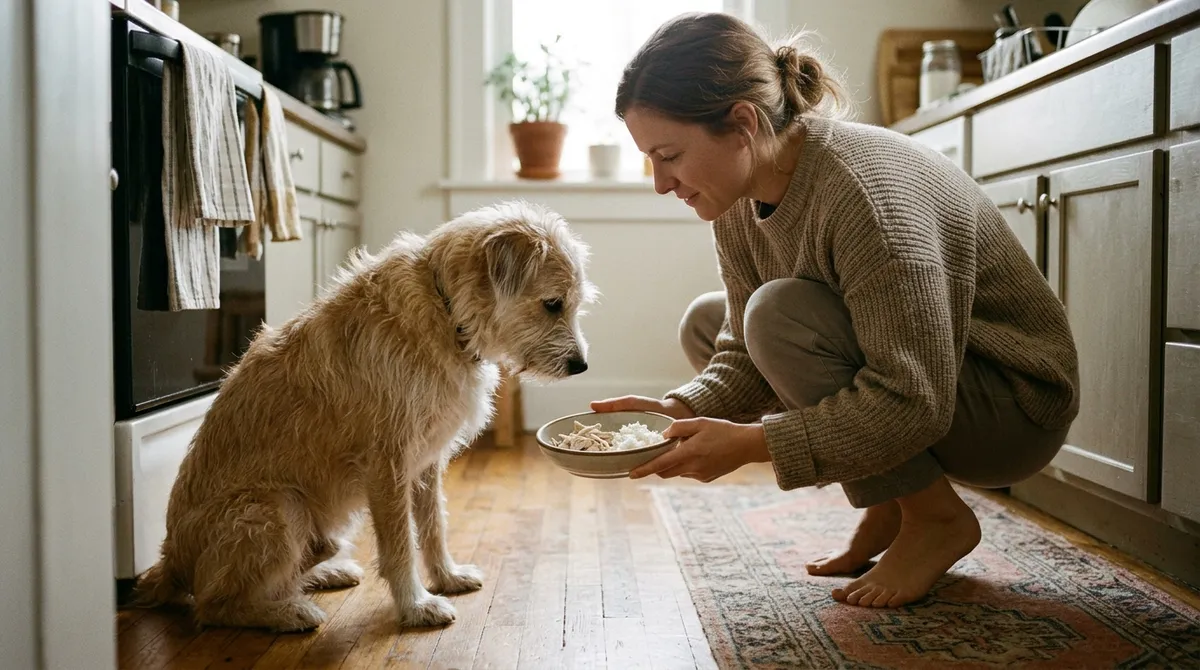
- Light, simple food. The classic option is boiled chicken with no skin, no bones and no seasoning at all, with well-cooked rice. No salt, garlic, onion, milk or fat. If the vet recommended another diet, stick with theirs.
- Start with a spoonful and wait a bit to see if it stays down.
- Stayed down? Offer another small portion, several times through the day, instead of a full plate.
- The next day, mix in the usual food with the light food and increase the proportion over a few days. Going straight back to a full bowl is asking for another rug to wash, and an abrupt food change, on its own, already causes vomiting.
- Threw up again when eating resumed, or refused even the light food? Call the clinic.
My dog throws up whole kibble right after eating: vomiting or regurgitation?
The dog finishes eating, drinks water and a minute later the kibble is back on the floor, intact. Plenty of people write something like “I think mine is regurgitating, he's a glutton.” It may well be.
The difference is in the effort:
- Vomiting is active. The dog gives warning first: gets nauseous, drools, licks their lips, retches, and you see the belly contract hard.
- Regurgitation is passive. The food comes back from the esophagus with no belly effort, almost dribbling out, usually soon after eating. It comes up undigested, covered in mucus and sometimes even tube-shaped.
When you're not sure, film it. The difference matters because vomiting and regurgitation have different causes and different tests, and because regurgitation carries its own risk: the dog can pull food into the lungs and get aspiration pneumonia.
For the glutton that brings it back from rushing
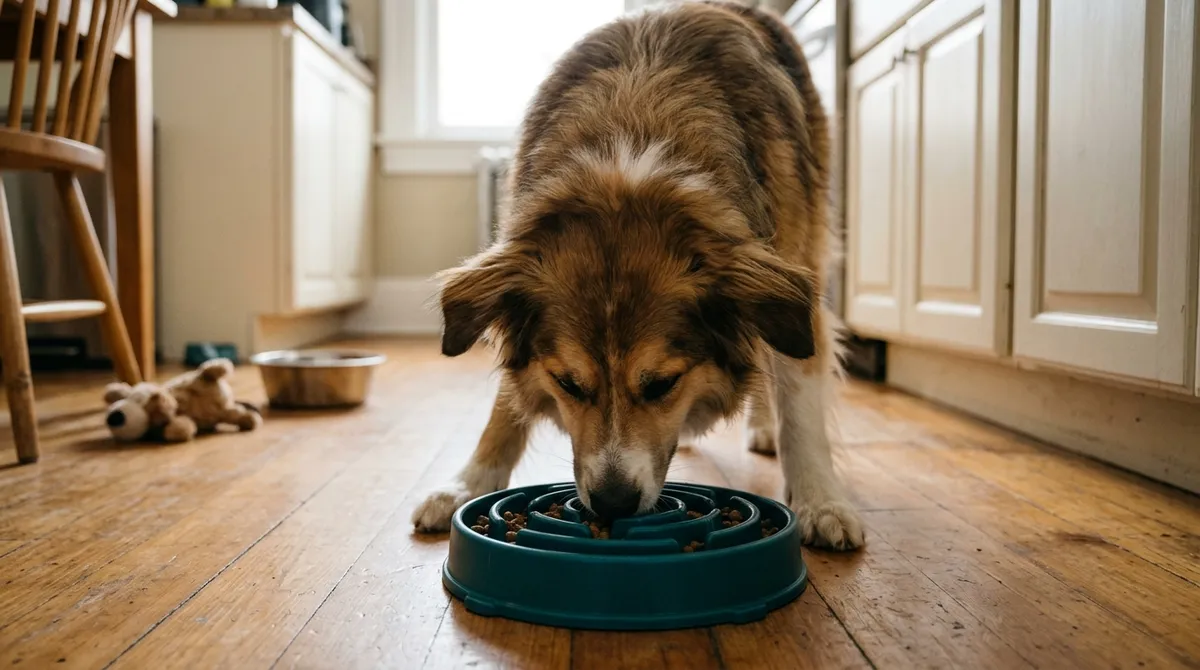
- Split the daily portion into three or four smaller meals.
- Use a slow feeder, the kind with obstacles on the bottom that make the dog hunt for the kibble.
If even when eating slowly the dog keeps bringing food back, a vet visit goes into the plan.
Puppy that seems to be choking and senior dog that brings everything back
A 2- or 3-month-old puppy that regurgitates and seems to choke beforehand, and a senior dog that has started bringing back everything they eat, are not cases for a slow feeder and patience. Repeated regurgitation at these ages calls for a vet, both because of the cause and because of the risk of pneumonia. Bring the video.
What the color of the vomit means
Color gives a clue, not a diagnosis. Vomit may contain bile, food, foam, blood or remains of what the dog ate, such as grass, bone or a piece of an object.
Bright red blood or a coffee-ground look (dark brown, granular): emergency, go to the vet. A piece of plastic, fabric, bone or toy: your dog may have swallowed something that got stuck, and that is also a vet visit.
Dog throwing up yellow in the morning
The dog goes the night without eating and in the morning there's that yellow slime on the floor, sometimes with foam. Usually it's bile from an empty stomach. Many owners say it improved when they split the food into more meals, with a small portion close to bedtime, so the stomach isn't empty for so many hours. It's a common tip and carries no risk, so it's worth trying.
But if the yellow in the morning keeps showing up even with the food split, book an appointment to rule out another cause. And if it comes with a sad dog that won't eat, don't even wait: call today.
Dog throwing up white foam: it isn't always hunger
It can be an empty stomach, yes. But the foam sometimes doesn't even come from the stomach: coughing, heart disease, pneumonia and tracheal collapse can also end in a small puddle of foam.
That's why anyone searching “my dog keeps coughing and throwing up” needs to look carefully. If there's coughing, a choking look or different breathing along with the foam, the problem may be in the chest, and the way to go is the vet. Repeated foam with a swollen belly, retching or restlessness goes back to the gastric torsion alert.
For any other color or texture you don't recognize, the rule is simple: photograph it, note the time and show it to the vet.
Could it be parvovirus, poison or something swallowed?
It could, and each one shows up in its own way.
Parvovirus. Mainly hits puppies and unvaccinated dogs. The typical sequence starts with lethargy, then less appetite and vomiting, then diarrhea, often bloody and with a strong smell. If you were searching “my dog keeps throwing up and has diarrhea” and your dog is a puppy or isn't fully vaccinated, they need to be tested, without waiting. If another dog in the home got sick or died with the same symptoms, say so in the first sentence of the call.
Poison. Any suspicion of poisoning is an emergency, and most cases happen without the owner seeing. You only find the torn box afterward. If there's a chance, don't wait for things to get worse to confirm. Bring the packaging along if you find it, and don't try to induce vomiting at home: deciding that is the vet's job.
Swallowed object. The good news: most sudden vomiting isn't an obstruction and passes on its own. But if you know or suspect your dog swallowed the sock, the bottle cap or the mango pit, seek care, even if they seem fine. The 36-to-48-hour window for the object to “pass” that circulates out there applies to cases monitored with X-rays at the clinic, not to waiting at home.
Can I give human medicine for vomiting?
No. No human medicine without the vet's guidance, not what's left in the drawer, not the home remedy from the neighborhood group: tea, oil, a mixture “to calm the stomach.” The wrong medicine can do harm on its own, and vomiting that is forced to stop can hide precisely the sign the vet needed to see. If your dog needs medication, the one who chooses which and how much is the vet who examined them.
What will the vet do?
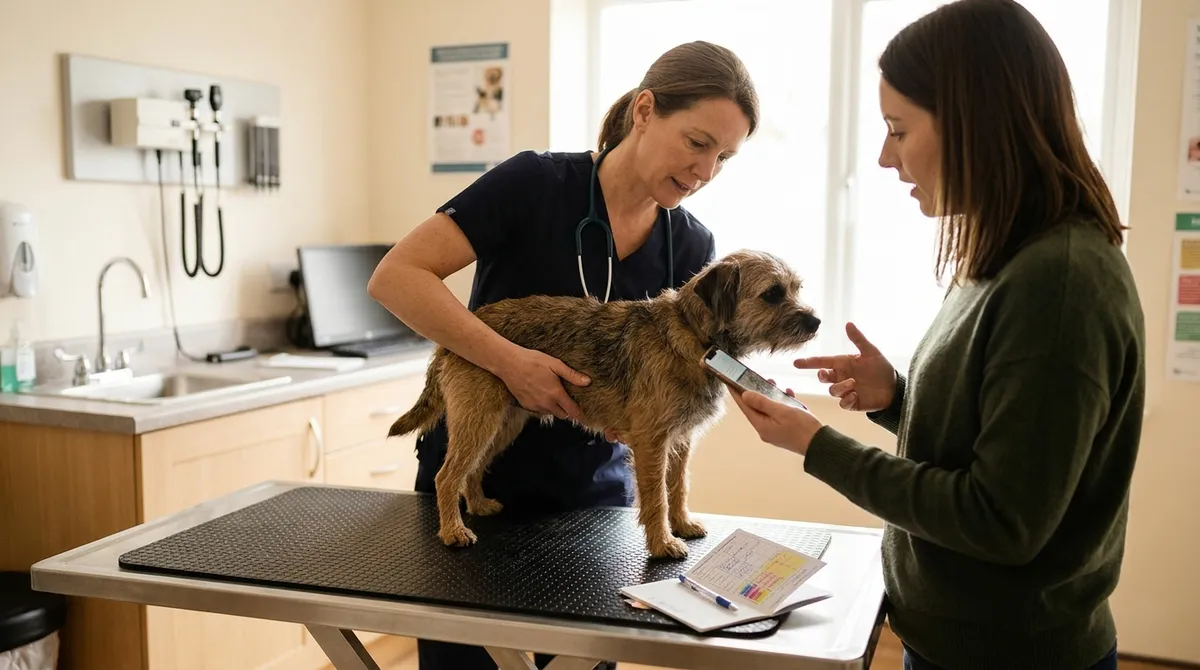
It depends on what they find in the exam. When the vomiting continues, the vet may order blood, urine and stool tests, and X-rays. In cases that drag on for a long time, endoscopy and biopsy may come in.
To make the visit count, pack a small bag before you leave:
- the note with the times, how many times your dog vomited and what came out each time;
- the photos of the vomit and, if you have it, video of the retching, coughing or regurgitation;
- what they ate in the last hours and whether they got into trash, plants, toys or medication;
- whether they peed and pooped, and what the stool looked like;
- the vaccination record, especially for a puppy.
Summary: watch, call or rush
- Watch: threw up once or twice, still playful and alert, an otherwise healthy adult. Food withheld for 6 to 8 hours, water in sips, then light food in small portions.
- Call: the vomiting repeats, goes past a few hours, comes with refusing food, or your dog is a puppy or senior.
- Rush: retching with nothing coming out, swollen belly, blood, lethargy, pain, suspected poison or object, can't keep even water down.
- Never: cut off water on your own, give human medicine or a home remedy, or think “nothing came out, so it isn't serious.”
When in doubt, ask the question from the start: does your dog look sick? If yes, the rug can wait. Your dog can't.
Sources
This text was written from the sources we consulted in October 2026:
- Vomiting in Dogs — Merck Veterinary Manual
- Disorders of the Stomach and Intestines in Dogs — Merck Veterinary Manual
- Gastrointestinal Obstruction in Small Animals — Merck Veterinary Manual
- Gastritis in Small Animals — Merck Veterinary Manual
- Vomiting in Dogs — VCA Animal Hospitals
- Common Emergencies in Dogs — VCA Animal Hospitals
- When to See the Vet and When to Treat at Home — American Kennel Club (AKC)
- Tummy Troubles: When Does Dog Vomiting Require Veterinary Care? — American Kennel Club (AKC)
- Dog Vomiting: Causes, Diagnosis, and Treatment — American Kennel Club (AKC)
- Vomiting in Dogs vs. Regurgitation: Everything You Need to Know — American Kennel Club (AKC)
- Why Is My Dog Throwing Up White Foam? — American Kennel Club (AKC)
- Vomiting or Regurgitation in Dogs and Cats? — Veterinary Partner (VIN)
- Gastric Dilatation and Volvulus (GDV) in Dogs — BluePearl Pet Hospital
- GDV (Gastric Dilatation Volvulus) in dogs — PDSA
- Parvovirus: Transmission to treatment — Cornell University College of Veterinary Medicine
- Dog Vomiting: Causes, Treatment, and When To Worry — PetMD
- Dog Vomiting, Diarrhea, Shaking or Not Eating: When to Call a Vet — Pieper Veterinary
- Vômitos frequentes em cachorros: quando se preocupar e levar ao veterinário — Hospital Veterinário LeVet