
Why Does My Cat Bite Me? What Your Cat Is Warning You About and How to Make It Stop
Why does my cat bite me? Almost always for one of these reasons: the petting went past what your cat can take, play picked your hand or foot as prey, your cat got worked up over something it can’t reach (the neighbor’s cat in the window, say), or it got scared. Pain is on the list too, especially when the biting is new. What to do today: stop petting at the first sign of discomfort, take hands and feet out of the game, leave the worked-up cat alone in a quiet room and, if the bite broke your skin, wash it with soap and water and see a doctor.
If your hand is still throbbing, breathe. Your cat isn’t crazy or mean, and your cat likes you. It warned you first, in a language of ears, tail and pupils that you can learn.
The four types of cat bites, and which one is yours
A cat that bites its owner usually falls into one of four boxes, and each one needs a different plan:
- Fear. Your cat feels cornered and defends itself: body crouched, ears flat against the head, hissing.
- Petting. You’re stroking, your cat is purring and, suddenly, chomp.
- Redirected. Your cat gets upset about one thing and takes it out on whoever is nearby. This is the famous bite “out of nowhere.”
- Play. An ambush in the hallway, a pounce on your ankle, a foot under the sheet turned into a mouse.
The most useful clue is sound. During play, a cat almost never hisses or growls: it arrives silent, like a hunter. Did you hear that “fffff” or a low growl before the bite? Cross play off the list and think fear, irritation or pain.
And you can forget the so-called “dominance”: a cat bite is not a contest over who runs the house.
Why does my cat bite me when I pet her?
The scene is so common it looks scripted. Your cat climbs into your lap, turns around twice, settles in and purrs like a little motor. You stroke the back once, twice, five times. On the sixth stroke, your cat whips its head around, sinks its teeth in and jumps to the floor as if nothing had happened. Sometimes it’s a light nip; sometimes it leaves a mark.
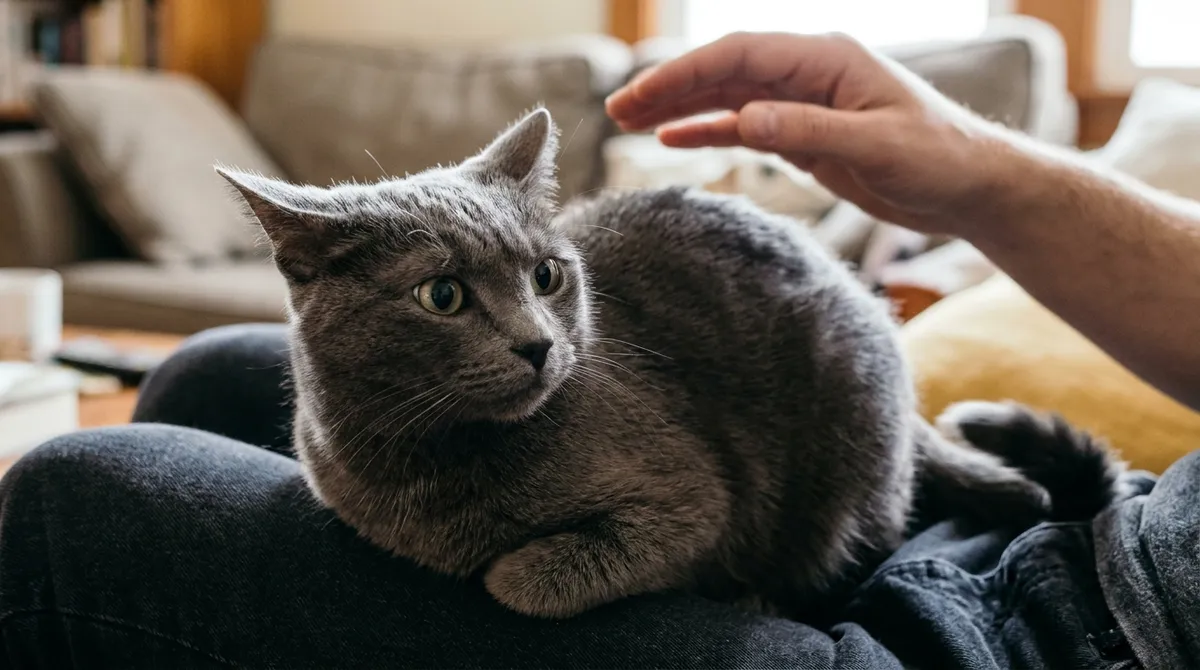
It wasn’t betrayal. It was overload. The nice petting from the start builds up, like tickling that stops being fun; repeated touch in the same spot excites, bothers and sometimes even gives a little static shock in the fur. There’s also the conflicted cat, who wants to be near you but doesn’t want to be touched. And there’s the location: cats groom each other on the head and neck, and back, tail and belly are another story. This bite shows up more in males.
By nature, cats aren’t big on physical contact, and some bite to avoid being handled while sleeping or eating. You’re in good company: a 2024 article by behaviorists at NC State shows that biting during petting accounts for about 40% of the feline aggression cases seen by those specialists.
Why does my cat bite me then lick me? The so-called love bite
A seven-year-old female cat licks her owner’s hand devotedly and, mid-lick, bites. Treat this love bite for what it is: the same overstimulation as in petting, with a warm-up lick beforehand, and the same plan, right below. The exception: if she has tolerated petting all her life and only now started biting, it may be pain, and that conversation has its own section further on.
The signs that a bite is coming
A cat rarely bites without warning. It warns you silently, while we’re watching TV. Watch for:
- head turning quickly toward your hand;
- tail twitching or lashing, even if only the tip;
- ears flattened or rotating back and forth;
- skin on the back rippling, as if a wave were passing through;
- dilated pupils;
- stiff, restless body, eyes fixed on your hand.
See one of these? Stop, no “just a little more.”
How to teach your cat to accept more petting
You can stretch your cat’s patience. The treat-based petting training fits on the sofa:
- Count. How many strokes does your cat accept before biting? Say it bites on the eighth or ninth.
- Stop early. Give five strokes, stop and offer a treat. Five, treat, done.
- Stay on the head. Cheeks, chin, behind the ears. The back can wait, if your cat wants it later.
- Go up one at a time. After a few calm days, move to six. A few more days, seven. Always stopping before the limit.
Bitten anyway? Take your hand away, stop touching and ignore your cat for 5 to 10 minutes, without scolding. Your cat learns that biting ends the party.
A belly up is not an invitation
“But he showed me his belly!” says the owner, hand trapped between four paws and a mouth. A cat on its back may be relaxed, but may also be in a defensive position, with all four weapons pointed at you, and even a truly relaxed cat can react badly when someone touches there. Read the belly as “I’m comfortable around you,” never as “you may touch.” Petting goes on the head.

Why does my cat bite me when I walk by? Play biting: feet, hands and the middle-of-the-night attack
You go to the kitchen for water at two in the morning, in socks, in the dark. In the middle of the hallway, a shadow comes out from behind the sofa, grabs your ankle, bites and runs. Welcome to the play bite, the most common cat bite on an owner: stalking, chasing, ambushing, pouncing and biting is the hunter in training. If no moving toy shows up, a moving foot will do. It’s much more common in kittens and cats under 2 years old, and it gets worse when:
- the kitten didn’t learn from its littermates. Playing with the litter is how a cat learns to measure its bite and keep its claws in. An orphan or a kitten weaned too early may never have had that class;
- it spends many hours alone without play, or it’s young and the only cat in the house, and the pent-up energy comes out on whoever walks in;
- someone played “grab the hand” when it was small and cute. The kitten grows, the bite grows with it, and it doesn’t understand why the rule changed.
Why does my kitten bite me at night?
“It’s obsessed with attacking my feet. I can only sleep with my feet out of the bed.” That’s the classic report of the 2- to 3-month-old kitten, who sleeps much of the day and turns into a hurricane at eleven at night. A foot moving under the sheet is, to a kitten, the best toy in the house.
The routine that gives the night back:
- A hunting session before bed. A real wand toy, running, jumping, until your cat tires out and loses interest. Let your cat catch the toy at the end, to close the hunt with a win.
- After the hunt, food. Hunt, eat, sleep is a cat’s natural script.
- A foot under the sheet is never a toy. Not by day, not “just a little.” If the foot is play by day, at night your cat will come to collect.
- Attacked in bed? Stay still, slowly pull your foot away and, if your cat insists, leave the room or put your cat outside for a few minutes. Prey that stops moving loses its charm.
The cat that jumps in your face in the middle of the night falls under the same plan: tiring play before bed and no excited reaction in the middle of the night, no laughing, no cuddling.
How to make your kitten stop biting your hands
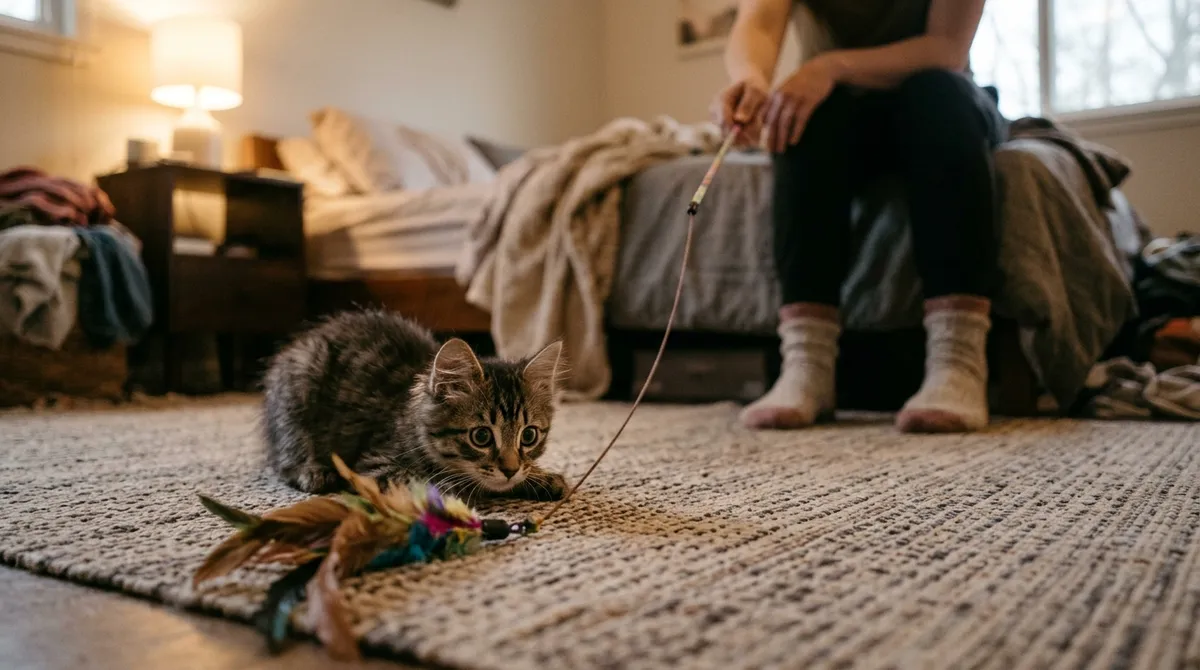
Hands aren’t toys, and neither are feet. This goes for everyone in the house, including the guest who thinks it’s funny. Every game goes through a moving object: a feather wand, a dragged string, a ball tossed down the hallway. And how you move it matters, because a still toy is a dead toy:
- Run from the cat. Real prey doesn’t come toward the hunter. Drag the feather away and stop suddenly, or hide it behind a cushion.
- Rotate the cast. Put some toys away and swap them from time to time.
- Play at attack time. Does your cat ambush you when you get home from work? The wand comes in through the door with you.
What if your cat sinks its teeth into your hand in the middle of play? Don’t pull: pulling is what prey does, and the bite tightens. Keep your hand limp and still, wait for your cat to let go and then ignore it or leave the room. Play ended because your cat bit, and that’s the lesson.
Would a second cat fix it? A lone young cat is more likely to take its energy out on you, but nobody can promise another cat will end the biting. Start with play and routine; the second-cat idea, and the question about neutering, are a conversation for the vet.
Why does my cat bite me for no reason? Is it crazy or mean?
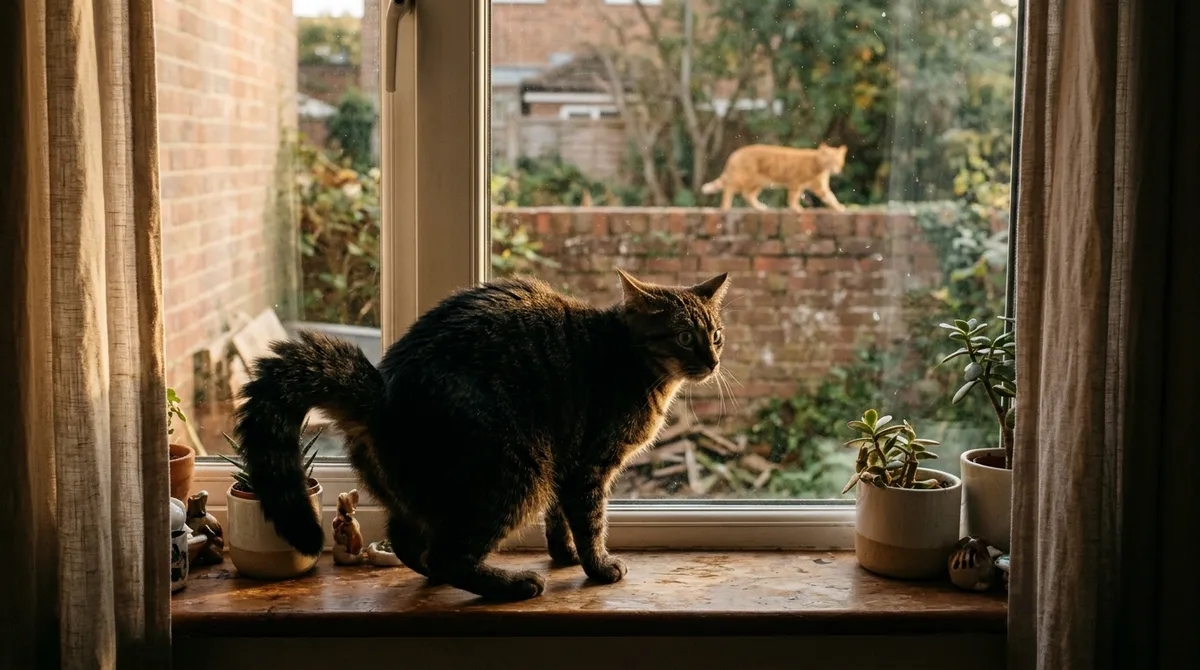
Neither. “It bites me really hard, draws blood. It’s out of nowhere, when I turn my back.” Picture the scene: late afternoon, your cat is at the window, tail puffed, eyes glazed. Outside, on the wall, the neighbor’s orange cat strolls by. You walk behind your cat and take a hard bite on the calf. To you, it was out of nowhere. To your cat, it was the peak of an anger that had been building for ten minutes, and you were the first thing that came within reach.
This has a name: redirected aggression. Your cat gets worked up over something it can’t reach and takes it out on whoever is near. It’s the type that scares people most, because it’s usually strong and comes from behind, and it accounts for about half of the cases of cat aggression toward people. The most common triggers:
- a stray cat seen through the window, the door or the fence;
- the smell of another animal on your shoe, clothes or backpack;
- a loud, sharp noise;
- you trying to break up a fight between cats.
And the effect lasts: after the scare, your cat may stay worked up for hours, sometimes days. The attack at night may have started with the cat on the wall in the morning.
What to do in the moment
- No lap and no comforting. A very worked-up cat should not be picked up, not even to calm it down.
- Isolate. Take your cat to a quiet, dark, safe room until it returns to normal. To move it, use a thick towel, or open the door and let it go on its own.
- Cut the trigger. If it’s the stray cat, frosted film on the glass takes the intruder out of sight.
- Never break up a cat fight with your hand. Put a thick cushion or a piece of cardboard between them. A hand between two furious cats is an invitation to a redirected bite.
What about an adopted cat that used to live on the street?
These cats often bite out of fear. A kitten that is only handled by people after 14 weeks of age tends to be more fearful, and the street cat was often that kitten. No forced cuddling: let your cat come to you, offer treats, and the five-stroke training starts at one or two.
Scolding, spray bottle, clapping, flicking, scruffing: don’t
“I’m using a spray bottle, but she doesn’t listen.” She doesn’t listen because the spray doesn’t teach what you want. The cat doesn’t link the water to the bite. The cat links the water to you.
The safest path is to leave out of the plan everything that works through fright or pain: spray bottle, yelling, clapping, air horn, a flick on the nose, holding by the scruff while saying “no.” Punishment can increase the aggression and the fear, which are often the very cause of the bite, and can make your cat start avoiding you. At best, your cat learns not to bite in front of you; when you leave, nothing has changed.
And a slap at the moment of the bite? It makes things worse: physical punishment can cause pain-related aggression, and the hand that hits is the same hand that pets.
What works instead is dull and effective: read the signs, give your cat a toy for its teeth and end the interaction when it bites. Cats learn very well from what they lose.
Was calm and started biting: think pain
When a cat that never bit starts to bite, the cause is often in the body, and the first suspect is pain: tooth, arthritis, abscess, trauma. Hyperthyroidism, epilepsy, toxoplasmosis and rabies also change behavior. In an older cat, stiff joints, failing senses and a confused memory make patience with touch shorter.
Be more suspicious when the bite is new, when your cat bites when touched in a specific spot (hip, back, mouth) or when another change came along with it: eating less, hiding more, jumping less, changing how it uses the litter box. In these cases, the first step is a full exam at the vet, before any training, because no training can teach a cat to like being touched where it hurts.
A special case: a female cat that has just had kittens gets crankier in the first days after birth. It’s protecting the litter. Give her space and leave the petting for later.
Why does my cat bite me so much: the diary and the behaviorist
The bite diary
The tool that helps most costs a notebook. For every bite, one line: who was bitten, when, where and what happened in the half hour before (a visitor, a cat on the wall, the vacuum cleaner, you came in from outside smelling of dog). Something like: “Thursday, 10:10 p.m., bed, bit Ana’s foot. Before: was alone all afternoon, didn’t play.” In two weeks, “out of nowhere” becomes “at eleven, in the hallway, after spending the day alone,” and you know where to put the hunting session.
When the plan at home isn’t enough
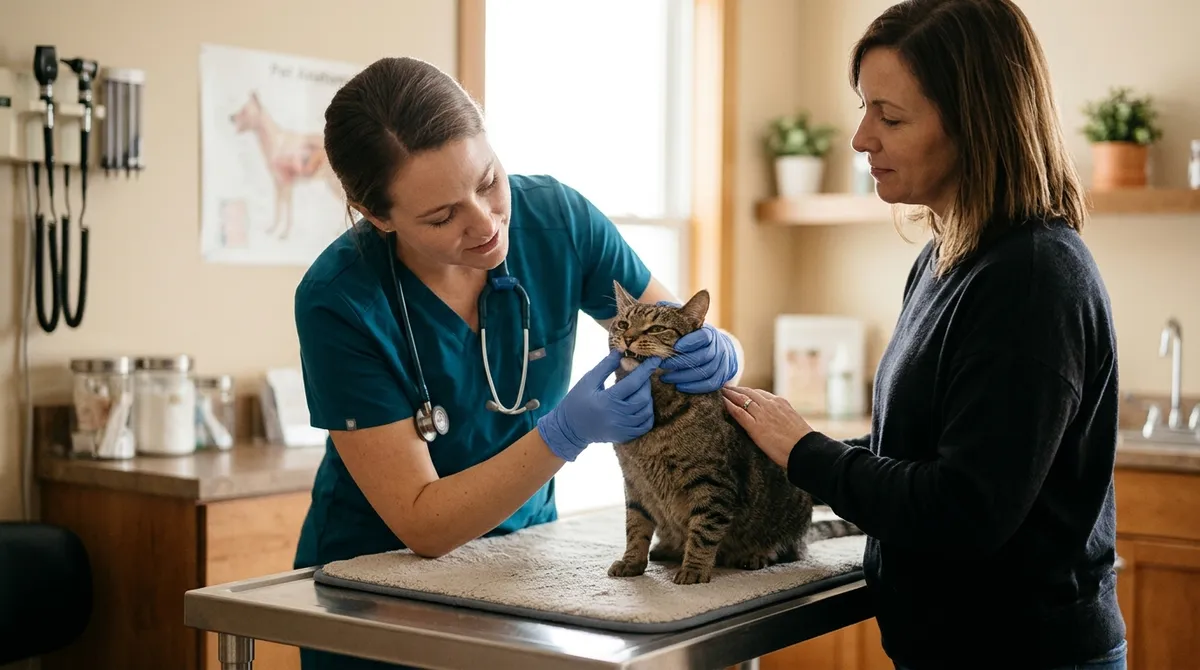
Sometimes you do everything and your cat keeps biting hard. It’s not your fault. It’s time for a veterinary behaviorist, and the sooner one steps in, the better the odds. Treatment follows five steps:
- Find the triggers and remove them. This is where the diary becomes gold.
- Rebuild the relationship with interactions your cat accepts and enjoys.
- Enrich the home: toys, shelves to climb, a scratching post, a safe window.
- Gradually get your cat used to the triggers, in small doses, each tied to something good, like a treat.
- Medication, if needed, always prescribed by the vet after evaluating the cat. Never on your own.
“I already took her to the vet and to the animal behaviorist and nothing.” It’s frustrating. But treating biting is weeks or months of work, and it only works with the whole household doing the same: nobody plays with hands, nobody scolds, everybody stops at the first sign. Go back to the appointment with two weeks of diary and ask to adjust the plan.
Are cat bites dangerous? When to see a doctor
They are, more than they seem, because a cat’s mouth carries plenty of bacteria: about 200 types. One of them, Pasteurella, lives in the mouths of 70% to 90% of cats. According to the Cleveland Clinic, 20% to 80% of reported cat bites become infected, and in one study 30% of people treated for a bite on the hand ended up hospitalized, on average for more than 3 days.
If the bite broke the skin: wash right away with running water and soap and see a doctor within 8 hours. You may need IV antibiotics and, in the most serious cases, hospitalization; the doctor will also check whether you need a tetanus booster.
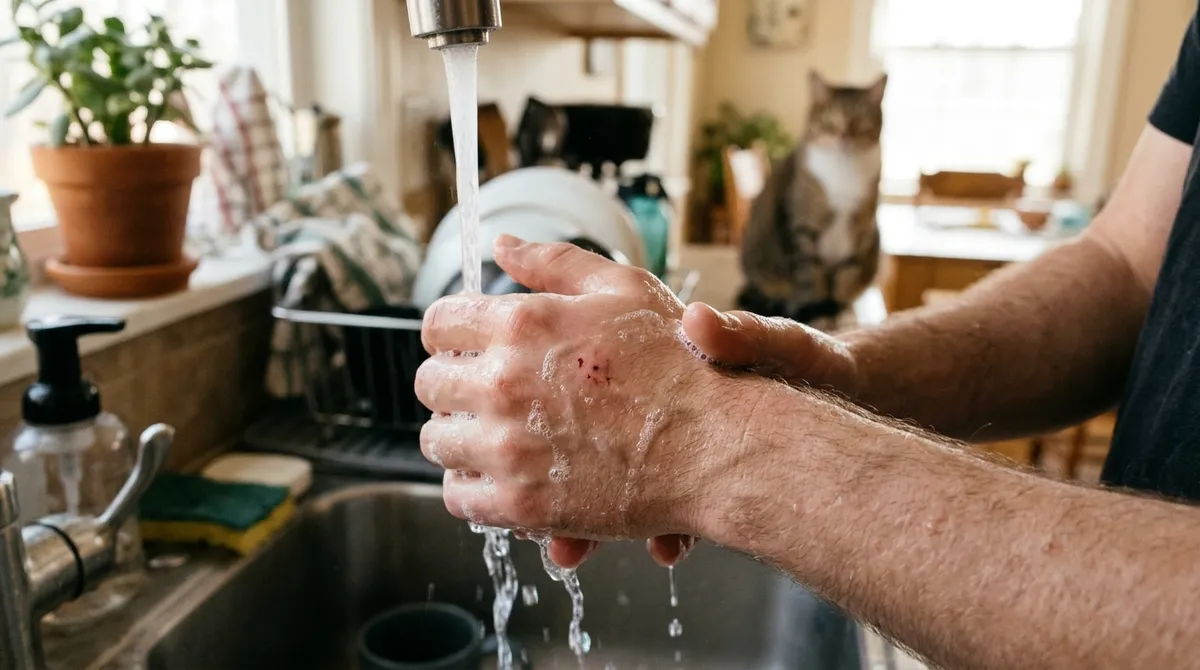
In the following days, redness, swelling, increasing pain or fever call for a doctor again. A Pasteurella infection can cause pain and swelling just a few hours after the bite, so don’t wait until the next day if your hand starts throbbing.
Who is at higher risk: people with diabetes, people with weakened immunity, older adults and children. For someone with diabetes who is often hurt by their cat, the rule has no exceptions: every bite that breaks the skin goes to a doctor within 8 hours, even one that looks small, while the plan with the vet continues without a pause.
A stray or unfamiliar cat: the bite requires a rabies risk assessment, and it’s the doctor who decides what to do.
Scratches count too. Cat scratch disease symptoms can take up to 10 days to appear. If the area swells or a fever shows up in that period, tell the doctor about the scratch.
Fridge cheat sheet
- A bite is almost never out of nowhere: look for the warning or the trigger.
- Lashing tail, ears sideways, wide pupils: hand away.
- Short petting, on the head, with a treat, one more stroke at a time.
- A belly up is not an invitation.
- Hands and feet are not toys. Hunt with the wand before bed, food afterward.
- Teeth in your hand: limp hand, wait for the release, leave the room.
- A very worked-up cat: quiet room, no lap.
- Never a spray bottle, yelling, slapping or scruffing.
- Was calm and started biting: vet before any training.
- Broke the skin: water, soap and a doctor within 8 hours.
The cat that bites the hand that pets it isn’t rejecting you. It was warning you all along, in the only language it has. Once you learn to read the warning, the bite loses its purpose and your lap goes back to being a place for purring.
Sources
This article was written from the sources we consulted in October 2026:
- Aggression in Cats — ASPCA
- Owner-Directed Feline Aggression — Today's Veterinary Practice
- Play and Predatory Aggression in Cats — VCA Animal Hospitals
- Behavior Problems in Cats — Merck Veterinary Manual
- Petting-Related Biting — The Anti-Cruelty Society
- Petting-induced and play aggression in cats — Animal Humane Society
- Overstimulation (Cats) — San Francisco SPCA
- AAFP Feline Behavior Guidelines — American Association of Feline Practitioners
- What To Do for a Cat Bite or Scratch — Cleveland Clinic