Why Is My Cat Throwing Up? What's Normal, What's a Warning and What to Do Now
Why is your cat throwing up? Because her stomach reacts to a lot of things: a hairball, something she ate and shouldn't have, an ingredient in her food that doesn't agree with her, worms and, in other cases, diseases of the intestines, kidneys or thyroid, or poisoning. The rule of thumb is simple. An occasional vomit in a cat who eats right afterward, plays and acts like herself can be watched at home. Vomiting that repeats the same day, comes back every week or shows up with any other sign of a sick cat calls for the vet.
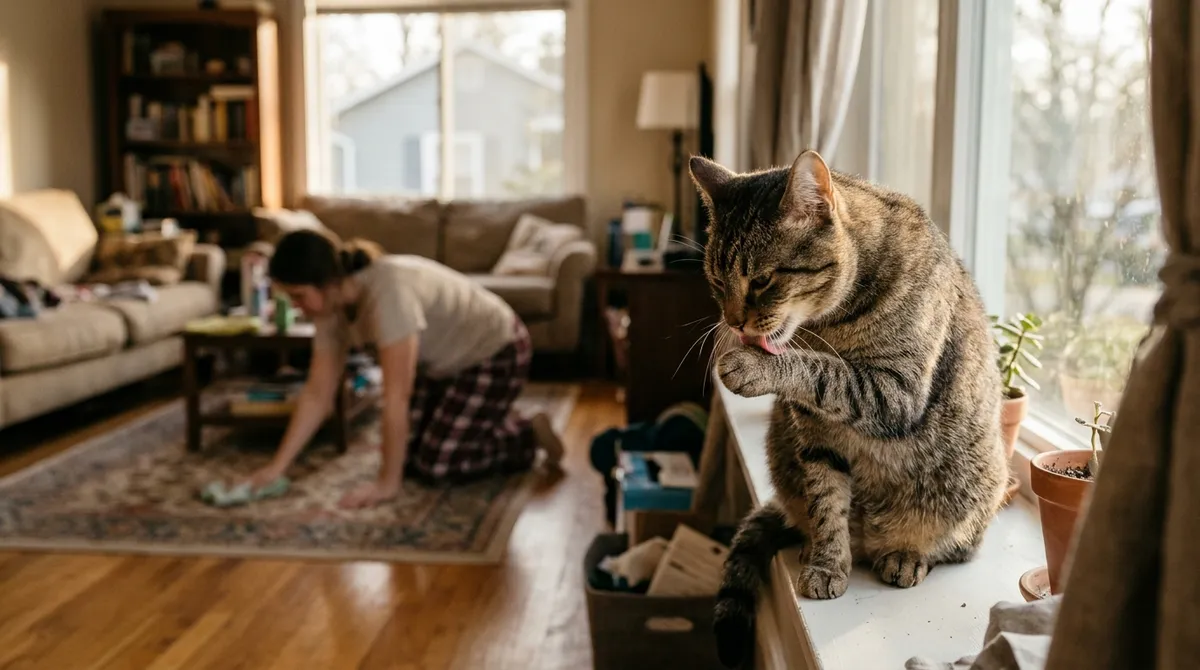
It's six in the morning. From the living room comes the sound every cat owner recognizes with their eyes closed: a rhythmic rumble, getting stronger, like a little engine sputtering. You jump out of bed, run to get her off the rug and arrive two seconds late. The puddle is there. And the cat? She's already sitting on the windowsill, licking a paw, watching the birds as if nothing happened. You stand there with a rag in one hand and your phone in the other, typing the usual question: is this normal? Do I take her in or not? Let's go through it step by step.
How often is it normal for a cat to throw up?
Cats throw up easily, and anyone who shares a home with one learns that early, usually by stepping barefoot in the wrong spot. A single episode in a cat who is otherwise well often means nothing, especially if what came out was mostly fur.
The danger lives in the phrase "cats just throw up," which lets many families spend years cleaning rugs without asking why. Vomiting is a sign that shows up in a cat who chewed a plant and in a cat with a serious problem alike. That's why what matters is the pattern. Keep three yardsticks in mind:
- In the week: a cat who throws up more than once a week needs to be evaluated, even if she looks great.
- In the day: the Merck Veterinary Manual considers vomiting more than once or twice in the same day a reason for a detailed exam.
- In duration: passing vomiting lasts less than a day or two, and many cases get better on their own within 24 hours. If the cat seems fine but keeps vomiting for more than a day or two, it's time to book a visit.
A little notebook makes a difference: without notes, "once in a while" is an impression; with them, you can see four times in the month, or three in the same week.
My cat threw up but is eating and playing: do I need to take her in?
Was it just once, did she eat at the usual time, chase the ball and nap in the sun? No need to rush out. Write down the date, the time and what came out, and go on with your day.
Just don't treat "she's eating well" as a clean bill of health. Some cats have always thrown up a little, eat eagerly, look great and gradually start vomiting more times a month. That's the profile that fools people the most, and it has its own section further down.
Is it vomiting, regurgitation or coughing?
To someone in pajamas in the living room, all three look like the same mess on the floor. To the vet, they are different paths.
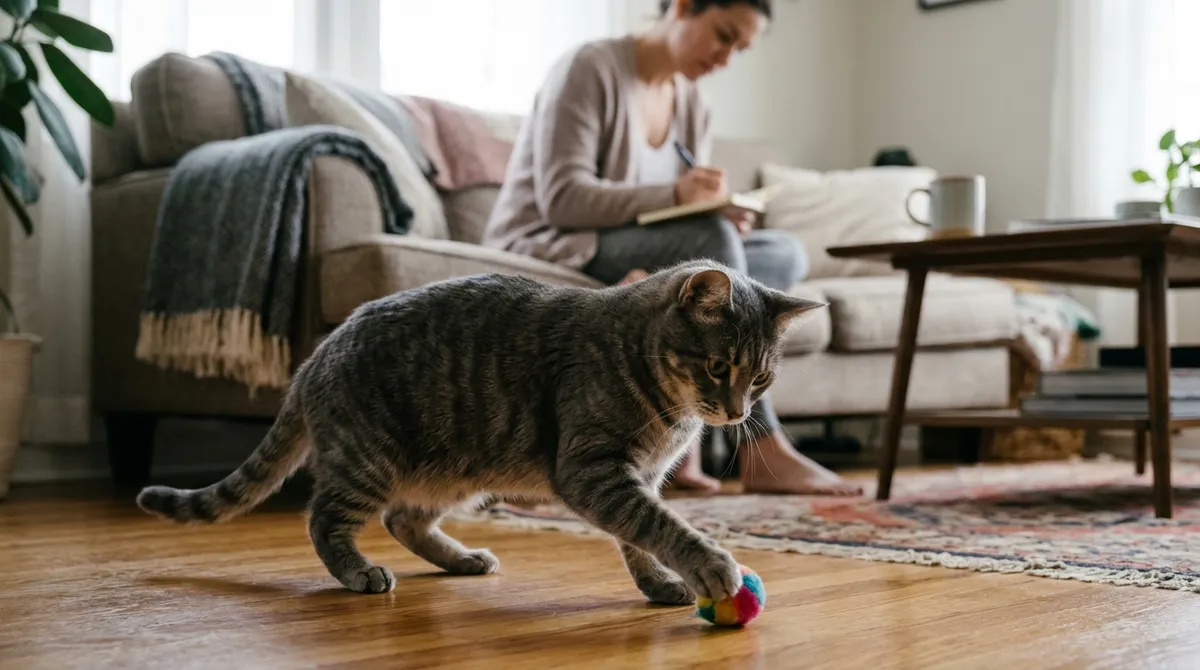
Vomiting is work. The cat gets restless, licks her lips, drools, swallows several times and then comes the retching: the belly contracts hard, in waves, and the whole body pushes. That's the rhythmic rumble in the early morning.
Regurgitation is no work at all. The food simply comes back up, fast, with no retching and no belly effort, often right after eating or drinking. What comes out is almost intact food, sometimes in a tube shape molded by the esophagus, the channel that carries food to the stomach. Regurgitation usually has to do with it.
Coughing fools everyone. The cat crouches on all four paws, stretches her neck forward and makes a dry sound. Sometimes a foam comes out, which she swallows again. Many people swear the cat "tried to throw up and nothing came out" when she was actually coughing.
Next time you hear the sound, grab your phone before the rag and film it. Ten seconds of video show the vet whether there was belly effort, whether it was passive or whether it was a cough.
Why does my cat throw up her whole meal right after eating?
You fill the bowl, she wolfs it all down in a minute, takes two steps and gives the whole meal back on the floor. "My cat eats very fast and then throws it all up" is one of the phrases that comes up most among owners.
Was there retching, the belly contracting? Then it's vomiting, and the causes are in the next section. Did the whole meal come out right after eating, with no effort? That's usually regurgitation, and it's worth testing at home, because it costs nothing:
- A slow feeder, the kind with obstacles in the bottom that make the cat fish out the kibble. If you'd rather not buy one, spread the food on a wide, shallow plate or in an empty ice cube tray.
- Smaller portions, more often during the day, splitting the same amount into three or four meals instead of one full bowl at once.
- One cat per bowl. If one eats in a rush while watching the other's bowl, separate the spots.
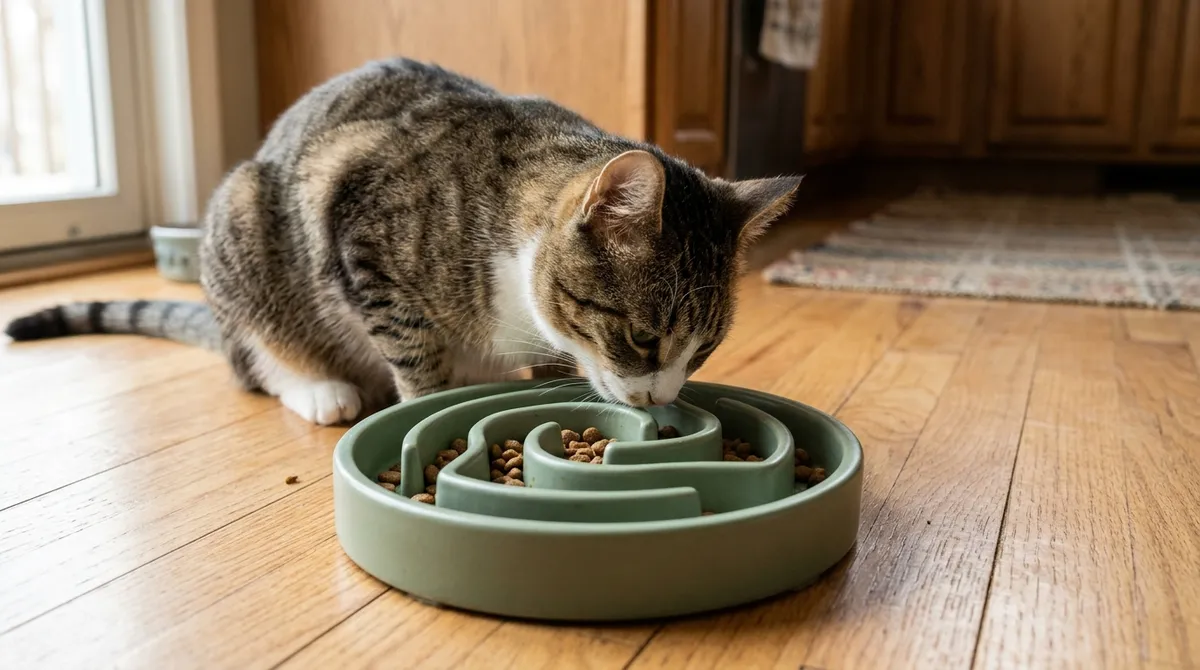
Give the test about two weeks and keep notes. Is the food still coming back even though she's eating slowly? Then the trick has run out: frequent regurgitation can come from an esophagus problem, and no feeder fixes that. It's a vet visit, with the video in hand.
"He throws up a hairball shaped like a cylinder"
Look at what's inside. A little roll of barely chewed kibble that came out with no effort looks more like regurgitation. If it's compact fur, the hairball conversation further down applies. In both cases, if it has become routine, don't treat it as normal.
The most common causes of vomiting in cats
The milder ones
Day to day, most vomiting comes from:
- hairballs;
- eating what she shouldn't have: plants, table scraps, spoiled food, insects;
- intestinal worms;
- intolerance or allergy to an ingredient in the food;
- spoiled food.
"Mild" means it's generally not an emergency and there's time to book a visit calmly. Worms still need treatment, and a food allergy needs investigation.
The household ones, which call for a walk-through with a cat's eye
Cats are curious, and whatever goes into their mouths tends to keep going down. These are among the causes of vomiting that can't wait:
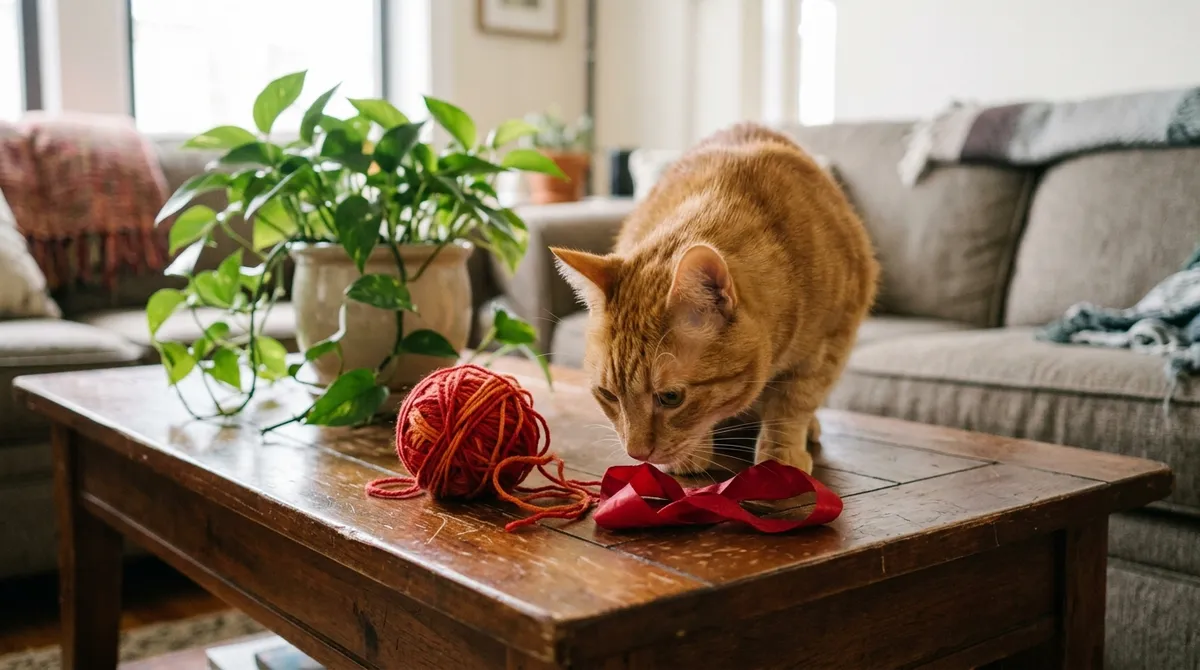
- string, thread, dental floss, gift ribbon and hair ties;
- small objects, like paper clips and bottle caps;
- human medication, including the pill that dropped on the floor without anyone seeing;
- chocolate and onion, including in an open trash can;
- toxic plants;
- antifreeze, in the garage.
Put away the sewing box, close the trash, pick up the pill packs from the nightstand. Suspect she swallowed something on this list? Go straight to the emergency section.
The diseases behind the vomiting
On the other side are the serious causes: viral or bacterial infections, obstruction from a swallowed object, poisoning, urinary blockage, pancreatitis, liver or kidney disease, thyroid problems, diabetes, constipation, inflammatory bowel disease and cancer. Without treatment, several of them can be fatal, which is why repeated vomiting isn't something to treat by guesswork. Notice the pee too: if she's started peeing much more or much less, tell the vet right away.
Why does my cat throw up saliva, white foam or yellow liquid?
Saliva and drool are usually nausea coming on. If the stomach is empty, what comes out afterward is just liquid and foam.
Yellow, foamy liquid usually contains bile, which shows up when the stomach is already empty. It's what you see, for example, in gastroenteritis, the inflammation of the stomach and intestines.
White foam can be vomit, and it can also be a cough. When in doubt, film it.
Color doesn't make a diagnosis, but it's a clue. A single small yellow puddle in a cat who is otherwise well falls under the "watch and write it down" yardstick. Has it become a habit? Book a visit, with a photo and the time of day it usually happens.
Are hairballs normal?
Here is the most comfortable myth on the list. "It's just a hairball" has been the explanation for a lot of sick cats.
The fur a cat swallows while grooming isn't digested and builds up in the stomach. Sometimes that clump hardens, irritates the stomach and can even block the intestine. Long-haired cats are at higher risk.
An occasional hairball in a healthy cat is common, but it isn't the rule: an editorial in a feline medicine journal estimates that about 10% of healthy cats vomit hairballs. In other words, most cats don't do it.
The safest approach: for an occasional one in a cat who is well, brush her and keep watch. If it becomes routine, more than one a month, or comes with another sign (weight loss, diarrhea, less appetite, more vomiting): see the vet. Frequent hairballs can be a sign that the cat is swallowing too much fur, from itching or fleas, or of a food intolerance or chronic intestinal disease.
Not every bit of fur in vomit is a hairball
A hairball is a compact little cigar of matted fur. Loose strands floating in a yellow, foamy or clear liquid are not a hairball: they're vomit that took fur along with it. Seeing fur and closing the subject is the shortcut that lets a lot of problems go unnoticed.
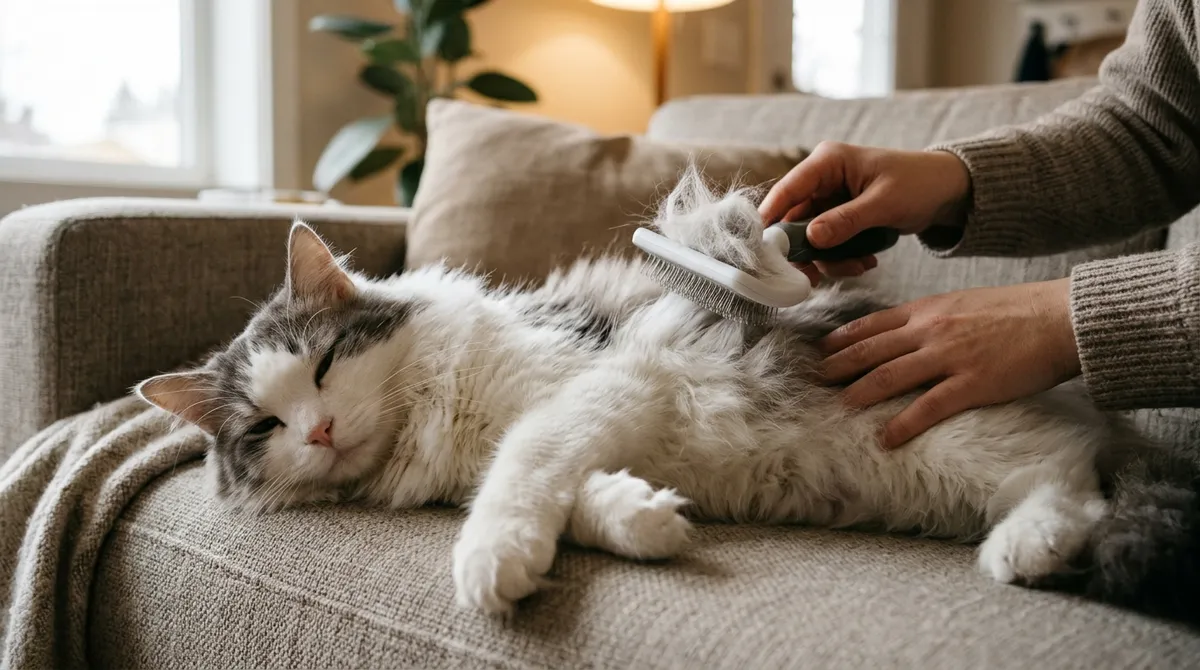
Brushing helps
Brushing often removes loose fur before it ends up in the stomach, especially in long-haired cats and during shedding season. Cat doesn't like it? Two strokes, a treat, done; tomorrow, four. Just don't use the brush as a substitute for a visit if the hairballs keep showing up.
She eats grass and throws up: is it to "cleanse herself"?
She chews the grass with all the concentration in the world and, minutes later, gives it all back, green, on the floor. Popular belief says it's on purpose, to cleanse herself.
The most accepted explanation is a lot duller: the cat eats it because she likes the taste, and it's the grass that irritates the stomach and causes the vomiting. She doesn't know she's sick and went to the garden for medicine.
A green vomit after a grass session, in a cat who is well, is nothing to worry about. Just check that it's really grass and not a toxic houseplant. And if she throws up without having eaten grass, or the vomiting has become routine, the grass is no longer the explanation.
She has thrown up now and then for years and now throws up more: could it be a disease?
It could, and it's the case that fools people the most. The story usually goes like this: the cat has always thrown up a little, everyone got used to it, "it's just how she is." Then she starts vomiting once or twice a month; later on, almost every day. And the whole time she looks well and eats well. It's the classic picture of chronic vomiting that isn't hairballs.
In most of these cats, the problem is in the small intestine. Among the causes are inflammatory bowel disease (IBD), common in cats, which can also bring weight loss, diarrhea, bloody stool, lethargy and less appetite, and intestinal lymphoma, a type of cancer. The two look so alike that often only a biopsy tells them apart.
If your notes show vomiting getting more frequent over the months, take her to the vet, even if she looks great. And weigh the cat now and then: slow weight loss isn't noticeable on your lap.
"He's thrown up since he came home, he's 5, and he's had about 6 ultrasounds"
It's understandable to be tired, but an ultrasound doesn't show everything. If the tests come back "normal" and the cat keeps vomiting, don't give up. Bring the complete history and ask the vet plainly: what is the next step to close the diagnosis? Sometimes the answer is an endoscopy with biopsy, sometimes it's a referral to a specialist.
It started after another cat arrived, or after neutering
"He kept vomiting for almost a month after the new cat arrived." It may be only a coincidence of dates. Whatever the origin, weeks of vomiting never explain themselves as a "phase" or "adjustment." Write down when it began and what changed in the home and in the food, and bring it to the visit.

When to take your cat to the vet urgently
This is the list that doesn't wait for the next day. Go right away, or call the clinic, if the vomiting comes with any of these:
- lethargy, weakness or the cat hiding, with no interest in anything;
- loss of appetite;
- fever;
- belly pain (she complains when touched or stays curled up);
- diarrhea;
- signs of dehydration;
- blood in the vomit;
- much more thirst than normal;
- a change in the amount of pee, more or less;
- weight loss;
- vomiting more than once or twice in the same day.
And also, even without any other sign yet:
- suspicion that she swallowed an object, such as thread, string, ribbon, a hair tie or a paper clip;
- suspicion of something toxic, such as human medication, a plant, chocolate, onion or antifreeze.
If you see a thread coming out of the cat's mouth or rear end, don't pull it. Call the clinic.
Vomiting together with diarrhea calls for double the attention: when both go past 24 hours, dehydration can set in fast. When in doubt between waiting and calling, call.
"I don't have the money for the vet right now"
It happens to a lot of people. You can take notes, film, make sure she has water and watch a single episode in a cat who is well. You can't wait when facing any sign on the list above: the minimum is to call a clinic and describe what you see, and that conversation often already tells you whether to go now.
University veterinary hospitals often see patients at lower prices, and it's worth finding the closest one before you need it. Giving medication on your own is never a way to save money.
What to do at home right after she throws up
If she has none of the signs on the emergency list, breathe. Here is the routine:
- Look at what came out before cleaning it up. Whole kibble, yellow liquid, foam, fur, blood, a piece of thread or plastic? Take a photo from a distance.
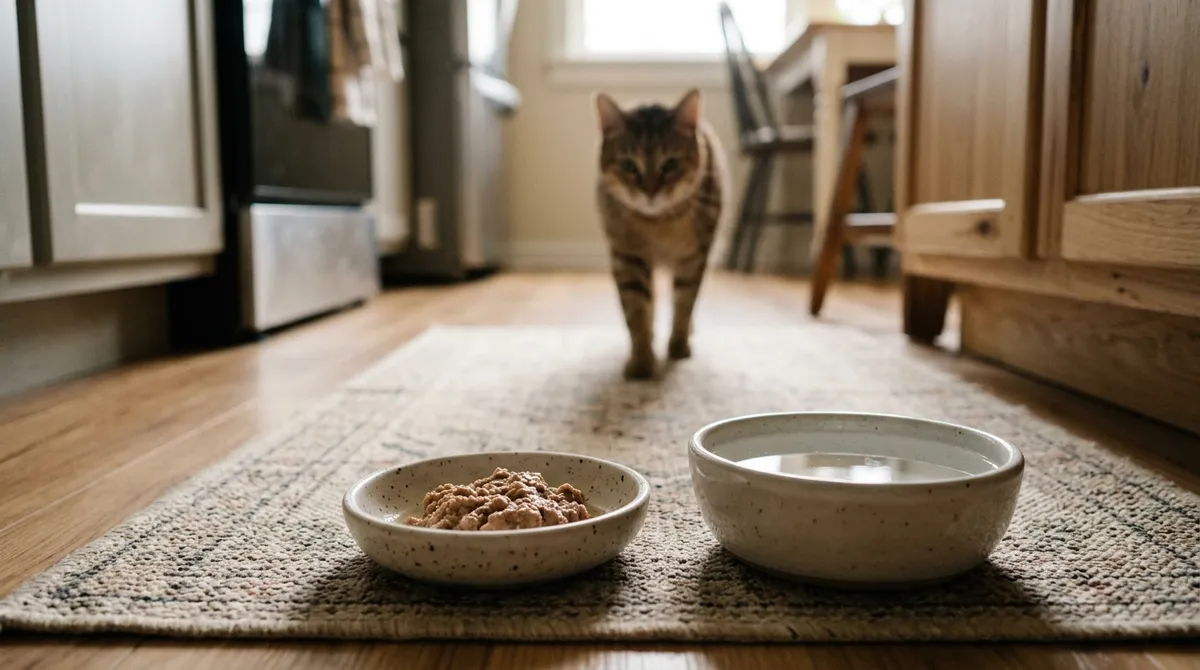
- Water always available. Never take the cat's water away: without it, dehydration gets worse.
- Write it down. Date, time, whether it was right after eating, how many times. It's what helps the vet most.
- Watch the next few hours. Back to normal, asked for food, peed and pooped? Or hiding and wanting nothing?
Should I take the food away?
Don't invent a fast on your own. Whether the cat goes without food for a while, and for how long, is the vet's call. When going back to food, the way is light, easy-to-digest food, in small portions and more often during the day, with no treats and nothing new during this period.
What not to do
The neighborhood group always has a recipe: homemade rehydration solution, tea, milk, the anti-nausea pill that worked on your kid. None of it. Human medication is on the list of things that make a cat throw up, and "just a little piece" doesn't change the math. Medication only what the vet prescribes, for that cat, after examining her.
And after treatment starts?
With treatment underway, the expectation is that the cat improves in a few days. If there's no improvement within 48 hours, tell the vet without waiting for the scheduled recheck: the plan may change or more tests may be needed.
How the vet investigates vomiting
Knowing what's ahead helps you arrive prepared. It all starts with the conversation, the history, and the physical exam. Depending on the case, these may be added:
- blood, urine and stool tests;
- X-rays;
- ultrasound;
- in some cases, endoscopy with biopsy, which in chronic vomiting is often the only test that identifies the cause.
Not every cat needs all of this. Since the investigation starts from the history, whoever arrives with material saves time and, sometimes, tests. Bring:
- your notes on date, time and frequency;
- the photos and the video of the episode;
- the brand of food, the treats and any recent change in what she eats;
- anything you noticed that's different in appetite, water, pee and poop;
- anything she may have chewed or swallowed.
Fridge cheat sheet
- One stray vomit, cat fine afterward: watch and write it down.
- Film the next episode.
- More than once a week: vet visit, even if the cat looks great.
- More than once or twice in a day, or for more than a day or two: vet.
- Vomiting with lethargy, blood, diarrhea, pain, fever or not eating: fast care.
- Thread, hair tie, medication, plant, chocolate: don't wait for any sign.
- Whole meal back up with no effort: may be regurgitation; slow feeder and smaller portions, and a visit if it continues.
- Hairballs more than once a month: vet. And brush the cat.
- Used to vomit a little and now vomits more: investigate all the way.
- Water always. Fasting only with guidance.
- Never human or homemade medication.
The cat will keep making the face of someone who has nothing to do with the puddle. The one who has to pay attention is you, and now you know what to look for.
Sources
This article was written from the sources we consulted in October 2026:
- Vomiting in Cats (Cat Owners) — Merck Veterinary Manual
- Vomiting in Cats — VCA Animal Hospitals
- Vomiting — Cornell Feline Health Center
- Inflammatory Bowel Disease — Cornell Feline Health Center
- Chronic vomiting in cats: it's really not hairballs (Proceedings) — dvm360
- Gastroenteritis in Cats — VCA Animal Hospitals
- Hair Balls in Cats: A normal nuisance or a sign that something is wrong? — SAGE Journals
- Bad hair day — SAGE Journals
- Hairballs — Cat Friendly Homes (American Association of Feline Practitioners)