Why Does My Cat Meow So Much? How to Stop It, Day and Night
Why does your cat meow so much? Because it is asking you for something (food, attention, an open door, a litter box that got shut away) and, almost always, because it has learned that meowing works. Sometimes the reason is pain, illness or, in an older cat, confusion. The path is the same in every case: meet the real need, rule out illness once, then stop rewarding the meow.
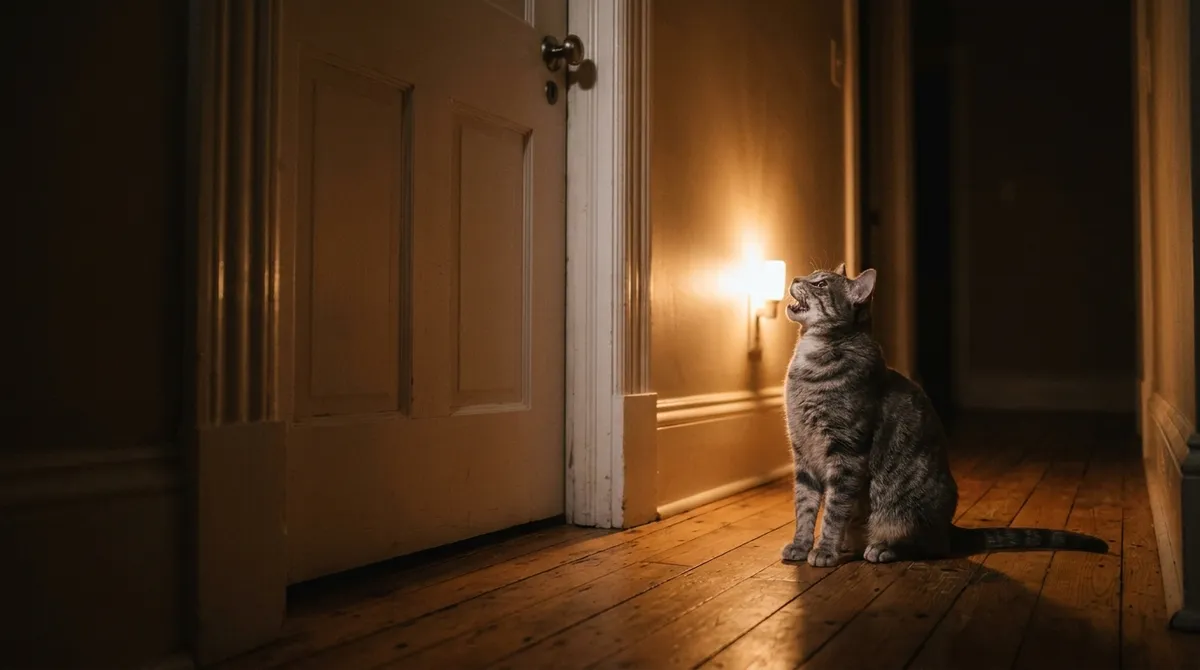
It is four in the morning. The cat sits outside the bedroom door and lets out that long meow that rises at the end like a question. You pretend to be asleep. It repeats, louder. You think about the neighbors, you think about illness, and, a little ashamed, you think that you just wanted to sleep. At six comes the second shift: the breakfast screaming. It can be fixed, and we will go step by step.
Cat meowing nonstop: check the basics first
A lot of insistent meowing is a request nobody answered. Do the rounds every experienced cat owner does in pajamas:
- Water. Did the bowl run dry, tip over or end up in a closed room?
- Litter box. Is it clean? A door closed at night is enough to leave it on the other side.
- Trapped cat. Closet, wardrobe, laundry room, balcony. A cat shut in by mistake will meow until someone finds it.
- Mealtime. Does the meowing always start close to the time someone usually serves food?
- Outside cat. Is a visitor prowling around the window or the wall?
- Heat. Is she an unspayed female? Or an intact male who can sense the neighborhood females?
A lot of nighttime meowing ends right here. If the rounds explain nothing, and especially if the meow is new or different from the usual one, read the next section before any other.
When meowing calls for a vet
Continuous or excessive meowing is not normal, even in a cat that has always begged for food loudly: it deserves a checkup before any training.
Go now, without waiting for daylight
- A changed voice with noisy or difficult breathing, a cat breathing with its mouth open, head low, or struggling or in pain when swallowing. The Merck Veterinary Manual warns that swelling of the larynx can form within hours and suffocate the cat.
- A cat that has always been quiet and suddenly meows a lot. The first suspect is pain, and pain is ruled out with an immediate visit.
- An older cat that seems to have gone blind overnight: bumping into furniture, missing jumps, meowing lost in places it has always walked. High blood pressure can detach the retina, and that is urgent.
Book a visit soon
- The voice changed and came with yellow or green discharge from the nose or eyes, squinting eyes or lethargy.
- It is not eating or drinking properly. Here the urgency goes up.
- The meow is new, changed in tone or became more urgent, for no reason you can find.
- The cat is middle-aged or senior and started meowing more. At this stage, pain, thyroid problems, kidney disease and high blood pressure are on the list, and only testing takes them off.
"I don't have money for the vet right now"
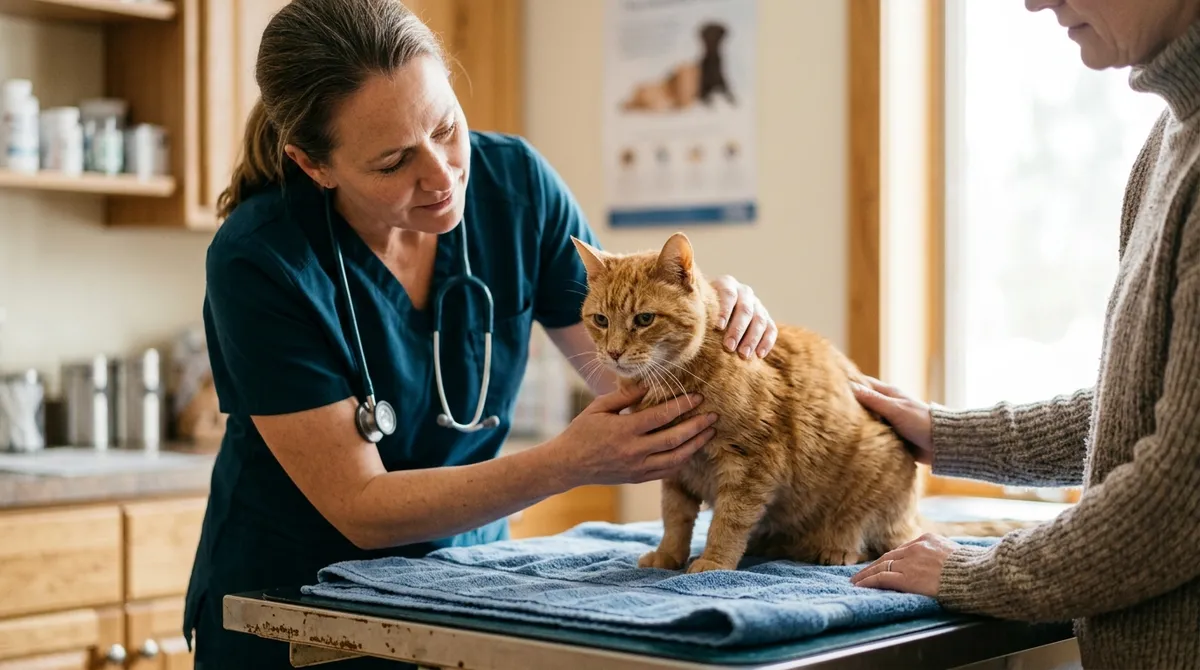
It happens. The first step costs one phone call: tell the clinic what you are seeing and ask whether it can wait. Write down when the meowing started, at what times it shows up, and whether the cat eats, drinks, pees and poops normally, and film the cat meowing and breathing. The "go now" signs do not wait until the end of the month. And medicating on your own is out of the question: it can hide exactly what needed to be seen.
Adult cats meow at you, not at other cats
Kittens meow to their mother when they are cold or hungry. Once grown, cats almost stop meowing at other cats and save the meow for people.
In other words, the meow is a conversation with you, and what you do in response teaches whether it is worth speaking again. Every meow that opened a door or filled a bowl was a lesson, and what was learned can be unlearned.
The exception is the yowl, that long, drawn-out, almost sung meow that adults use with each other during mating season. If that is the sound of your night, heat goes on the list of suspects.
And the kitten crying for its mother?
A newly arrived kitten that meows at night is calling for its mother. Two owner tricks usually help: a T-shirt or pillowcase you have worn in its bed, so it sleeps with your scent, and a warm (never hot) water bottle, well wrapped in a towel.
The most common reasons cats meow too much
Attention and food, and how we teach it without noticing
This is the champion. The cat meows, you look. It meows again, you say "what is it, baby?" It meows louder, you get up and fill the bowl. Done: it learned the recipe.
The worst part is that you do not have to give in every time. Giving in now and then keeps the habit strong, the same way a slot machine keeps a gambler hooked. Scolding counts too, because for many cats a "stop that!" beats being ignored. A cat that spends many hours alone also tends to meow more when the house fills up.
Heat, intact males and outside cats
A female in heat gets clingy, rubs on everything, rolls on the floor and meows a lot; an intact male who senses a female nearby paces back and forth and does not stop meowing (heat has its own section below). Even a neutered cat can spend the night meowing at the cat prowling around the house.
Siamese and other chatterboxes
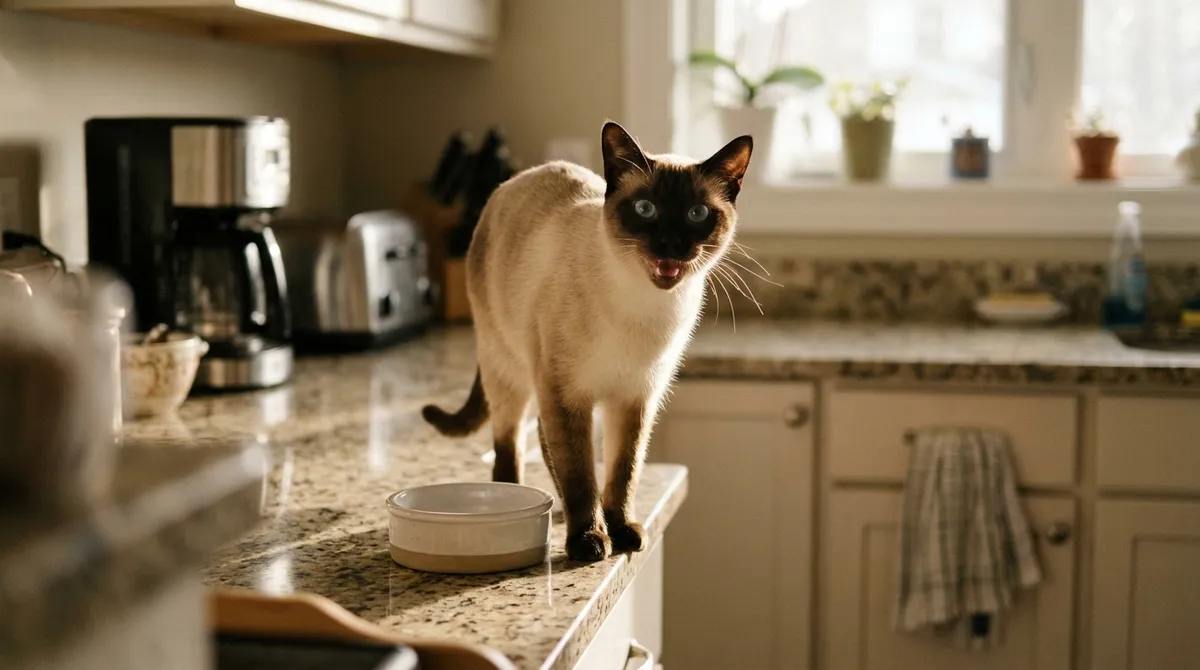
Some breeds meow far more than others, and the Siamese is the classic example. If yours has always been talkative, that is personality. What deserves attention is change: the chatterbox that got louder, or the quiet one that started talking.
Changes in routine or home
Work hours changed, a baby arrived, the furniture was rearranged, you moved apartments. Cats are creatures of routine and complain about change out loud.
Pain and illness
Illness can leave a cat abnormally hungry or thirsty, restless or irritable, and all of it comes out as meowing. With age, hyperthyroidism and kidney disease become more common and can cause excessive meowing, and so can high blood pressure. None of this can be confirmed at home; that is why the checkup comes before the training.
My cat yowls at night: why especially at night?
First, the myth: "cats are nocturnal." Not quite. They are crepuscular, most active at dawn and late afternoon, which are their natural hunting hours. Add the rest:
It slept all day. You left at eight and came back at seven, and it spent the day on the couch recharging its battery.
The night already paid off. It took only one time getting up at four to put food out and it wrote down the time.
The senses got weaker. A cat that sees or hears less sleeps lighter and wakes at anything.
The litter box got hard to reach. A cat that has to go more often and cannot find the box or get to it (closed door, stairs, high rim) wakes up and walks around the house calling.
Illness. Loud meowing at night is relatively common in cats with hyperthyroidism or high blood pressure.
So is it behavior or illness? In most homes the two get mixed together, and the safest path is simple: take the cat in for a checkup once. If the vet finds nothing, you work on behavior with a clear conscience. If the vet finds something, you treated early something that has a treatment.
Older cat meowing loudly at night: is it dementia?
It could be. The fourteen-year-old cat starts pacing the living room at three in the morning, letting out a loud, mournful meow, staring at the wall. There is a condition similar to Alzheimer's, feline cognitive dysfunction, and it is far more common than it seems: the ASPCA estimates it affects more than 55% of cats aged 11 to 15 and more than 80% of those aged 16 to 20. Disorientation shows up in at least 40% of cats aged 17 or older, and the signs are usually clear from about 10 years old.
The signs you see at home
- Seems lost in places it knows or stares fixedly at nothing.
- Has swapped day for night.
- Pees or poops outside the litter box.
- Meows more at night, louder, in a more urgent or mournful tone, for no apparent reason.
- Gets anxious in the small hours, afraid of being away from the sleeping family or of walking around the house in the dark.
"How did you detect that he has dementia?"
The vet confirms it, by exclusion. A diagnosis of cognitive dysfunction is only made after ruling out what mimics or worsens the picture: arthritis, tooth pain, thyroid disease, loss of vision or hearing, urinary disease and even cancer can produce the same night. So do not accept "it's just old age," not even from yourself. A lot of what looks like age is treatable illness.
In a study of 37 owners of senior cats with cognitive dysfunction who had started meowing more, owners attributed the meowing to disorientation in 40.5% of cases, to attention seeking in another 40.5%, to seeking food or another resource in 16.2% and to pain in 2.7%. This is the owners' perception in a small sample, not a diagnosis, but it shows that even in the confused cat, company and food are still in play.
The meow got hoarse or changed: is it serious?
It depends on what comes with it. The most common cause of a hoarse voice is a respiratory infection, cat flu, and the voice usually comes back anywhere from a few days to a few weeks after the infection clears. Smoke, dust and too much meowing itself also irritate the throat: a cat that spent three nights yelling can wake up hoarse because of it. Less common and more serious are a foreign body in the throat, an abscess, a tumor and laryngeal paralysis.
The rule of thumb: hoarse with noisy or difficult breathing is an emergency; hoarse with discharge, lethargy or not eating means a visit soon (both cases are in the vet section). And hoarseness with nothing else, but that does not improve, also deserves an evaluation.
How to make your cat stop meowing at night without being cruel
With illness ruled out and the rounds done, the work is about routine, and it starts during the day:
- Keep a diary for a week or two. Time of the meow, what happened before and what you did afterward. The pattern shows up fast: "always at 4:10."
- Fill its day. A toy that releases kibble gradually, a new cardboard box, a shelf at the window, short play sessions.
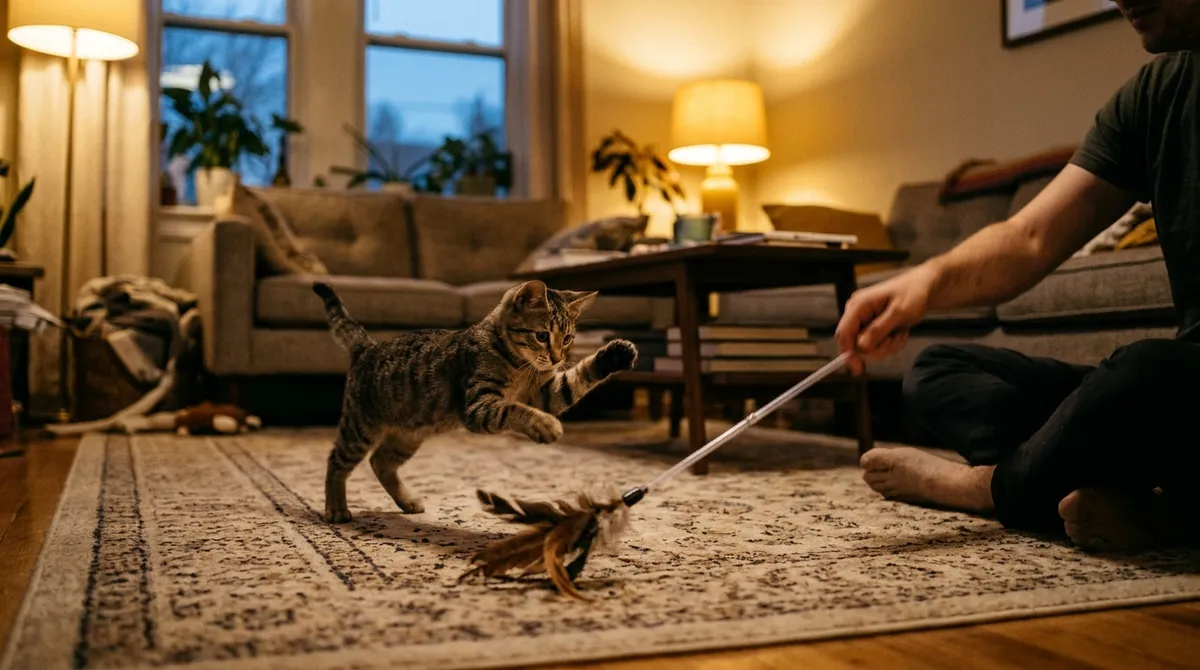
- Play hard before bed. Ten or fifteen minutes with a feather wand, letting it catch the "prey" at the end. Then, the last meal of the day. Hunt, eat, sleep is the cat's natural sequence.
- Get yourself out of the waiter role. An automatic feeder on a schedule makes the cat ask the machine, not your bed.
- Give attention only in silence. Quiet? Petting, talking, a treat. Meowing? Nothing, not even a look.
- Deal with outside cats. Frosted film or a curtain on the lower part of the window, and white noise in the room (a fan on is enough).
- Keep everything accessible. Water, food and litter box within reach all night, with no door in the way.
My cat meows in the morning for food: do I feed it or not?
"In the morning I have to prioritize him, or here comes the screaming." But serving food in the middle of the screaming teaches exactly the screaming, and tomorrow it starts earlier. Pick a fixed breakfast time and stick to it every day, weekends included. If your wake-up time varies, let the automatic feeder serve. And if you are the one serving, wait for a breath of silence, even three seconds, and only then put the bowl on the floor.
Do I ignore it or get up in the middle of the night?
Ignoring works, but only after you are sure nothing is missing and the cat is not sick. That is why the secret is the checklist before bed: full water, food served or feeder programmed, clean litter box with a clear path, doors open (or the cat in a comfortable room with a bed, water and litter box), nobody trapped in a closet, play done, vet already consulted.
Everything in order? Then you do not get up. Not even a "shh" through the door, not a scolding. If the meow sounds different from the usual request, frightened or in pain, then yes, you get up and check in silence, with no fuss and no food.
Scolding and spray bottles: no
Do not use them. Scolding is attention: if it meows to call you and you show up, even angry, it got what it wanted. The spray bottle silences it on the spot and teaches something else, fear of you. In an older or anxious cat, punishment increases the anxiety that makes it meow. What works is boring and simple: the meow brings nothing, silence brings everything.
It will get worse before it gets better
Warn everyone in the house. When the meowing stops paying off, it usually gets louder and more insistent for a while before it fades. It has a name: extinction burst. It is a sign the plan is taking hold, and it is on this night that almost everyone gives up. If you get up at the worst moment, you teach that the secret is yelling twice as loud. Hold through this phase. It passes.
"I've done everything and he keeps going"
Pheromones, neutering, toys, attention, and the cat keeps screaming. Almost always one of these pieces is missing:
- The pattern. Without the diary, you attack the wrong reason. A cat that meows for food does not get better with a toy.
- The whole house on the same rule. You ignore it, but someone gets up at five "just this once." To the cat, that occasional prize is the strongest there is.
- The checkup. If it has not been done, or if the meow changed after the last one, now is the time.
- Time. Pick one plan and hold it for weeks, including through the extinction burst.
Does free-feeding kibble solve it?
For some cats, yes. Dry food always in the bowl can end hunger meowing, but it only suits cats that do not gain weight easily, and only with your vet's approval. For most, the safe standard is a fixed schedule and an automatic feeder.
Older cat with cognitive dysfunction: what helps
If the vet confirmed the diagnosis, the house can become an ally:
- Predictable routine. Food, play and lights-out always at the same times, furniture in the same place.
- Pheromone in a diffuser or spray, near where it sleeps.
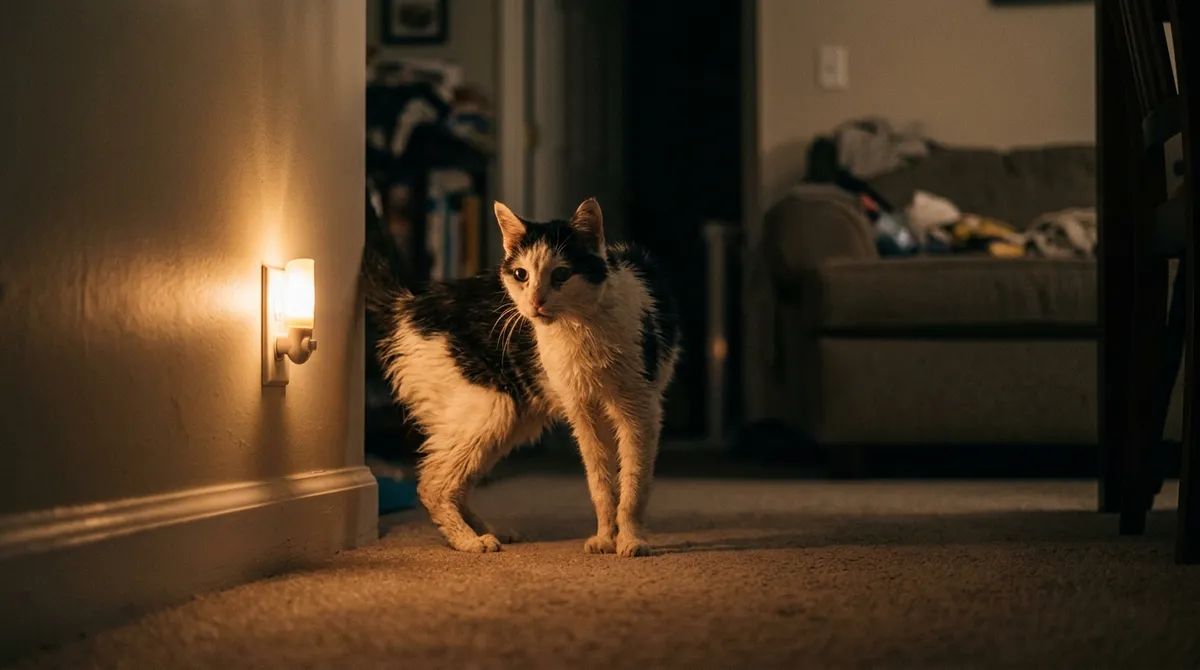
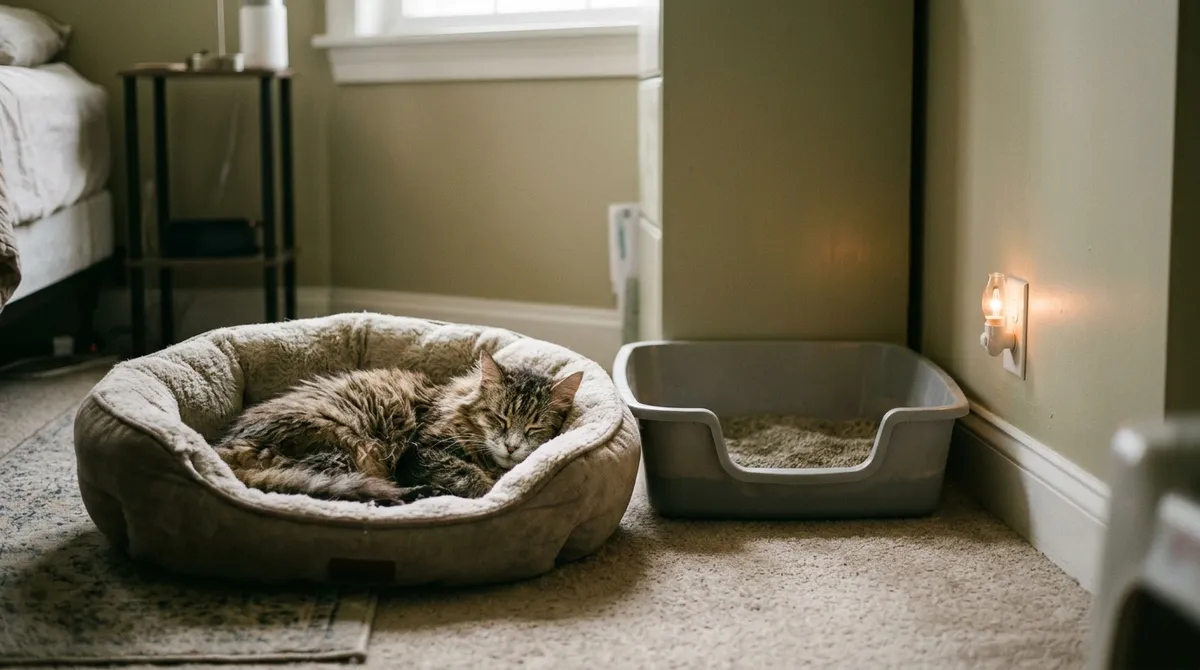
- Dim light at night in the hallway and near the litter box, so the dark does not frighten it.
- Easy litter box. Low rim, close to the bed, one on each floor if the house has stairs.
- Patience in your voice. Frustration and punishment make the senior cat more anxious, and an anxious senior meows more.
There is medication for some cases, and only the vet decides whether it suits and which one to use.
Female screaming: is it heat? Does spaying fix it?
If she is not spayed and the screaming comes with rubbing on furniture, rolling on the floor and extra cuddling, it is almost certainly heat. It lasts 4 to 10 days and, if she does not mate, comes back every 18 to 24 days. A cat that lives indoors can go into heat all year, so "waiting it out" is not a plan.
The intact male senses the female from far away and joins the same chorus. Toys, routine and scolding do not silence heat meowing. Spaying or neutering is the best way to end it, in both cases; talk to your vet about the best timing.
Moved house or stopped going outside: how long does it last?
The cat that used to go out to the yard hunting birds and now lives only indoors will protest at the door and the window, and this meowing can last weeks or even months. Moving house brings the same stress.
My cat meows at the door to go out: do I open it just a little?
Never. Opening the door "just so it stops" teaches, perfectly, that meowing at the door opens the door, and you restart the count from zero. Do the opposite: a screened window with a shelf, a hunting game every day, the old feeding times kept, and petting when it is quiet and away from the door. With consistency, the door meowing thins out. If it does not decrease over the weeks, or comes with other signs, go back to the vet section.
Summary to stick on the fridge
- Rounds first: water, litter box, door, trapped cat, food, outside cat, heat.
- Vet today: changed voice with difficult breathing, quiet cat that became a talker, older cat that seems blind.
- Visit soon: new meow, changed voice with discharge or lethargy, cat that is not eating, older cat meowing more.
- A full day, play before bed, food at a fixed time and in silence.
- Checklist before bed and, with everything in order, nobody gets up.
- Attention only in silence, with the whole house on the same rule.
- Scolding and spray bottles: no.
- It will get worse before it gets better. Do not give up on the worst night.
- Older cat: checkup first, then routine, dim light and an easy litter box.
- Heat: spaying or neutering fixes it. Door: never opened to silence a meow.
A cat that meows is talking to you, and only you. Once it discovers that the good conversation happens in silence, the night goes back to being for sleeping.
Sources
This article was written from the sources we consulted in October 2026:
- Meowing and Yowling — ASPCA
- Older Cats with Behavior Problems — ASPCA
- Cat Behavior Problems – Vocalization — VCA Animal Hospitals
- Cognitive Dysfunction — Cornell Feline Health Center, Cornell University
- Laryngeal Disorders in Cats — Merck Veterinary Manual
- Potential Causes of Increased Vocalisation in Elderly Cats with Cognitive Dysfunction Syndrome as Assessed by Their Owners — PubMed Central
- Continuous Meowing or Vocalization — Maddie's Fund
- Excessive Meowing — San Francisco SPCA
- Can Cats Lose Their Voice? — PetMD