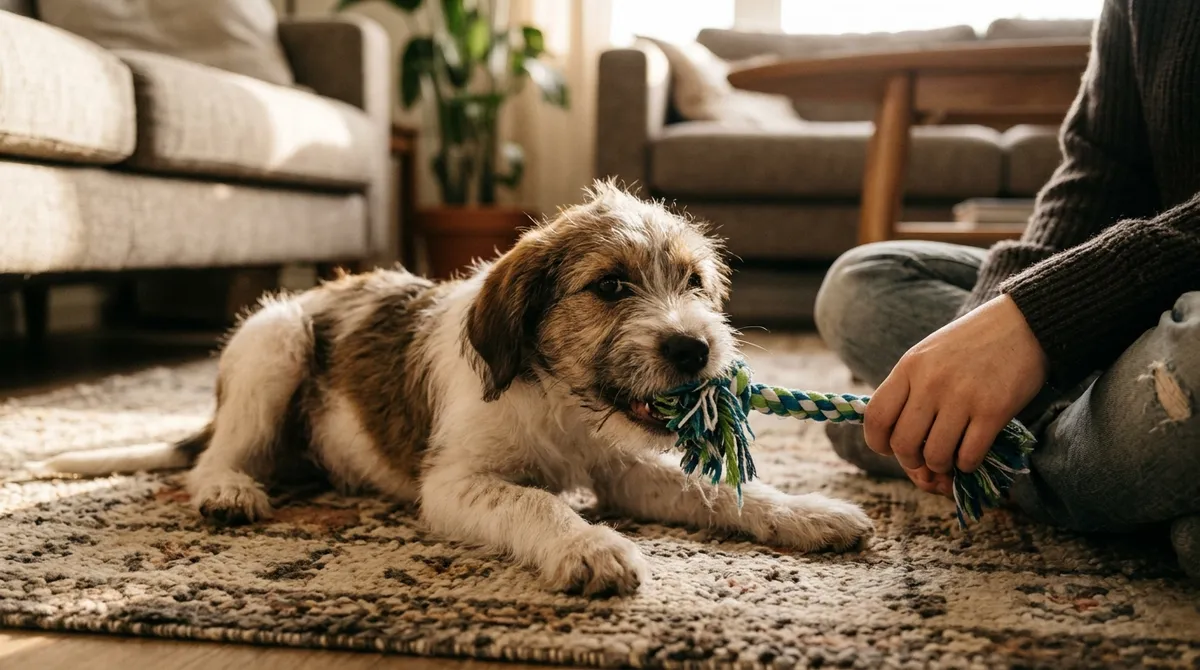
How to Stop My Dog Biting Me: The Plan to Save Your Hands and Shins
How to stop my dog biting me comes down to two stages: first he learns to control how hard he bites, then he learns that no teeth touch skin at all. Every bite pauses the game for a few seconds, a toy takes the place of your hand, and smacking, scolding and gripping his muzzle stay out of the plan.
It's seven in the evening. You sit on the couch to take off your shoes and, out of nowhere, that ball of fluff that slept all afternoon turns into a piranha. He leaps at your pant cuff, sinks needle teeth into your shin, lets go, comes back, grabs your shoelace. You pull your foot away, he thinks that's fantastic and comes back harder. By the end of the week your shins look like you walked through a rosebush. Relax: there's an explanation and there's a fix, and we'll go step by step.
Is biting normal in a puppy, or a sign of aggression?
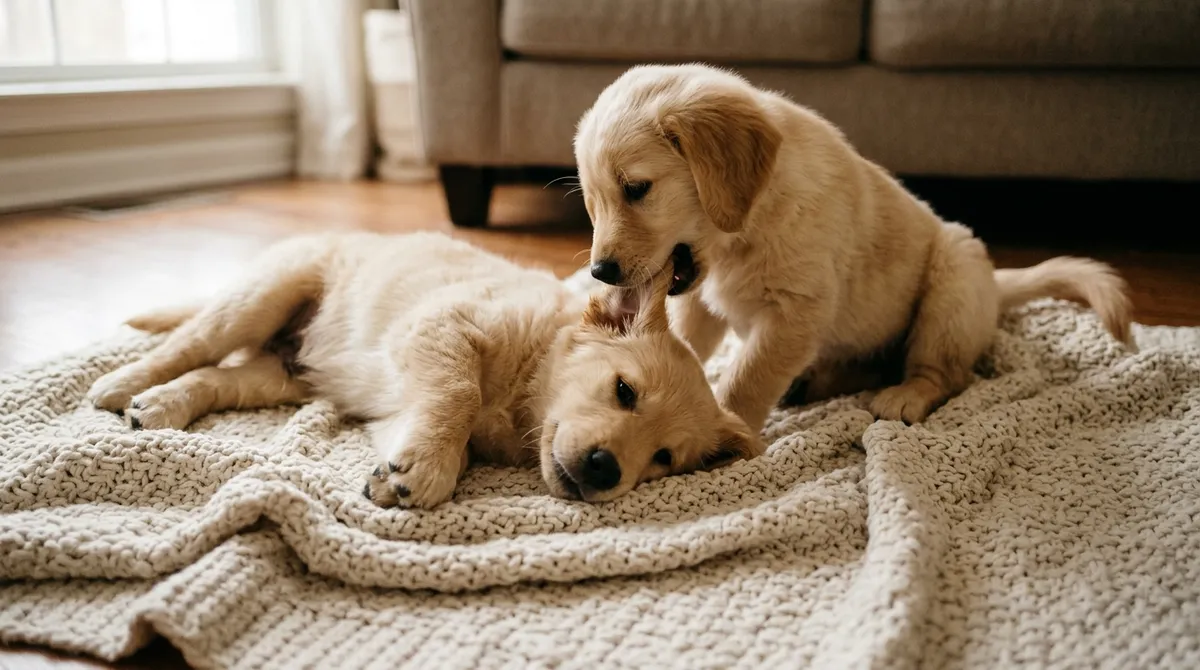
It's normal. A puppy explores the world with his mouth: he plays, chews and tests everything within reach. When the game is with people, hands, legs and clothes become targets. In his head, you're a big, slightly slow littermate.
And littermates are where he learns his limits. When one puppy bites too hard, the other yelps and the game stops on the spot. That's why he shouldn't go to his new home before 7 to 8 weeks of age: the last lessons at that school happen on the floor, among siblings. If yours came home early, you're now the teacher.
Is it because of teething?
Less than you'd think, and it's the most comfortable myth, because it leaves you with nothing to do. When a puppy grabs your hand, he's almost always inviting you to play. Teething shows up differently: it's what makes him gnaw the table leg, the slipper, the corner of the rug.
If your problem is "he chews things" or "he bites everything," organize what can be chewed. Put shoes, cords and the remote out of reach, leave two or three approved chew toys in every room and, when you catch him with a slipper, swap it for the chew toy without drama and praise him when he takes it.
If what he bites is his own tail or paw, that's a different issue: book a vet visit.
How to stop my dog biting me: the step-by-step plan
The order matters. Many people ask whether you really need to teach gentle biting before banning it altogether. You do. Many experts bet that a dog who learned to use his mouth gently is less likely to break skin if he ever bites out of fear or pain. Before you start, place a tug toy in every spot where you play: bite training often fails because, at the crucial moment, the toy is in the other room.
Stage 1: teach a soft mouth
- Play as usual, with a toy in your hand.
- When a bite that hurts comes, let out a short, high-pitched "ouch!", like the yelp of a littermate.
- Keep your hand limp and still. Don't pull away: a hand that runs becomes prey and invites the puppy to jump and grab.
- If he backs off or licks your hand, praise him and go back to playing.
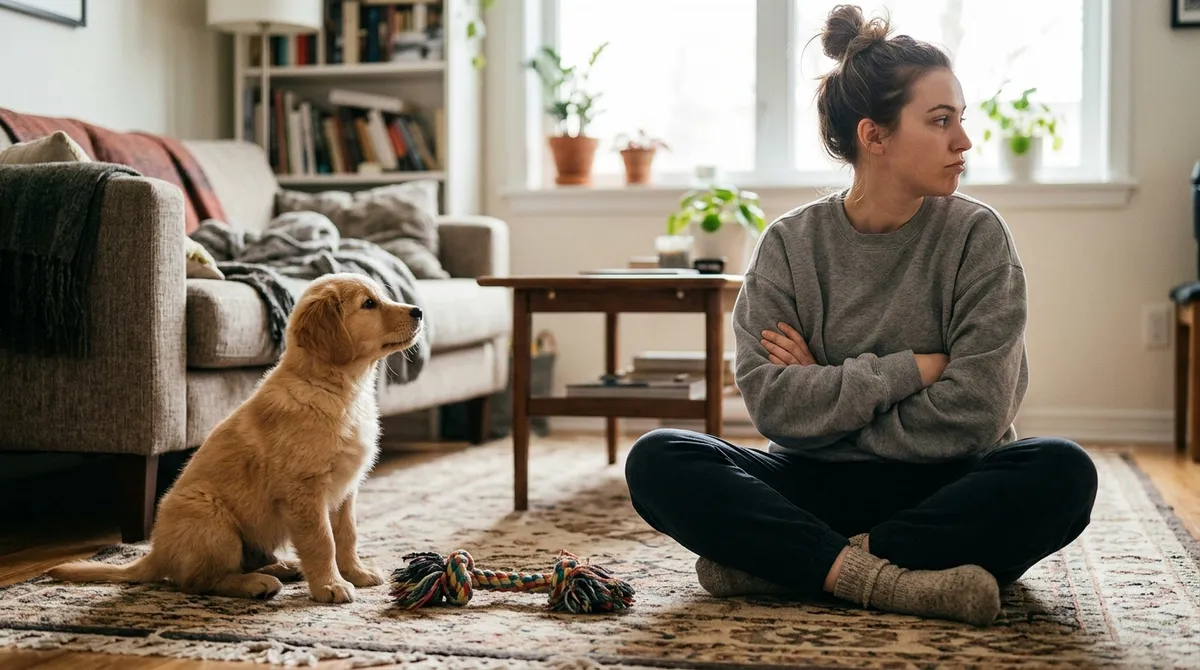
- If he doesn't settle, stop everything for 10 to 20 seconds: arms crossed, eyes on the ceiling, no talking. Then go back to playing as if nothing happened.
Use the "ouch!" at most 3 times in 15 minutes. Beyond that, the sound becomes the soundtrack of the game and he stops paying attention. From then on, pauses only.
Stage 2: no teeth on skin
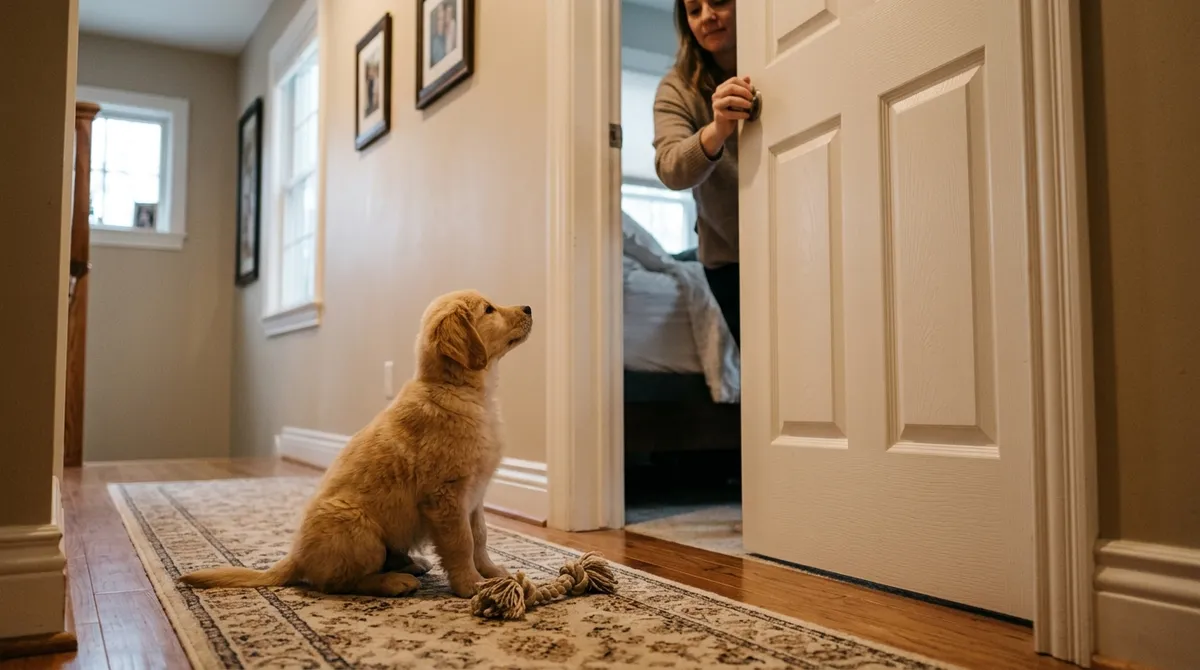
When the hard bites become rare (and they do), raise the bar. Any teeth on skin, even the gentlest, ends the game for 30 to 60 seconds. The clearest way is to leave the room and close the door, without saying anything. When time's up, come back calmly and offer the toy.
That answers the question of how long to ignore him before going back to cuddles: 10 to 20 seconds after a hard bite, 30 to 60 seconds after any touch of teeth. Vanishing for half an hour doesn't teach more: what teaches is the short pause, repeated the same way every time.
What if he keeps at it or chases after you?
This is where a lot of people say "I'm losing it." You leave the room like the videos tell you, and the puppy follows, biting your shin with every step. The way out is physical:
- Leave and close the door. Door, baby gate or playpen: he stays on the other side for half a minute. Losing your company weighs far more than any scolding.
- Don't pick him up to move him. Being picked up in the middle of the frenzy is just more play.
- Use the leash. If you need to move the puppy, guide him with a light leash to a calm corner, with a chew toy.
- Bitter-taste spray. If pauses aren't enough, apply a bitter spray made for dogs to your hands, shins and clothes for at least 2 weeks, together with the pauses and never instead of them.
How to stop my puppy biting me when playing: swap your hand for a toy
Hands are for petting; toys are for biting. Whenever he aims at your hand or foot, the toy appears.
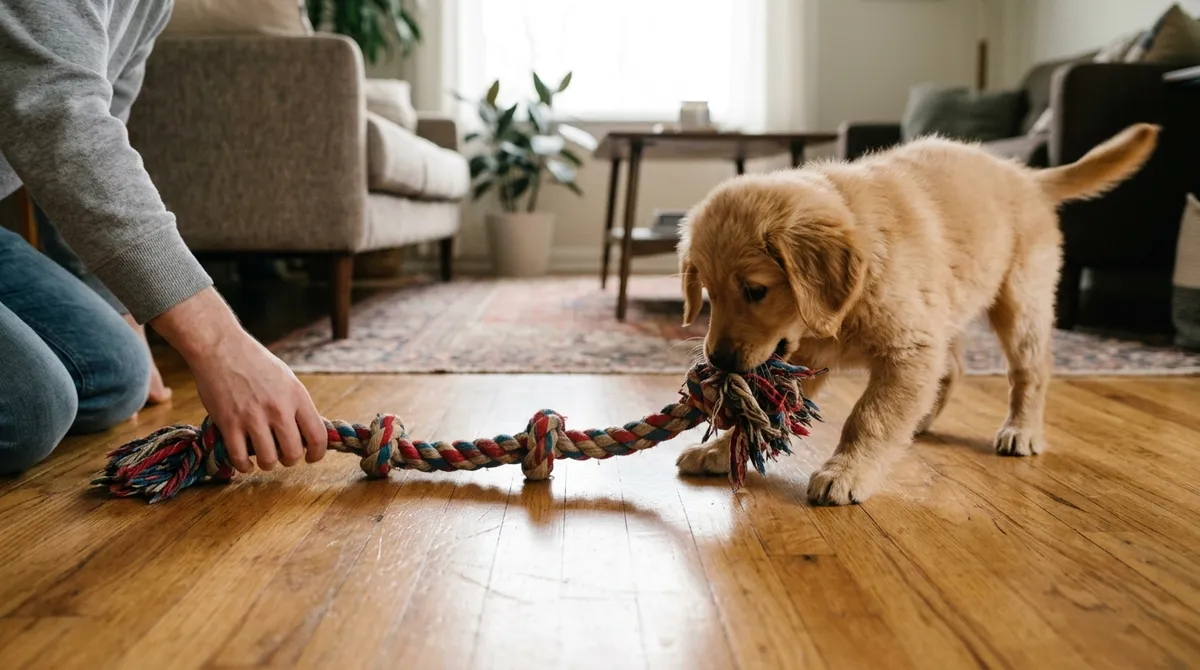
Hand wrestling, the rolling-on-the-rug kind, teaches exactly what you want to end. Swap it for play that doesn't involve skin, like fetch and tug-of-war with rules: you start and end the game, he lets go when you ask, and the game stops if a tooth slips onto your hand. If your puppy gets too wound up with the rope, start with the ball and save tug for later.
Ask for a "sit" before every round. He sits, the ball flies: he learns that calm switches on the fun. And burn energy every day, with exercise, walks and new things to sniff. Plenty of seven-o'clock piranhas are just puppies who spent the day bored.
"He ignores the toys, I've bought plenty and nothing works"
A toy lying on the floor loses badly to an ankle that moves. Bring it to life: drag the rope along the floor like a critter running away, roll the ball along the ground. Leave only two or three in sight and rotate them every few days. He doesn't need more toys; he needs you on the other end of them.
He bites my hand when I pet him
You're watching TV, give a distracted pat and, two seconds later, a little mouth full of needles is clamped on your wrist. Some dogs get wound up just from being touched.
The trick is to keep the mouth busy: with one hand you pet, with the other you offer small treats, one after another. Touch starts to mean something good, and the mouth is busy with something tastier than your wrist. Over time, space the treats out.
He attacks my feet, ankles and shins when I walk around the house
To a puppy, a walking foot is a critter running away, and it gets worse when you speed up. The routine:
- He attacked: stop moving your feet.
- Offer the tug toy you keep in your pocket.
- He took the toy: start walking again, dragging the toy along.
- No toy at hand? Stand still like a statue and praise the instant he lets go.
"I leave the room and he follows to bite my shin. Ignoring doesn't work"
Ignoring him while you walk, with him hanging off your leg, really doesn't work: someone who moves is still a toy. Stop first, put the toy in his mouth and praise him when he lets go of your pants. Before getting up from the couch, hand him a stuffed chew toy. If he still keeps at it, leave quickly and close the door behind you.
Does yelling "ouch" work, or does it get him more worked up?
It depends on the dog. Some puppies hear the "ouch!" and back off right away; others find the sound the best thing ever and come back twice as excited. If yours backs off, keep using it within the limit. If he speeds up, drop the yelp and stick to the pause.
And if he's in a tantrum, stiff and growling, no sound: in that state the yelp can maintain or even increase the aggression. Withdraw your attention and leave the room.
Can I smack his muzzle, slap him or hold his mouth shut?
No. Slapping, flicking the muzzle, shaking him by the scruff, holding his mouth closed or sticking fingers down his throat are a recipe for a puppy who bites harder, becomes afraid of you and may turn into a truly aggressive dog.
According to the AVSAB, the American veterinary behavior society, punishment should not be the first option or be used early: it holds the behavior back for a while without treating the cause, creates fear that spreads to other situations, can worsen aggression, wipes out the warnings that come before a bite and damages your relationship with him.
Other mistakes that look harmless: waving fingers or feet in front of his muzzle, yanking your hand away suddenly and, out of tiredness, quitting play with him altogether. Gentle play is only learned by playing.
What about scaring him with noise, a water spray or a head halter?
A can of coins, a water spray, an alarm, a head halter to keep his mouth shut: all of this shows up in puppy guides. The safest path is to leave all of it out at first, because a scare is also punishment and carries the same risks. Start with pauses, the door, toys and exercise. Nothing changed after weeks of careful training? Talk to a behavior professional before using any equipment.
"Does he want to be the leader? Do I need to show him who's boss?"
No. The puppy who bites your shin isn't contesting the throne of the house: he's playing, the way he played with his littermates. The idea that a dog bites to dominate, and that he must be forced into submission, has been discarded by those who study animal behavior. Even aggression toward people in the home usually has other causes: fear, possessiveness, redirected aggression or conflict. Trying to "show who's boss" by force feeds exactly the fear. What works is being predictable: the same rule, every day.
At what age does a puppy stop biting me on his own?
He doesn't, on his own. In a puppy under 4 months, some mouth exploration is expected and acceptable, and it's the best stage to train, because the bite doesn't really hurt yet. But a bite that comes from frustration or tantrums doesn't fade with age, and the adult who never learned keeps biting, now with adult teeth and strength. The sooner you start, the shorter the scratched-shin phase.
My adult dog still bites: can it be fixed?
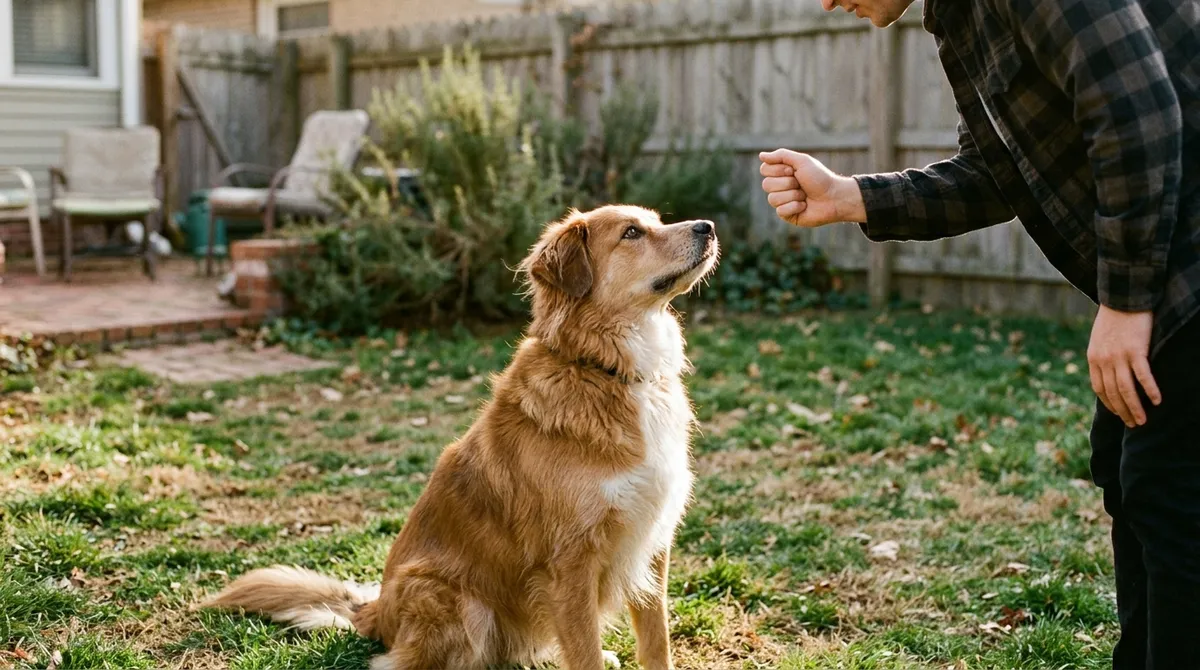
It can, with more work. The adult reacts less to "ouch!", is harder to restrain and the bite really hurts. The techniques are the same: yelp, pause, door, toy in place of your hand, no-contact play. What's added are self-control exercises, five minutes a few times a day, with treats:
- Sit: before food, leash, ball, petting.
- Wait: he's sitting, you take a step back; he stayed, he gets a treat.
- Leave it: treat in a closed hand; he gave up and pulled his nose away, he gets one from the other hand.
"Mine is a year and a half old and hyperactive"
A year and a half is adolescence with energy to spare, and energy is the first job: a long walk with time to sniff, fetch, a chew toy. With the energy taken care of, self-control goes in much better. Everything he wants comes after a "sit," and within a few weeks sitting becomes his way of asking.
He only bites one person at home, or the kids
Almost always, the one who gets bitten most is whoever reacts in the most fun way: yelling, running, yanking the hand away. If you stop the game and your brother wrestles with his hand, the puppy learns that it's not allowed with you and allowed with him. Dogs don't understand "sometimes."
"I try to teach the people at home, but they don't listen." Agree on three short rules ("bite, game over"; "hands aren't toys"; "no wrestling"), stick them on the fridge and leave a chew toy in every room. For anyone who resists, ask for just one thing: no wrestling.
With children, the care doubles. They shout, run and flail their arms, and the puppy takes it all as an invitation to chase. Teach the child to freeze like a statue when he comes (still, arms close to the body, looking at their feet) and to call an adult. According to the AVMA, the American Veterinary Medical Association, more than 4.5 million people are bitten by dogs every year in the United States, at least half of them children, and in those under 4 years old bites usually hit the head and neck. Fixed rule: child and dog together only with an adult watching, even if it's the family dog.
Play or aggression: how to tell the difference
Look at the body, not just the mouth.
- Play: loose body, relaxed face, wagging tail, play bow with the chest on the floor.
- Tantrum or aggression: stiff or frozen body, lips pulled back, teeth showing, growling, a faster and more painful bite.
Too much mouthing can also be a sign of fear or stress. Watch for him cowering, lowering his head, showing the whites of his eyes or trembling.
"Mine doesn't bite to play, he bites to hurt." If it's your 5-month-old beagle, do the body test at the next bite. Loose body and a hard bite is play without force control: go back to stage 1, with the whole household on board. Stiff body, growling and teeth showing is a tantrum: don't yell, don't try to hold him, leave the room and seek professional help as soon as possible, without waiting for him to grow out of it.
He growls and bites when I take something from him or touch him
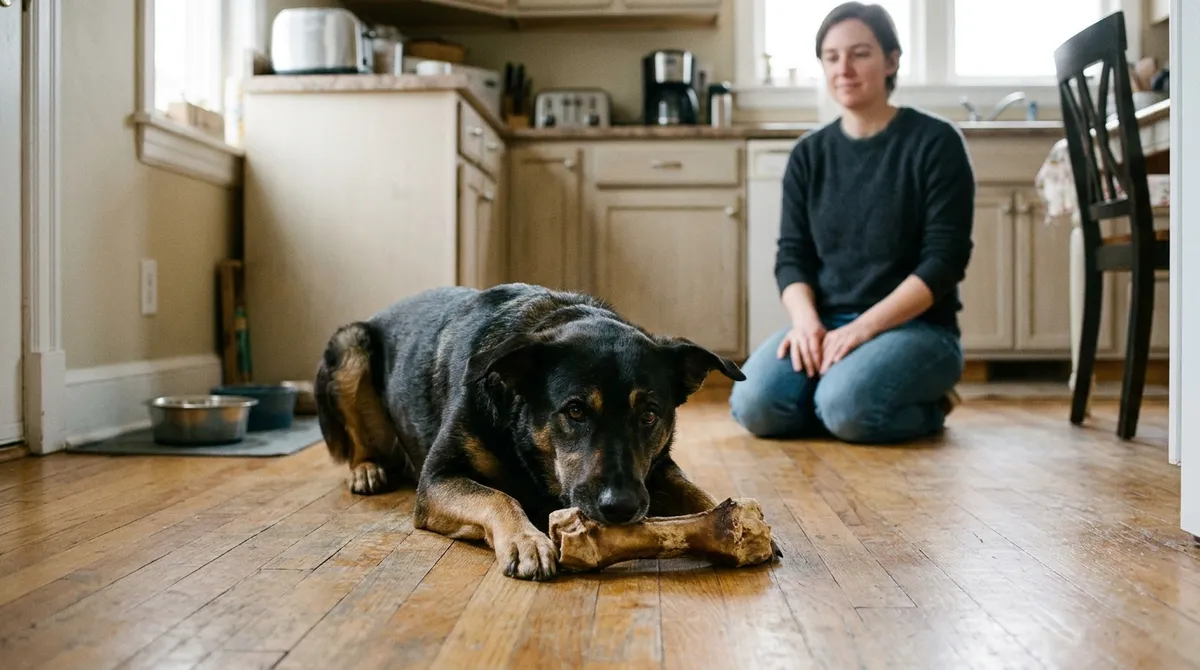
This is no longer play. The dog who growls when you get near his bowl, bone or toy is guarding a resource. And any dog can bite, even the gentlest and best trained, if bothered while eating, sleeping or caring for puppies.
Don't punish the growl: a growl is a warning, and a dog scolded for growling learns to jump straight to the bite. If you need to take something, trade it for a better treat instead of snatching it, and let him eat and sleep in peace.
When to see a vet, a trainer or a behaviorist
Vet first when he started biting suddenly, bites when you touch a certain part of his body, or when the bite became aggressive, painful, unusual or impossible to control. Aggression with a medical cause can appear at any age. VCA explains that conditions like hypothyroidism, epilepsy and tumors can cause aggression, and that pain, from teeth or arthritis, makes a dog more irritable. Many "mean dogs" are dogs in pain.
Behaviorist when there are signs of aggression: stiff body, growling, teeth showing, biting to hurt, resource guarding. Look for a veterinary behaviorist or a certified behaviorist.
Trainer for play biting that hasn't improved with this plan. If the case involves aggression, ask first whether he has experience with it, because a trainer's certificate doesn't guarantee it.
What if the dog bites someone?
First, the person: a bite wound is a medical matter, and they should seek care. Then give them your name, address, phone number and the details of the dog's latest rabies vaccine. Finally, look for the cause with the vet and a behavior professional.
Summary to stick on the fridge
- First, controlled force; then, no teeth on skin.
- Hard bite: "ouch!" (at most 3 times in 15 minutes), limp hand, 10-to-20-second pause.
- Any teeth on skin: leave the room and close the door for 30 to 60 seconds.
- He chased you: door or baby gate, leash to a calm corner, never pick him up.
- Hands and feet are not toys. A tug toy in every room.
- "Sit" before every game and exercise every day.
- The whole household on the same rule. Children only with an adult watching.
- Never: smacking, flicking the muzzle, scruff, holding the mouth shut, scolding a growl.
- Sudden biting, biting at touch or with a stiff body: vet and behaviorist.
Every scratched shin today is a lesson the puppy is having. With patience and the same rule every day, the seven-o'clock piranha becomes the dog who lies at your feet chewing his own toy.
Sources
This text was written from the sources we consulted in October 2026:
- Mouthing, Nipping and Biting in Puppies — ASPCA
- Mouthing, Nipping and Play Biting in Adult Dogs — ASPCA
- Play Biting in Puppies — VCA Animal Hospitals
- Dog Aggression Diagnosis and Overview — VCA Animal Hospitals
- Veterinary behavior society announces position on punishment — JAVMA News / AVMA
- Position Statement on the Use of Dominance Theory in Behavior Modification of Animals — AVSAB
- Behavior Problems in Dogs (Dog Owners) — Merck Veterinary Manual
- National Dog Bite Prevention Week (April 12–18): AVMA emphasizes protecting children through education and supervision — AVMA
- Preventing dog bites — AVMA
- Managing Mouthy Behaviors — Indoor Pet Initiative, The Ohio State University College of Veterinary Medicine
- Por qué muerden los cachorros y cuándo acudir al veterinario — Banfield Pet Hospital