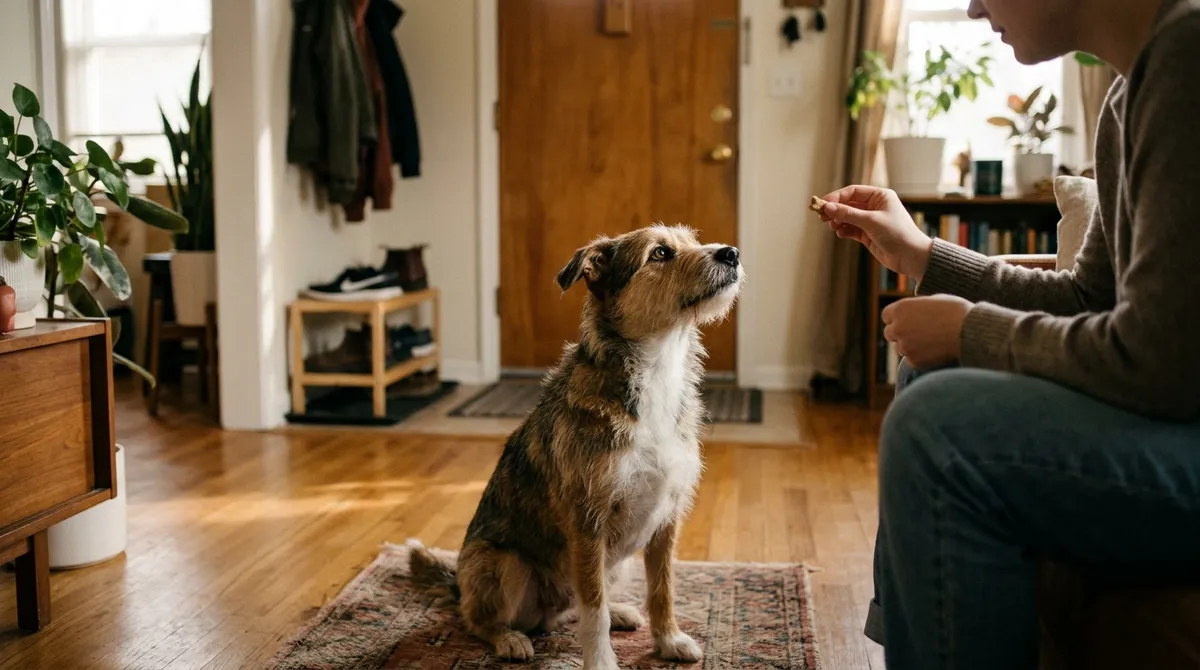
How to Stop My Dog Barking Without Yelling (or Fighting With the Neighbors)
To stop your dog barking, first work out why he barks, remove whatever sets him off, and reward the quiet with a treat, a cuddle or play, never in the middle of the fit. Yelling and punishment stay out of the plan, because they almost always make it worse.
The doorbell rings. The delivery guy hasn't even lifted his finger off the button and your dog is already at the door, telling the whole building the pizza is here. You yell “enough!”, he barks louder, the neighbor downstairs bangs on the ceiling. Sound familiar? Breathe: barking has a reason, and almost every reason has a fix.
How to stop my dog barking: start here
First, the right goal. Barking is a dog's normal way of talking, and nobody wants a silent dog: we want one that gives a heads-up and then settles. The realistic goal is to cut down the barking. There's no quick fix either, and some breeds were simply born chattier, which lengthens the road.
What you can do today:
- Stop reacting to the barking. No scolding, no talking, no eye contact while he barks.
- Block the view of the street and turn on background sound that covers the hallway noise.
- Burn off energy with a real walk and a food-stuffed toy.
- Catch the quiet in the act. See him lying there calm? Treat or cuddle right away.
Why does my dog bark at everything?
“Barks at everything” is almost never true. He barks at a few things, a lot, and each type of barking needs a different fix.
Territorial. The mail carrier reaches the gate, a neighbor walks down the hallway, and the dog announces that this house has an owner.
Alarm. The elevator door, a crack in the kitchen, a motorcycle outside.
Attention. You sit down to dinner and he barks at your plate. He learned that barking works.
Greeting. You get home from work and are met with barks, a wagging tail and a whole body wiggling.
Contagion. A dog barks three streets over, another answers, and in ten seconds the neighborhood is a choir. Yours joins in.
Frustration. Behind the gate, watching another dog stroll by off leash. He barks because he can't get where he wants to go.
Compulsive. Repetitive, almost mechanical, at shadows, reflections or nothing at all, sometimes spinning or running along the fence.
Pain or illness. He barks when you touch his paw, or started barking for no apparent reason.
Separation anxiety. He barks, howls and cries only when left alone, and you hear about it from the neighbors.
“I know when he barks. Now what?”
Knowing the time is half the way; now turn the time into a clue. For a few days, write down every episode: when it was, where he was, who or what he barked at, what happened just before and what he seemed to want. Usually two or three triggers show up, and each one has its own training below.
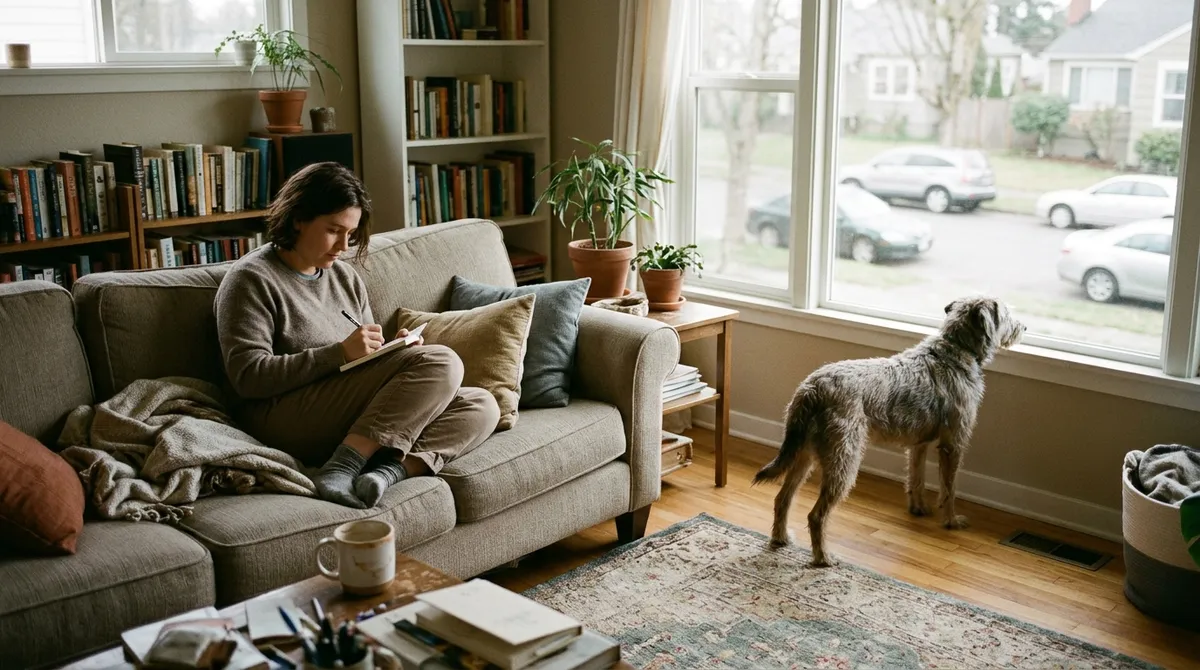
Can the barking be pain or illness?
It can. If the barking started out of nowhere, changed in style or came along with other signs (eating less, sleeping differently, limping, touchy when handled), the vet visit comes first. In an older dog the attention is doubled, because health problems often weigh on barking in seniors.
Does yelling or scolding make a dog stop barking?
No. He barks at the door, you yell from the kitchen, and what he hears is the whole family barking along. The noise and the anxiety go up, and the next bark comes out stronger. With attention barking, a scolding is a prize: he wanted you looking, and he got it.
With territorial barking, punishment is dangerous. Even if the scolding silences the dog in the moment, the urge to protect the house stays. What disappears is the warning, and he may start biting without warning first.
That's why this blog follows the line of reward-only training backed by veterinary behaviorists. The can of coins, the shaken keys, the spray bottle and holding the muzzle shut are all out: they quiet him for a second and teach nothing.
The “quiet” command, step by step
“Quiet” teaches one simple thing: silence pays better than noise. Set out treats the size of a kidney bean, because you'll use a lot of them.
- Let him bark 3 or 4 times. He gave the alert, all good.
- Say “quiet” once, in a calm voice. The tone of someone asking for the salt at the table.
- Hold a treat right at his nose. A dog can't sniff and bark at the same time.
- Mouth closed? Hand over the treat and praise softly.
- Stretch the silence gradually. First 2 seconds between “quiet” and the treat, then 5, 10 and 20.
- Vary the timing. Once he gets the hang of it, mix it up: 5 seconds, then 12, then 3, then 20. He doesn't know when the reward comes, so he stays quiet and waits.
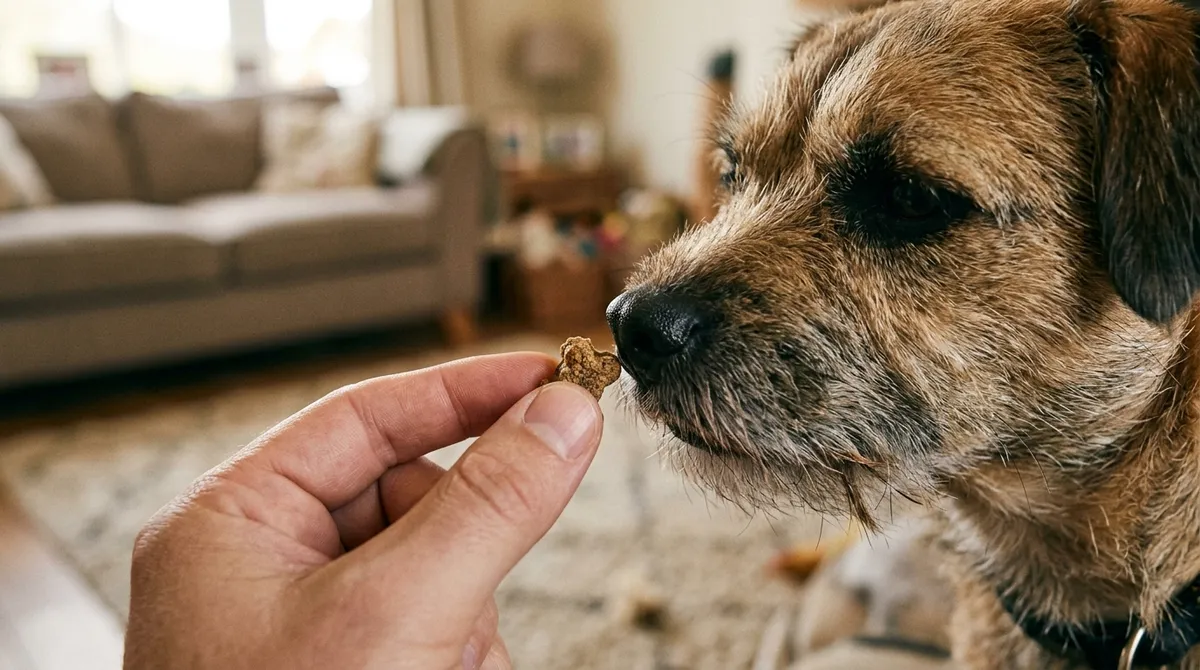
“Positive reinforcement makes it worse: if I give a treat, he throws a fit to get it”
Almost always the problem is the clock. If the treat comes out while he's still barking, or half a second after a bark, what he learned is “barking makes food fall from the sky.” The fix: treat only in the silence, never during the noise. Did he bark to ask for something? Wait for him to stop, count a few seconds and only then pay. After that, increase and vary that time.
What if “quiet” doesn't click?
Teach “speak” first: trigger a bark with a knock at the door, say “speak” and reward. Once he barks on command, alternate with “quiet.” It's easier to switch off a sound he learned to switch on. If nothing has changed after 10 to 20 well-run tries, call a trainer who works with rewards only or a veterinary behaviorist.
Dog barking when visitors arrive or the doorbell rings
In an apartment, this is the heart of the problem: intercom, deliveries, neighbors chatting in the hallway, guests. The trick is to give the dog a job when the doorbell rings: going to his spot.
- Pick the spot. A mat or bed about 8 feet (2.4 meters) from the door, where he can see the door.
- Give it a name. Say “place” and toss a treat on the mat. Do 10 to 20 repetitions, never fewer than 10 per session.
- Make it harder only when he gets 8 out of 10 in a row. Lots of mistakes? Go back a step.
- Teach him to stay. When he can hold 30 seconds on the mat, start walking to the door, then opening it, then ringing the doorbell.
- Run practice visits. A patient friend arrives, stays 5 to 10 minutes, leaves for 5 to 10 minutes and comes back, at least 10 times in a row. The goal is for him to get about 9 out of 10 right.
- With real visitors, greet the person without a fuss and wait about 1 minute after they sit down before allowing the greeting.
This step-by-step for the spot takes work and it works. Three shortcuts help:
- Change the doorbell sound. The old one has already become an alarm.
- Toy in the mouth. A plush toy near the door: a busy mouth barks less.
- Greet calmly. If you rush to the door all wound up, he joins the party.
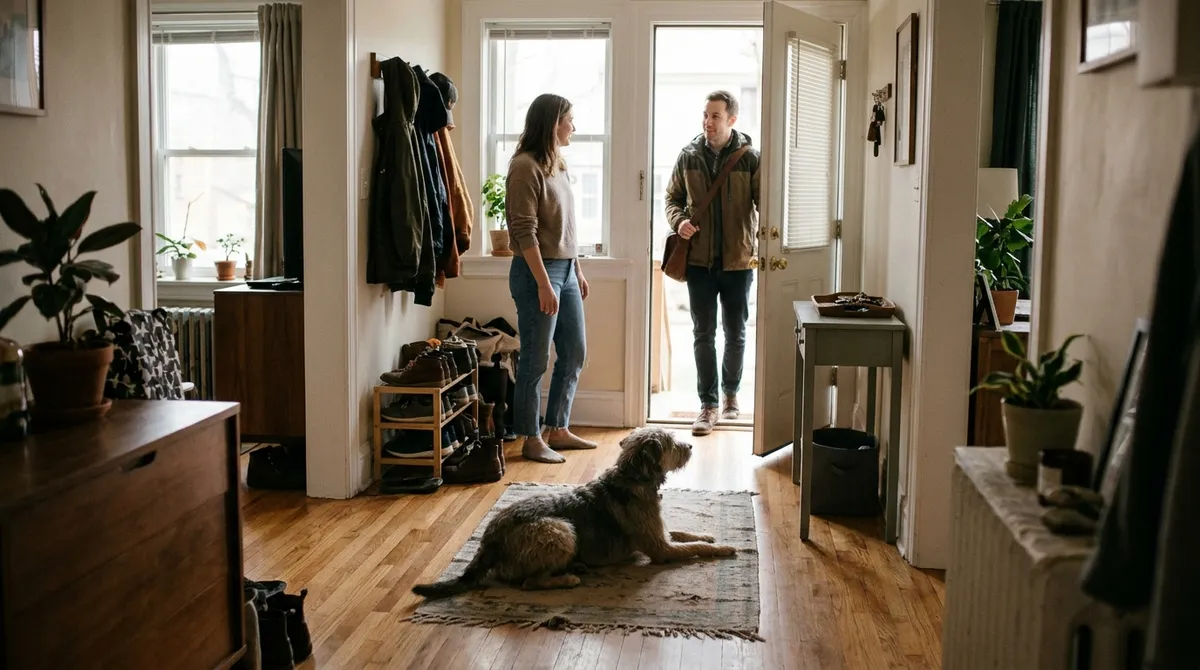
Dog barking at the gate, at the window and at people walking by
The guard dog at the window works all day. He barks, the person keeps walking (they were going to anyway), and he concludes he chased off the intruder. The first fix here is the scenery:
- Take away the view. Frosted film or a curtain on the window, fencing or solid panels on the gate.
- Take the dog off his post. When unsupervised, bed and toys away from doors and windows.
- Muffle the sound. Music, TV or white noise cover footsteps in the hallway and chatter on the sidewalk.
For other dogs: getting used to them gradually
For the trigger you can't hide, like another dog walking by, the way is a step-by-step desensitization:
- Find the distance where he sees the trigger and does not bark.
- Right there, while he looks calmly, treat after treat.
- At each session, move a little closer.
- Barked? You went too fast. Go back to the previous distance, no scolding.
With other dogs, this takes days or weeks.
Rescue dog afraid of noises
The dog rescued from abuse who barks at every noise is scared, and fear is not punished. Start by masking outside sounds with music or white noise, so he can rest. Then the same desensitization, much more slowly: a quiet sound from far away, always with something good alongside. If he trembles, hides or doesn't improve, call a behavior specialist.
Dog barking at you for food, play or attention
The family taught this bark by accident. He barked at dinner and got a piece of bread to quiet down. Looking, touching, talking and scolding: to the dog, all of it is payment.
- Really ignore him. Look at the ceiling, turn your back or leave the room. No “shhh.”
- Pay only for silence. Quiet for a few seconds? Then comes the cuddle, the ball, the food.
- Never give in, not even once in a while. Giving in once out of ten teaches that persistence works.
Before it gets better, it gets worse: he'll try harder. Stick it out through this phase and it passes. If the barking is to ask to go out, hang a little bell on the doorknob and teach him to ring it with his nose.
Dog barking when I leave: is it separation anxiety?
You leave at seven. At the end of the day, the neighbor lets you know, polite but worn out: the dog barked and howled all morning. It may be separation anxiety, especially if he barks only when alone, with no other trigger, and with other signs: pacing, destroying doors, peeing or pooping indoors, drooling a lot, getting agitated when you pick up the keys. Suddenly being alone for 6 hours or more, a move or a family member leaving can set it off. To settle the doubt, film yourself leaving.
This is suffering, not spite. Scolding when you return only makes the next departure scarier.
Mild cases
As you leave, hand over a stuffed toy that takes at least 20 to 30 minutes to empty, and take it away when you're back. Leaving starts to announce something good.
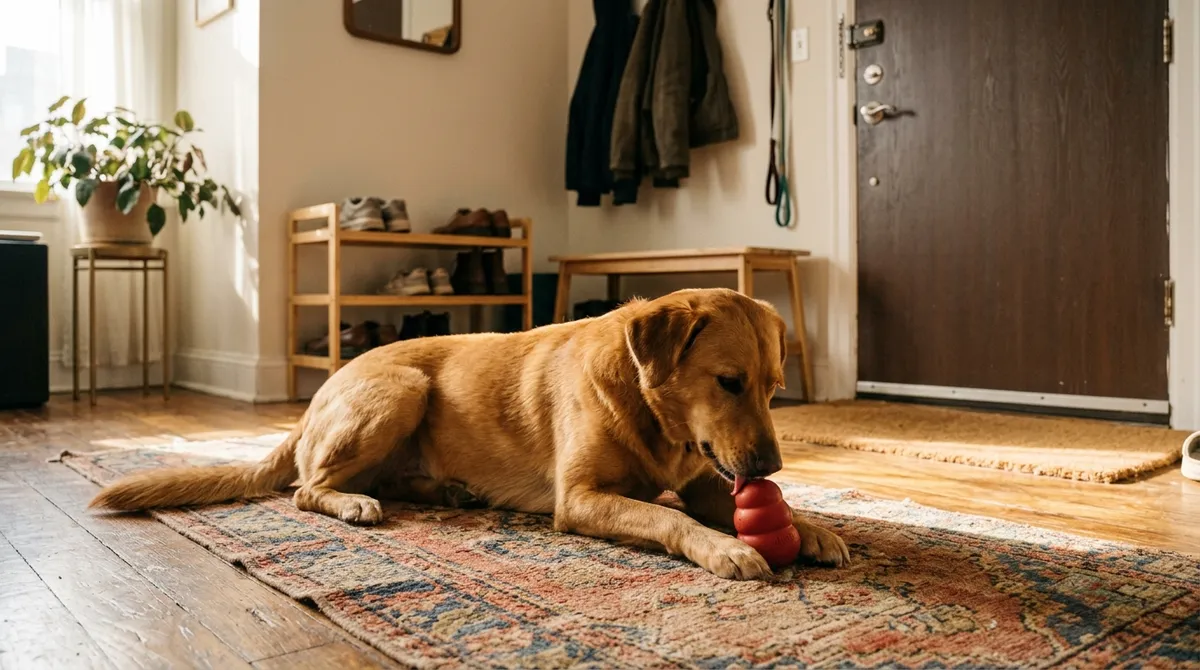
Absence training for stronger cases
The start is the hardest part: according to the ASPCA, most anxious reactions happen in the first 40 minutes alone. The training tackles that start:
- Begin with absences so short he doesn't even get upset.
- Up to 40 minutes, add only a few seconds per session.
- Then in 5-minute steps and, later, 15-minute steps.
- When he stays calm for 90 minutes, he can probably handle 4 to 8 hours. Start with 4.
It's several sessions a day, for a few weeks. And the condition that trips up many families: during training, he is not left alone outside the sessions. Daycare, a sitter, a relative or taking him to work fill the gap.
Crate, another dog and medication
- Crate, only if he already likes it. If he panics when shut in, use a baby gate closing off a safe room.
- Another dog is no guarantee. It only makes sense if the family truly wants a second dog.
- Medication, in severe cases, only with the vet, always alongside training.
- Injury means the vet right away. Broken tooth, cut paw, sore nails from chewing or digging at the door.
And the neighbors, while the training hasn't kicked in?
The fear of complaints and reports is real, and training takes time. Meanwhile, reduce what reaches the neighbor: curtains closed, background sound, dog away from the door and from the wall shared with the next apartment, a stuffed toy when you leave and as little time alone as possible. And talk to them before the next complaint: telling them you're training buys more patience than apologizing afterward.
Dog barking at night and the senior who started barking in the early hours
In a young dog, night barking usually has the same reasons as daytime, only every sound grows on the quiet street. The same rules apply: low background sound, bed away from the window and energy spent before lights out.
The different case is the thirteen-year-old dog who started barking at three in the morning, staring at the wall. In seniors, medical problems weigh heavily on barking. There's also cognitive dysfunction, the aging of the dog's brain: he gets lost in places he knows, mixes up day and night, starts peeing in the wrong place again and interacts less with the family. There's treatment through the vet, so bring notes on what changed. At home, patience: scolding in the middle of the night only frightens a dog who is already confused.

Barking at shadows, reflections or “nothing”
The dog who barks at the reflection of the wall clock, runs the fence end to end barking or spins barking at his own shadow isn't badly behaved. This metronome-rhythm barking is compulsive and isn't solved with treats. It calls for a behavior specialist or a veterinary behaviorist.
Do anti-bark collars work?
They work while on the neck, and that's the problem. Almost every dog learns not to bark with the collar and goes back to barking as soon as it comes off. The sound one fails in most dogs. The microphone one gets confused in a home with more than one dog and can punish the quiet one for the other's bark. And every anti-bark collar, whether shock, citronella or ultrasonic, is punishment: in a dog who barks from fear or anxiety, it increases exactly what causes the barking.
Is there surgery to remove the barking? And a muzzle?
There's a surgery called devocalization, and the AVMA, the American Veterinary Medical Association, strongly discourages the procedure. It harms welfare, doesn't treat the cause and doesn't even eliminate the barking: it only lowers it, and often doesn't work.
A muzzle isn't for shutting a dog up either. Worn for a long time or without supervision, he can't eat, can't drink and can't pant to cool off. And a muzzle tied with string, rubber band or tape, never.
Will he stop barking when he grows up?
Not on his own. A puppy who barks and gets rewarded becomes an adult who barks with more practice. The good news is that puppies learn fast: introduce people, other animals and varied noises early, in doses he can handle and with something good alongside. From the start, silence wins and barking doesn't.
How long does it take for him to stop barking so much?
There's no magic deadline. What exists is a pace: “quiet” grows from 2 to 20 seconds; the spot only moves up a level at 8 out of 10; desensitization to other dogs takes days or weeks; absence training, a few weeks. The rule for all of them: only move ahead when he's getting it right.
The family mistakes that keep the barking going
The dog barks at the gate and someone asks, excited, “who's there?” There it is: reinforcement. Other common mistakes:
- Everyone does something different. One ignores, another yells, grandma gives a cookie to quiet him.
- A rule that changes with the sound. Praising the bark at the stranger at the gate and scolding the bark at the delivery person.
- Attention once in a while, which teaches the dog to push harder.
Get the family together and agree on a single rule.
When to see the vet or a specialist
Vet before any training when the barking is new, changed suddenly or came with signs of pain or illness; when the dog is older and his sleep, habits or way of interacting changed; and when separation anxiety is strong. Vet right away if he hurts himself trying to escape while alone.
A behavior specialist who works with rewards only, or a veterinary behaviorist, when the barking is compulsive, when fear or anxiety don't improve with training and when “quiet” hasn't clicked after 10 to 20 tries.
Summary to stick on the fridge
- Goal: bark less, not zero.
- Reason first: write down when, where, at whom and what came before.
- New barking or senior dog: vet before training.
- Never: yelling, punishment, anti-bark collars, scaring him, a muzzle to shut him up.
- “Quiet”: treat at the nose, silence of 2, 5, 10, 20 seconds, then varying.
- Doorbell: spot about 8 feet (2.4 m) from the door, 8 out of 10 before moving on.
- Attention requests: disappear when he barks, show up when he stops.
- Alone: stuffed toy and short departures that grow.
A dog that barks is saying something. Find out what, show him a better way to say it, and the whole building will thank you.
Sources
This text was written from the sources we consulted in October 2026:
- Barking — ASPCA
- Separation Anxiety — ASPCA
- Barking in Dogs — VCA Animal Hospitals
- How to get your dog to stop barking — Humane World for Animals
- Behavior Problems in Dogs (Dog Owners) — Merck Veterinary Manual
- Position Statement on Humane Dog Training (2021) — American Veterinary Society of Animal Behavior (AVSAB)
- Canine devocalization — AVMA
- Seu cachorro não para de latir no portão? Veterinário explica o que fazer — Metrópoles